 ChatGPT,
 Claude,
 Gemini,
 Grok — all four for

Key highlights
- Know the real, fully loaded cost of hiring a human receptionist in 2026, not just the salary number on a job posting.
- Learn how AI receptionist pricing compares to human staffing costs, so you can budget with actual numbers instead of guesses.
- Explore a side by side breakdown of availability, response speed, channels and consistency between two.
- Understand where a human receptionist still outperforms AI, so you don’t over automate the parts of your front desk.
- Uncover a simple framework to decide which setup makes the most sense for your business.
If you run a small business, you already know the feeling. A customer calls at 7pm asking to book an appointment, and nobody picks up. By the time your team calls back the next morning, that customer has already booked with someone else.
Multiply that by every missed call, every after hours message and every weekend inquiry. That’s how much revenue quietly slips away without a receptionist—human or AI—to answer.
So the question a lot of business owners are asking right now is simple. Should you hire another receptionist, or should you let an AI receptionist handle the front desk?
It’s not really an emotional decision. It comes down to cost, coverage and what your business actually needs from an AI receptionist versus a human one. This article breaks down the real numbers on both sides so you can make that call with facts instead of guesswork.
What hiring a human receptionist actually costs?

When business owners think about the cost of hiring a receptionist, they usually think of salary. But salary is only part of the bill.
According to the Bureau of Labor Statistics, the median hourly wage for receptionists was $18.27 in May 2025. That works out to roughly $38,000 a year depending on region and industry. Medical and legal receptionists tend to sit a bit higher, often in the $36,000 to $46,000 range, because those roles require extra training and specialized software knowledge.
That base salary is just the starting point. The true cost of employing a receptionist typically runs 1.25 to 1.8 times the base salary once you factor in everything else that comes with a hire:
- Payroll taxes
- Health insurance and benefits
- Paid time off and sick leave
- Equipment, desk space and software licenses
- Training time before they’re actually productive
- Management time spent supervising and reviewing their work
So the total cost of employing a receptionist earning $34,000 a year can realistically run anywhere from $42,000 to $61,000 a year once everything is added up. And that’s for coverage during standard business hours only.
If you want true 24/7 coverage, one human receptionist simply cannot do it. You’re looking at hiring two or three more people to cover nights, weekends and holidays, or paying overtime rates that push costs even higher.
There’s also turnover to consider. Replacing a receptionist, including recruiting, onboarding and lost productivity while the role sits open, typically costs a business somewhere between $5,000 and $8,000 per hire. SHRM benchmarking data puts average cost per hire at close to $4,700 for non executive roles, and notes that the total cost to fill a role can run several times the position’s salary once lost productivity is factored in. Front desk roles have relatively high turnover, so this isn’t a one time cost you can ignore.
Quick snapshot: cost of hiring a receptionist
| Cost component | Estimated annual cost |
| Base salary (median) | $34,000 to $38,000 |
| Payroll tax, benefits, PTO | $8,500 to $23,000 |
| Equipment and workspace | $2,000 to $5,000 |
| Training | $1,500 to $3,000 |
| Turnover (per replacement) | $5,000 to $8,000 |
| Total for one FTE (business hours only) | $42,000 to $61,000+ |
| Cost for true 24/7 coverage (2 to 3 hires) | $100,000+ |
That last line is the number most business owners underestimate. Front desk coverage around the clock isn’t a nice to have anymore. According to HubSpot, 82 percent of customers expect an immediate response from a business, so slow follow up isn’t just inconvenient, it actively costs you deals. But staffing that kind of availability with people alone gets expensive fast.
What an AI receptionist actually costs?
There’s no payroll tax, no health insurance and no PTO to plan around costs that add up fast when hiring a receptionist. There’s no recruiting cycle when someone quits either. The AI doesn’t call in sick, and it doesn’t need two weeks of training before it’s useful.
Setup typically happens in days rather than weeks. With a service like Bluehost AI Receptionist, a professional services team helps configure the knowledge base and goals for you, so you’re not stuck figuring it out alone.
Quick snapshot: human receptionist vs AI receptionist cost
| Human receptionist (fully loaded) | AI receptionist | |
| Monthly cost | $3,500 to $5,000+ | $25 to $50 |
| Coverage | Business hours (more hires needed for 24/7) | 24/7, every day |
| Benefits and taxes | Yes | None |
| Turnover cost | $5,000 to $8,000 per replacement | None |
| Ramp up time | Weeks | Days |
| Scales to multiple channels at once | Limited | Yes |
This is the number that tends to reframe the conversation for small business owners. It’s not really AI receptionist vs human receptionist as a fight to the death. It’s a math problem, and the math is fairly one sided when you’re comparing raw cost of coverage.
Also read: How to choose a virtual receptionist service?
AI receptionist vs human receptionist: A side-by-side comparison
Cost is only one part of the AI receptionist vs human receptionist story. How each option actually performs at the job matters just as much.
Here’s how an AI receptionist stacks up against a traditional human receptionist across the things that matter most.
| Factor | Human receptionist | AI receptionist |
| Availability | Business hours, unless you pay for shifts | 24/7, including nights, weekends and holidays |
| Concurrent conversations | One call or chat at a time | Handles unlimited conversations at once |
| Channels covered | Usually phone, sometimes email | Web chat, SMS, WhatsApp, Instagram and more |
| Consistency | Varies by person, mood and training | Same accurate, on brand answer every time |
| Booking speed | Depends on callback times and manual scheduling | Instant booking through direct calendar integration |
| Scalability | Requires hiring more staff | No added cost as volume grows |
| Handling complex or emotional situations | Strong, human judgment | Limited, best handed off to a person |
| Setup time | Weeks to hire and train | Days to configure and go live |
The biggest gap shows up in after hours coverage and multi channel consistency. A human receptionist juggling calls, texts, Instagram DMs and web chat at the same time is going to drop something eventually. That’s not a knock on the person. It’s just the reality of manual work.
This AI receptionist, trained on your business’s actual knowledge base and set to your specific brand voice, doesn’t have that limitation. It answers a web chat, an SMS and a WhatsApp message at the same time, all with the same tone and the same accurate information, because it’s pulling from the same source every time.
Virtual receptionist vs human receptionist: where the ROI actually comes from
The cost comparison between an AI receptionist and a human receptionist is compelling on paper. But the real return on investment comes from what happens with the leads and bookings you’d otherwise lose.
Think about a small lawn care business that gets calls and messages both during work hours and after. If even a handful of after hours inquiries go cold each month because nobody was available to respond, that’s real revenue walking out the door.
A virtual receptionist that captures those leads the moment they come in, and books them straight into the calendar without a human middle man, can pay for itself many times over on a $25 a month plan.
This is where the direct Google Calendar integration in Bluehost AI Receptionist earns its keep. Instead of a customer waiting on a callback to confirm a 30 minute slot, they book it themselves in the same conversation. No back and forth, no double booking, no lost momentum while the customer is still interested.
Booking friction is one of the quieter reasons businesses lose customers, and it’s also one of the easiest problems to fix once you see it clearly.
A simple way to picture it
| Scenario | Monthly impact |
| Missed after hours inquiries per month | 5 |
| Average value per booked job | $200 |
| Potential revenue lost | $1,000 |
| Cost of AI Receptionist | $25 |
| Leads needed to cover the cost | Less than 1 |
You don’t need dramatic volume for the math to work in your favor. You just need to stop losing the leads that are already showing up.
This is also where the difference between a basic chatbot and an actual AI receptionist becomes clear. A lot of tools on the market can collect a name and number and call it a day. Bluehost AI Receptionist goes further with full OAuth access to your calendar, so it can see real time availability, respect blackout dates and confirm a booking on the spot rather than just passing along a message for someone to follow up on later.
Also read: Custom AI Chatbot vs Off-the-Shelf Platform: Which Wins?
Where a human receptionist still wins?
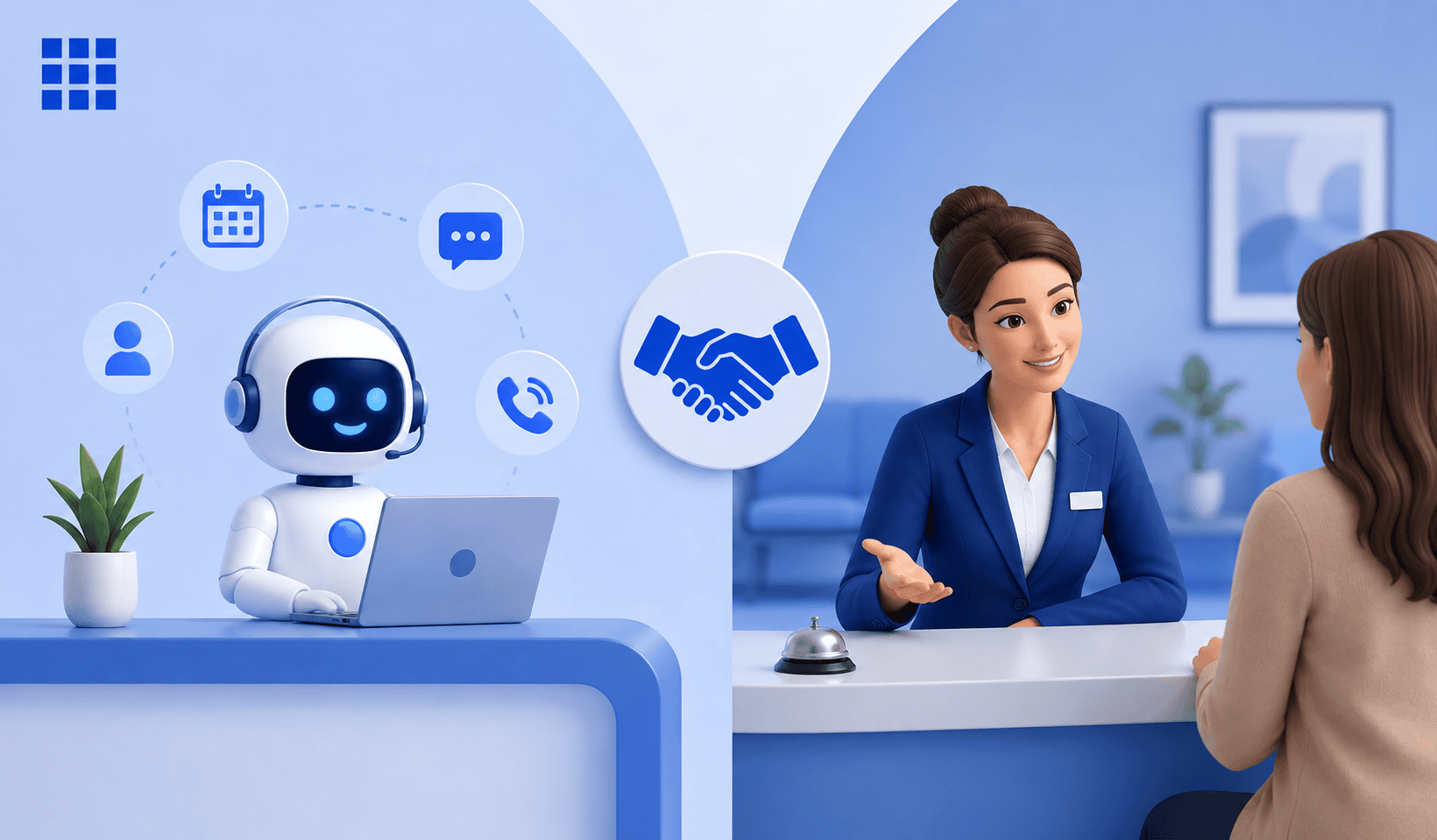
None of this means an AI receptionist should replace every human interaction at your front desk. It’s worth being honest about that.
Some situations genuinely need a person. A frustrated customer dealing with a billing dispute, a patient asking sensitive questions about a medical procedure or a client who just wants to vent before booking a service all show where a human receptionist still beats an AI receptionist on judgment and empathy.
AI is excellent at routine, repeatable tasks like answering FAQs, booking appointments and qualifying leads. But it’s not a replacement for the emotional intelligence a trained person brings to a difficult conversation.
Physical reception duties matter too. If your business needs someone to greet visitors in person, manage a waiting room or handle in office logistics, that’s simply outside what any AI receptionist is built to do.
The honest answer is that AI receptionists and human receptionists are good at different things. The businesses that get the most value are the ones that let each side do what it does best.
Bluehost AI Receptionist: AI and human working together
This is really where the conversation should land. It’s less about AI receptionist vs human receptionist and more about how the two work together.
A well set up AI receptionist reinforces your existing team rather than replacing them. It handles the routine work so your staff can focus on the conversations that actually need a person.
Here’s what that looks like with Bluehost AI Receptionist:
| Feature | What it does for your business |
| 24/7 context aware conversations | Answers instantly based on your knowledge base, any hour of the day |
| Automated appointment management | Books, reschedules or cancels appointments through Google Calendar, no coordinator needed |
| Knowledge base training | Learns from your actual documents, so answers stay accurate to your business |
| Custom voice and tone branding | Matches your brand’s personality in every conversation |
| Multi channel deployment | Works across Web, SMS, WhatsApp and Instagram from one system |
| Advanced admin and analytics | Tracks chat history, bookings and topic trends in one dashboard |
For a small, service based business like a one or two person lawn care crew, a salon or a local clinic, this setup solves the exact problem they’re facing. Too many inquiries, not enough hands and a tight budget that can’t stretch to another full time hire.
And for businesses that need more, there’s room to scale. Full multilingual support and enterprise grade multi tenancy with data isolation make the same product viable for larger, more complex organizations too.
How to decide between an AI receptionist and a traditional receptionist
If you’re still weighing the decision, ask yourself a few honest questions:
| Question | What it tells you |
| How many inquiries do you get after hours or on weekends? | Whether missed leads are costing you real money |
| Is your team spending time on repetitive questions and manual scheduling? | Whether AI could free them up for higher value work |
| Are you managing conversations across SMS, WhatsApp or Instagram? | Whether consistency across channels is a problem |
| What’s your budget for front desk coverage? | How that compares to a $25 a month plan |
| Are your interactions mostly routine, or often complex and sensitive? | Whether AI, human or hybrid fits best |
If the answers point toward high after hours volume, multiple channels and mostly routine interactions, an AI receptionist is likely to pay for itself quickly. If your business leans heavily on complex, judgment heavy conversations, a human receptionist or a hybrid setup makes more sense.
Most small businesses land somewhere in the middle, which is exactly why a hybrid of AI and human receptionist support tends to be the practical answer rather than an all or nothing choice.
It also helps to think about where you are right now versus where you’re trying to go. A one person business just trying to stop missing calls has very different needs than a growing team juggling multiple locations or languages. An AI receptionist for small business like Bluehost AI Receptionist is built to flex with both situations, whether you need a simple $25 a month setup to catch after hours leads or a more advanced plan with multilingual support and deeper analytics as you scale.
Note: All the cost figures in this article are estimates based on current data and industry averages. Actual costs can vary depending on your location, industry, business size and market conditions, so treat these numbers as a general guide rather than a fixed quote.
Also read: Top 10 AI Customer Service Automation Tools for Businesses in 2026
Final thoughts
When you actually run the numbers, the AI receptionist vs human receptionist debate stops feeling like a hard choice and starts looking like basic math. A fully loaded human receptionist can cost anywhere from $42,000 to over $100,000 a year depending on the coverage you need. An AI receptionist like Bluehost AI Receptionist starts at $25 a month and works around the clock without benefits, turnover or training time.
That doesn’t mean humans are out of the picture. It means the smartest setup uses AI for the repetitive, always on work and lets your team focus on the conversations that need a real person.
For small, scrappy businesses that can’t afford to staff a 24/7 front desk but also can’t afford to keep missing leads, that combination is often the difference between a booked calendar and a missed opportunity.
If you’re losing leads after hours or your team is buried in routine scheduling, it might be worth seeing what a 24/7 AI receptionist could do for your business, starting at just $25 a month.
FAQs
Not entirely. AI is taking over the repetitive parts of the job like answering FAQs, booking appointments and covering after hours inquiries. Human receptionists are still valuable for complex, sensitive or judgment heavy conversations that need a personal touch. Most businesses end up using both together rather than replacing one with the other.
For most small and service based businesses, yes. It lowers the cost of hiring a full-time receptionist, catches leads around the clock and keeps responses consistent across channels. It works especially well for businesses with high after hours inquiry volume or a tight budget that can’t stretch to another full time hire.
The value depends on how many leads you’re currently losing. If your business misses even a few after hours inquiries a month, the revenue saved usually covers the cost of an AI receptionist many times over. Plans like Bluehost AI Receptionist start at $25 a month, which is a small fraction of what a single missed booking can be worth.
It depends on your needs, but for small businesses looking for an affordable, easy to set up option, Bluehost AI Receptionist stands out. It offers 24/7 multi channel support, direct Google Calendar integration, custom brand voice training and professional services support to get you live quickly, with AI receptionist cost starting at just $25 a month.

Write A Comment