 ChatGPT,
 Claude,
 Gemini,
 Grok — all four for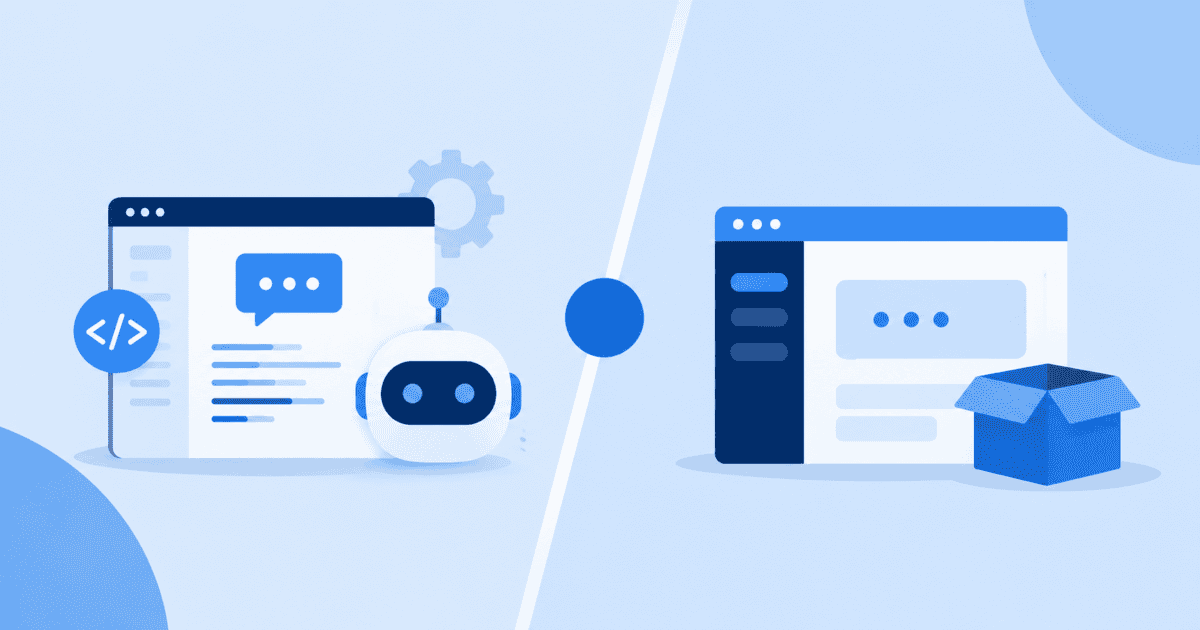
Key highlights
- Understand the difference between a custom AI chatbot and an off-the-shelf platform to identify which approach fits your needs.
- Compare custom chatbot features vs off-the-shelf chatbot features across customization, integrations, security, scalability, maintenance and control.
- Evaluate the pros and cons of custom vs off-the-shelf chatbots before committing to development or a ready-made platform.
- Compare custom chatbot vs off-the-shelf chatbot costs to make a more informed chatbot build vs buy decision.
- Explore how Bluehost AI Receptionist offers businesses a ready-to-use option for customer conversations, lead capture and appointment booking.
Overall, businesses of every size face the same choice: build a custom chatbot or purchase a ready-made platform. Deciding between a custom AI solution and an off-the-shelf platform impacts your budget, development timeline and customer experience for years to come.
Neither option works best in every scenario. A custom chatbot gives you greater control over system behavior and data, depending on the models, APIs and infrastructure you use. An off-the-shelf platform can often be deployed faster than a custom build, although setup time depends on configuration and integrations.
Comparing features, long-term costs and practical factors will help identify the ideal setup for your business goals.
What is the difference between a custom AI chatbot and an off-the-shelf platform?
A custom AI chatbot is developed around your specific workflows and data needs using custom code, existing models, APIs or frameworks. An off-the-shelf platform is a pre-built tool you configure through templates and settings. The core difference comes down to control versus convenience.
Custom AI chatbot
A custom AI chatbot is configured and developed around your specific business requirements. Developers can design conversation flows, connect business systems and ground responses in company data through retrieval, integrations or model customization. Tools like Rasa or a custom build using an AI API can give teams greater control over application logic, workflows and tone. This path suits businesses with workflows that generic tools cannot handle.
Off-the-shelf platform
An off-the-shelf platform is a ready-made chatbot you configure rather than build. Off-the-shelf platforms such as Intercom and Tidio offer configurable AI agents, workflows, knowledge sources and integrations, with capabilities varying by provider. You choose a plan, configure the platform and connect your channels, with launch time depending on your setup and integrations.
Also read: How Much Does a Chatbot Cost? AI Chatbot Pricing in 2026
How do custom chatbot features compare with off-the-shelf chatbot features?
Custom AI chatbots offer greater control and flexibility at the cost of higher development and maintenance demands. Pre-built platforms can enable faster deployment, while customization depends on the workflows, integrations, APIs and extension options the provider supports.
Here is a quick comparison:
| Comparison metric | Custom AI chatbot | Off-the-shelf platform |
|---|---|---|
| Customization | Can be designed around specific workflows, business rules and customer experiences | Configurable through available workflows, settings, prompts, templates and supported features |
| Integrations | Can be developed to connect with proprietary or specialized systems through APIs and custom development | Usually offers pre-built integrations and may support APIs or connectors for additional systems |
| Security | Gives the business greater ability to design data handling, hosting and access controls around its requirements | Security, hosting and data-handling options depend largely on the platform provider |
| Scalability | Can be engineered for specific usage patterns and scaling requirements | Infrastructure scaling is generally managed by the provider within plan and product limits |
| Maintenance | Requires ongoing technical work for monitoring, fixes, integrations and system updates | Provider handles much of the underlying platform maintenance, while the business manages configuration and content |
| Control | Offers greater control over architecture, workflows, integrations and system behavior | Offers less infrastructure-level control but reduces the technical work required to operate the chatbot |
1. Customization
A custom AI chatbot offers the most flexibility when your business needs highly specific conversation flows, rules or user experiences. Developers can design the chatbot around your processes rather than adapting your processes to an existing platform.
Off-the-shelf platforms provide different levels of customization. Many allow businesses to change prompts, workflows, branding, knowledge sources and routing rules, while more advanced platforms may also support APIs and custom integrations. The limitation is that customization still happens within the capabilities of the platform.
Choose custom when: your chatbot needs behavior or workflows that existing platforms cannot adequately support.
Choose off-the-shelf when: available configuration options already cover most of your requirements.
2. Integrations
Custom chatbots can be developed to connect with CRMs, internal databases, proprietary applications and other business systems. This makes them useful when the chatbot needs to work deeply with specialized infrastructure or perform actions across several internal tools.
Off-the-shelf platforms typically provide ready-made integrations with commonly used business software. Some also provide APIs, webhooks or third-party connectors for additional flexibility. The key question is whether the systems your business relies on are supported without extensive custom development.
Choose custom when: proprietary or complex integrations are central to the chatbot’s job.
Choose off-the-shelf when: your essential tools are already supported through integrations, APIs or connectors.
3. Security
With a custom chatbot, businesses can make more decisions about architecture, data flows, access controls and hosting based on their security requirements. That can be valuable when an organization has specialized governance or compliance needs.
With an off-the-shelf platform, many of these controls depend on the provider’s infrastructure and policies. Businesses should evaluate how a provider handles data storage, encryption, access, retention and relevant security or compliance requirements before choosing a platform.
Choose custom when: your security requirements demand architecture or controls that available platforms cannot provide.
Choose off-the-shelf when: a provider’s security and data-handling capabilities already satisfy your requirements.
4. Scalability
A custom chatbot can be engineered around expected traffic, workloads and performance requirements. This gives businesses flexibility, but scaling the system may require additional infrastructure, engineering work and monitoring as usage grows.
With an off-the-shelf platform, the provider manages the underlying infrastructure. Businesses can often accommodate higher usage through the platform’s available plans or capacity options, although limits and pricing vary by provider.
Choose custom when: you need direct control over how infrastructure and performance scale.
Choose off-the-shelf when: you prefer the provider to manage infrastructure as usage grows.
5. Maintenance
Custom chatbots require ongoing technical ownership. Teams may need to monitor performance, fix issues, maintain integrations, update dependencies and improve the chatbot as business requirements change.
Off-the-shelf platforms shift much of the underlying platform maintenance to the provider. The business still needs to keep its knowledge sources, workflows, integrations and chatbot settings accurate, but it does not have to maintain the entire technology stack.
Choose custom when: you have the technical resources to own and maintain the system long term.
Choose off-the-shelf when: you want to reduce the engineering work required to keep the chatbot running.
6. Control
Control is where the difference between the two approaches becomes clearest. A custom chatbot gives businesses greater influence over architecture, logic, integrations, data flows and how the system evolves.
An off-the-shelf platform gives up some of that control in exchange for faster implementation and less technical overhead. For many businesses, that trade-off is worthwhile if the platform already supports the capabilities they need.
Choose custom when: owning and controlling how the chatbot works is a business requirement.
Choose off-the-shelf when: speed, simplicity and reduced technical management matter more than infrastructure-level control.
Also read: AI Chatbot vs. Virtual Assistant: What’s the Difference?
What are the pros and cons of custom chatbots?
Weighing the pros and cons of custom chatbots makes the decision clearer.
Custom chatbot advantages
A custom build offers real advantages for businesses with specific needs.
- Full control over conversation logic and data.
- Deep integration with proprietary systems.
- Unique branding and tone matched to your business.
- Greater freedom to shape the chatbot’s roadmap around your business requirements.
These advantages come with added responsibility for building and maintaining the system.
Custom chatbot limitations
Custom chatbots also bring drawbacks worth planning for.
- Higher upfront cost and longer development time.
- Ongoing need for developer support.
- Slower time to launch compared to ready-made tools.
These limitations often push smaller teams toward ready-made platforms instead.
What are the pros and cons of off-the-shelf chatbots?
Now, let’s look at what off-the-shelf chatbots do and do not offer.
Off-the-shelf advantages
Ready-made platforms solve a different set of problems well.
- Fast deployment, often within days.
- Lower upfront investment.
- Built-in support and regular updates from the vendor.
- Easier for non-technical teams to manage.
These benefits can make off-the-shelf platforms a practical starting point for small businesses with limited technical resources.
Off-the-shelf limitations
Off-the-shelf tools have real constraints too.
- Limited customization beyond vendor settings.
- Less control over data handling details.
- Subscription, usage or plan costs that may increase as your requirements grow.
Knowing these limits upfront helps you avoid surprises later.
Also read: What Is an AI Chatbot? A Beginner’s Guide
How do custom and off-the-shelf chatbot costs compare?
A direct cost comparison between custom and off-the-shelf chatbots shows the upfront price is only part of the picture. Ongoing fees, maintenance and scaling all shape the real total.
| Cost factor | Custom chatbot | Off-the-shelf platform |
|---|---|---|
| Upfront cost | Varies with scope, development and integrations | Usually lower development requirements; setup costs vary |
| Ongoing cost | Hosting, model usage and technical support | Subscription, usage, seats or outcome-based fees |
| Maintenance cost | Ongoing technical ownership | Core platform maintained by provider; business manages configuration |
| Scaling cost | Depends on infrastructure, usage and engineering needs | May increase with usage, capacity or plan limits |
1. Upfront costs
Building a custom chatbot can require significant upfront investment, with costs varying widely by scope, integrations and development requirements.
2. Ongoing costs
Custom chatbots may carry hosting, model usage, monitoring and maintenance costs that vary by architecture and usage. Off-the-shelf pricing may be based on subscriptions, seats, conversations, usage, outcomes or custom enterprise agreements.
3. Maintenance costs
A custom chatbot needs a developer to fix bugs and apply updates, adding recurring labor cost. Off-the-shelf providers maintain the underlying platform, while businesses still manage their chatbot settings, content and integrations.
4. Scaling costs
Scaling a custom chatbot may require additional infrastructure capacity, engineering work and testing as usage grows.
Also read: AI Chatbot for Lead Generation: How to Get Qualified Leads Fast in 2026
When should you choose an off-the-shelf chatbot platform?
Some situations favor buying over building. Off-the-shelf platforms make sense in these four scenarios.
1. Faster deployment
If you need a chatbot live this month, an off-the-shelf platform delivers. Most tools launch within days using pre-built templates.
2. Standard workflows
Businesses with common needs, like answering FAQs or booking appointments, can often use configurable off-the-shelf workflows. Save custom development for problems templates cannot solve.
3. Lower complexity
Simple support tasks, like order status lookups or store hours, do not justify a custom build. Complexity is the real signal, not company size.
4. Limited technical resources
Teams without in-house developers may find ready-made platforms easier to configure and maintain. Many off-the-shelf tools support no-code configuration for standard use cases, although advanced integrations may still require technical work.
Also read: Top 10 AI Customer Service Automation Tools for Businesses in 2026
When should you build a custom AI chatbot?
Other situations call for a custom build instead. These four scenarios tend to justify the extra investment.
1. Complex workflows
Multi-step processes, like insurance claims or loan applications, often exceed what templates support. Highly specific workflows may exceed some platforms’ built-in capabilities, so each platform should be evaluated against your requirements.
2. Custom integrations
Businesses running proprietary software or legacy systems often need direct API connections. A custom chatbot offers greater integration flexibility when an off-the-shelf platform lacks the required connector, API or extension option.
3. Specialized data needs
Healthcare and finance may have specialized security and compliance requirements, so businesses should verify whether a platform provides the controls they need. A custom build can provide greater control over sensitive-data storage and handling, depending on the architecture and providers you use.
4. Greater control
Businesses with strict brand voice rules or unusual compliance needs benefit from full control. A custom chatbot gives you greater control over response rules, guardrails and data flows based on the architecture you choose.
Also read: 15+ Best ChatGPT Alternatives in 2026 (Tested, Compared & Ranked)
How should you choose between a custom chatbot and an off-the-shelf platform?
Turning this build vs buy decision into action starts with five factors.
1. Define your requirements
List the tasks your chatbot must handle, from answering questions to processing transactions. Specific requirements reveal whether templates will work.
2. Assess integration needs
Check whether your CRM, calendar or inventory system has a pre-built connector on platforms you’re considering. Missing connectors often mean custom development or workaround tools.
3. Evaluate technical resources
Be honest about your team’s development capacity. Without developers on staff, a custom build means hiring contractors, which adds cost and management work.
4. Compare total costs
Look past the sticker price and calculate total cost of ownership over three years. Add development, subscription fees, maintenance and scaling into one figure.
5. Consider future needs
Think about where your business will be in two years. A platform that fits today’s needs may not support tomorrow’s growth or integrations.
Also read: 10 Best AI Research Tools for Students, Marketers & Analysts (2026)
Is a customizable off-the-shelf platform a good middle ground?
Some platforms blend both worlds. Configurable off-the-shelf tools let you adjust workflows, connect custom APIs and fine-tune responses without a full custom build. This path suits businesses that need more flexibility than a basic template but do not want the cost of building from scratch.
Look for platforms offering open APIs, custom fields and flexible routing rules. These features can provide substantial customization without a full custom build, although advanced integrations may still require technical support.
The trade-off is that you still work within the vendor’s core architecture, so some limits remain. For many small and mid-sized businesses, a customizable off-the-shelf platform can provide greater flexibility without requiring a fully custom build.
How does Bluehost AI Receptionist fit into this decision?
For small service-based businesses that need help managing customer inquiries and bookings, Bluehost AI Receptionist offers a configurable alternative to building a custom AI solution. It supports routine sales and scheduling tasks around the clock without requiring businesses to manage the underlying technology themselves.
Bluehost AI Receptionist includes:
- 24/7 customer conversations: Answers questions using your business knowledge base.
- Lead capture: Engages prospects even when your team is unavailable.
- Appointment management: Lets customers book, reschedule or cancel appointments through Google Calendar.
- Knowledge base training: Uses your business documents and resources for company-specific responses.
- Custom voice and tone: Helps keep responses aligned with your brand.
- Admin and analytics: Tracks chat history, bookings and topic trends.
- Implementation support: Helps configure goals and knowledge sources before launch.
For businesses focused on common questions, lead capture and appointment scheduling, it can provide a practical off-the-shelf option without the development and maintenance required by a fully custom build.
Final thoughts
The custom AI chatbot vs off-the-shelf platform decision depends on your workflows, integration needs, technical resources and desired level of control. Off-the-shelf platforms often suit common business tasks, while custom chatbots make more sense when requirements are highly specialized.
For many businesses, a configurable off-the-shelf solution can offer a practical middle ground. Start by defining the tasks your chatbot needs to handle, then compare options based on fit, cost and long-term management.
If your business needs help answering customer questions, capturing leads and managing appointments, explore Bluehost AI Receptionist as a ready-to-use option without building a custom system from scratch.
FAQs
Neither option wins in every case. A custom chatbot suits complex, specialized workflows. An off-the-shelf platform suits speed, lower cost and standard use cases.
Most off-the-shelf chatbots allow customization within limits. You can typically adjust branding, greetings, routing rules and some integrations. Deeper behavioral changes may require advanced configuration, APIs, custom development or vendor support, depending on the platform.
Custom chatbots can require a higher upfront investment, with costs varying by scope, integrations and development requirements. Off-the-shelf platforms cost less initially but add ongoing subscription fees over time.
Custom chatbot development timelines vary widely based on scope, integrations, testing requirements and the technology used. Off-the-shelf platforms usually launch within days instead.
Small businesses with limited technical staff may find off-the-shelf platforms easier to deploy and manage. Businesses with unique workflows or in-house developers may still benefit from a custom build.
Yes, a business can start with an off-the-shelf platform and move to a custom build as its requirements become more complex. Migrating conversation data and integrations requires planning, but businesses can move to a custom solution as their requirements evolve.

Write A Comment