 ChatGPT,
 Claude,
 Gemini,
 Grok — all four for
When you manage multiple client websites, downtime affects your agency reputation, client trust and daily support workload immediately. Clients expect fast communication and stable website performance, even when problems originate from the hosting provider or infrastructure.
That’s why hosting SLAs for agencies are important when evaluating any hosting provider, cloud infrastructure or managed hosting platform. A service level agreement explains uptime guarantees, response times, support coverage and compensation policies before service disruptions happen.
It also helps you understand how traffic spikes, scheduled maintenance and infrastructure failures are handled across client websites. As your portfolio grows, you need scalable hosting with reliable support, proactive monitoring and consistent website performance.
In this guide, you’ll learn how hosting SLAs work and what to evaluate before choosing an agency hosting provider.
What is a hosting SLA?
A hosting SLA or service level agreement, defines the service standards your hosting provider guarantees for your websites and infrastructure. It explains uptime guarantees, support response times, scheduled maintenance policies and compensation terms for service interruptions or outages.
Most agency hosting providers include service coverage, escalation paths and support commitments within their hosting SLA agreements. Uptime SLAs measure website availability, while support SLAs define how quickly technical teams respond and resolve reported issues.
It is necessary to understand, a hosting SLA does not guarantee zero downtime or cover outages caused by plugin conflicts, code changes or third-party services.
Also read: What Is Agency Hosting? A Complete Guide for Growing Agencies
Why hosting SLAs matter for agencies
When you manage multiple client sites, one infrastructure issue can affect several websites and support requests at the same time. A weak hosting SLA increases downtime risks, slows incident response and creates unnecessary pressure on your agency support team.
Clients usually contact your agency first when websites experience outages, slow performance or failed transactions during high traffic periods. Even when the hosting provider causes the issue, your team remains responsible for updates, communication and restoring client confidence.
Frequent downtime can damage client relationships, increase churn risk and create additional emergency support workload for your internal teams.
Also read: How to Survive Site Downtime and Recover Fast
What uptime guarantees actually mean?
Uptime guarantees show how consistently your hosting provider keeps websites, cloud infrastructure and network services available throughout the year.
Even small uptime differences can create major service disruptions when your agency manages multiple client sites or eCommerce websites.
| Uptime SLA | Annual downtime |
| 99% | ~87.6 hours |
| 99.9% | ~8.76 hours |
| 99.99% | ~52.6 minutes |
| 100% | 0 downtime |
For agencies supporting high traffic client sites, downtime can increase support tickets, lost revenue and emergency response workload significantly.
Bluehost Agency Hosting provides 100% network uptime backed by enterprise infrastructure, proactive monitoring and high availability services. This level of service delivery helps agencies maintain stable website performance during traffic spikes, server load increases and infrastructure failures.
Most hosting providers calculate uptime differently, making SLA fine print important when comparing different hosting options. Some hosting SLA agreements exclude scheduled maintenance, emergency maintenance or force majeure events when calculating uptime percentages officially.
You should compare network level uptime separately from application uptime when evaluating hosting providers or enterprise infrastructure services carefully. Network uptime measures infrastructure availability, while application uptime measures whether websites remain fully accessible and functional for visitors.
Also read: Performance and Reliability for Agency Hosting: What Agencies Should Expect
The most important parts of a hosting SLA
Before comparing hosting providers, it’s important to understand the key components that determine how effective a hosting SLA will be for your agency.
Service scope
A hosting SLA should clearly explain which services, infrastructure-level resources and managed hosting services your hosting provider supports. Most hosting SLAs for agencies include uptime guarantees, proactive monitoring, daily backups and support for different hosting environments.
Some managed platforms also include global CDN integration, staging environments, isolated environments and recovery point objectives within SLA commitments.
Many SLAs exclude plugin conflicts, custom scripting, customer code changes and unsupported third-party services from service credits coverage. Some hosting providers also limit compensation applies policies for data loss, offsite storage failures or unsupported custom configuration requests.
Support response tiers (P1–P4)
Support response tiers define expected response time targets based on the severity of hosting, infrastructure or website-related service issues.
P1: Complete outage
P1 issues include complete outages, failed network level access or infrastructure failures affecting critical client sites and eCommerce sites immediately.
These incidents usually require rapid response from senior engineers until services are resolved quickly and fully restored for clients.
P2: Major functionality issues
P2 issues affect important website functions, including checkout failures, severe server load issues or high traffic performance disruptions.
These problems may not create full outages, but they still affect service delivery, client confidence and potential lost revenue significantly.
P3: Minor issues
P3 issues include slower website performance, isolated DNS issues or non-critical configuration problems requiring standard support and troubleshooting assistance.
These issues usually involve performance tuning, preventive measures or support tickets that do not affect overall website availability directly.
P4: General requests
P4 requests include account support, custom configurations guidance, compliance requirements or general hosting related questions without urgent business impact.
24/7 support availability
Agencies managing multiple client sites need round-the-clock priority support because infrastructure failures rarely happen during normal business hours. Reliable agency providers should offer rapid response support, clear escalation paths and experienced engineers available during critical incident response situations.
Bluehost Agency Hosting includes priority support with trained experts helping agencies address issues and reduce troubleshooting infrastructure problems. Fast support response also helps agencies maintain client confidence during traffic spikes, security patching requests or emergency maintenance situations.
SLA exclusions agencies often miss
Most hosting providers include fine print within their service level agreement SLA documents, limiting when compensation applies after outages occur.
Common exclusions include DDoS attacks, DNS issues, plugin conflicts and outages linked to unsupported third-party services or code changes. Some hosting providers also exclude scheduled maintenance, emergency maintenance and force majeure events from uptime guarantees completely.
Understanding these exclusions creates a shared understanding between your agency and service provider before infrastructure-related issues impact clients. You should also review whether hosting SLA agreements include post-incident summaries, restore points or root cause reporting after major outages.
Knowing what is and isn’t covered by a hosting SLA is important, but agencies should also understand what compensation may be available when service commitments are not met.
How SLA compensation works
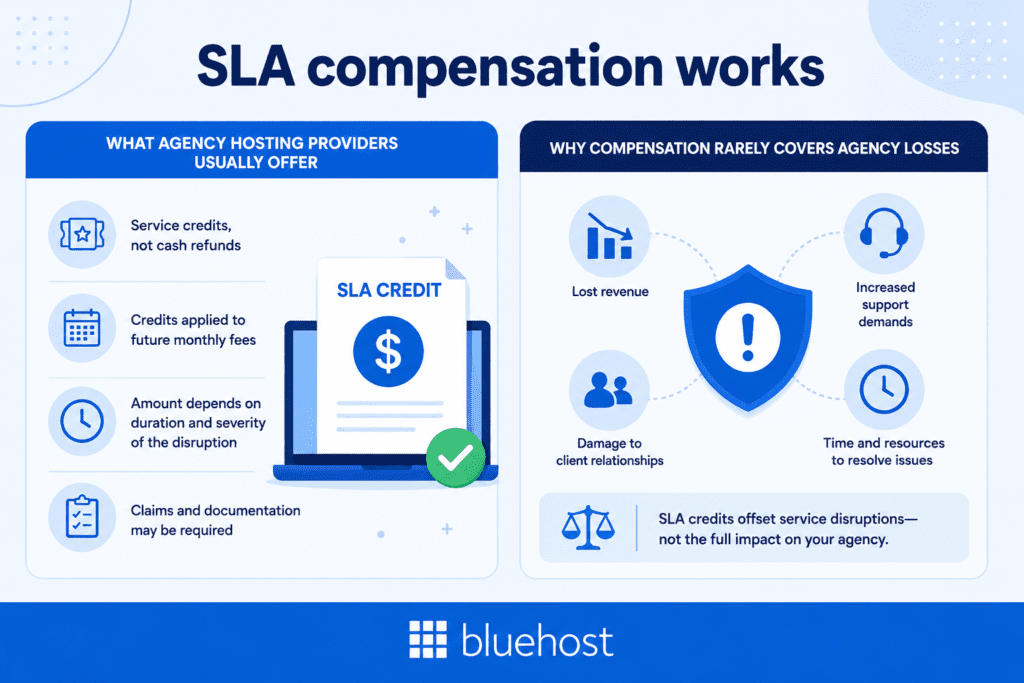
Understanding compensation policies is important because not all SLA violations result in refunds, and coverage often varies between providers.
What agency hosting providers usually offer
Most agency hosting providers offer service credits instead of direct cash refunds when uptime guarantees or SLA commitments are not fully met. These SLA credits are typically applied toward future monthly fees instead of covering actual business losses caused by downtime incidents.
Compensation policies vary by provider, and the amount awarded often depends on the duration and severity of the service disruption. Many hosting providers also require agencies to submit claims and provide supporting documentation before compensation applies for verified service failures.
Why compensation rarely covers agency losses
SLA compensation is intended to offset service disruptions, not cover the full business impact of downtime. For agencies managing multiple client sites, an outage can lead to lost revenue, increased support demands and damage to client relationships. While service credits may help reduce hosting costs, they rarely account for the time, resources and operational effort required to resolve issues and restore normal service.
Typical SLA claim process
If your hosting provider fails to meet its SLA commitments, following the correct claims process can improve the chances of a successful resolution.
1. Document the incident
You should record outage duration, affected client sites, monitoring logs and infrastructure related issues immediately after service disruptions occur.
2. Submit claims within the reporting window
Most hosting providers require support tickets or billing claims within a specific reporting window after downtime incidents officially occur.
3. Reference SLA clauses directly
Include outage details, service records and the exact hosting SLA terms related to uptime guarantees or response time failures clearly.
Most hosting providers do not apply service credits automatically, making proactive monitoring and detailed documentation extremely important for agencies.
How to compare hosting SLAs as an agency
Not all hosting SLAs offer the same level of reliability, support or infrastructure coverage. Before choosing a hosting provider, agencies should evaluate the factors that have the greatest impact on website availability, client experience and long-term service delivery.
What agencies should evaluate
When comparing hosting providers, focus on the service commitments that directly affect your ability to support client websites and respond to issues efficiently.
1. Uptime guarantees
Uptime guarantees help agencies measure how reliably a hosting provider maintains website availability across multiple client sites consistently. You should compare uptime percentages, high availability infrastructure and proactive monitoring capabilities before choosing any hosting solution carefully.
2. Support response times
Fast response time commitments help agencies resolve outages, server load issues and support tickets before problems affect client confidence significantly. Reliable hosting providers should offer rapid response support, escalation paths and experienced senior engineers during critical incident response situations.
3. Exclusions transparency
Most hosting providers include fine print exclusions limiting when compensation applies after outages, infrastructure failures or third party services disruptions occur. You should review exclusions related to plugin conflicts, DNS issues, emergency maintenance and customer code changes before signing agreements carefully.
4. Infrastructure reliability
Reliable infrastructure helps agencies maintain stable website performance during traffic spikes, high traffic events and unexpected infrastructure disruptions. Bluehost Agency Hosting includes enterprise infrastructure, global CDN integration and proactive monitoring designed for growing agency hosting environments.
| Feature | Bluehost Agency Hosting | Generic shared host | Managed hosting platform |
| Uptime SLA | 100% network uptime | 99.9% | 99.9%–99.99% |
| Support | 24/7 human support | Limited | Varies |
| CDN included | Yes | No | Sometimes |
| SLA transparency | Clear | Often vague | Varies |
Five questions every agency should ask
After comparing key SLA components, asking the right questions can help you identify potential gaps before committing to a hosting provider.
These questions can help you evaluate service commitments, support expectations and overall infrastructure reliability more effectively.
1. What exactly does the SLA cover?
Review whether the hosting SLA covers services, backups, CDN integration, security patching and infrastructure level support completely.
2. What exclusions apply?
Ask about exclusions involving scheduled maintenance, force majeure events, plugin conflicts and unsupported third party services before onboarding clients.
3. How is uptime measured?
Some cloud providers measure network level uptime differently from application uptime, which affects service delivery expectations and compensation policies.
4. What compensation is offered?
Most hosting providers offer SLA credits instead of refunds, making compensation policies important for agencies managing enterprise clients or eCommerce sites.
5. What are the guaranteed P1 response times?
Critical outages require rapid response support and experienced engineers capable of resolving infrastructure issues quickly during emergency situations.
Also read: How Agencies Make Money with Hosting
How to build an agency-client SLA
Your hosting provider’s SLA protects your agency, but it does not define the commitments you make to your clients. To set clear expectations and reduce disputes, you need a client-facing SLA that aligns with your hosting provider’s guarantees.
1. Understanding the two-layer SLA model
Your hosting provider manages infrastructure reliability, while your agency manages communication, support coordination and overall customer relationships daily. This creates two separate agreements, one between the hosting company and your agency and another between your agency and clients.
Clear responsibilities help reduce confusion during outages, server disruptions or unexpected performance problems affecting client websites and applications.
2. Best practices for agency SLAs
Do not commit to higher availability percentages than your hosting provider officially guarantees within documented hosting SLA agreements. Adding a safety margin between provider guarantees and client commitments helps reduce operational risks during infrastructure related disruptions or outages.
Your agreement should clearly explain what qualifies as downtime, including maintenance periods, network failures and third party service interruptions. Well-defined terms help agencies avoid disputes, delayed communication and unnecessary pressure during critical support or recovery situations.
Once you establish clear expectations and responsibilities, the next step is documenting the specific service commitments your clients can rely on.
3. What to include in a client-facing SLA
A client-facing SLA should outline the key service commitments your agency provides and how support related issues are handled.
Uptime commitments
Explain expected website availability levels, infrastructure coverage and any limits connected to hosting environments or platform related services clearly.
Incident communication timelines
Define when clients receive updates, outage notifications and recovery progress details during website or infrastructure related service interruptions.
Escalation process
Outline how technical issues move between support teams, senior engineers and infrastructure specialists during high priority incidents or failures.
Compensation terms
Specify whether customers receive service credits, billing adjustments or other remedies after verified service availability issues or prolonged downtime.
Even with clearly defined compensation terms, agencies should understand the steps required when a hosting provider fails to meet its SLA commitments.
Also read: How to Manage Client Websites with Agency Hosting?
What to do when a hosting provider violates the SLA
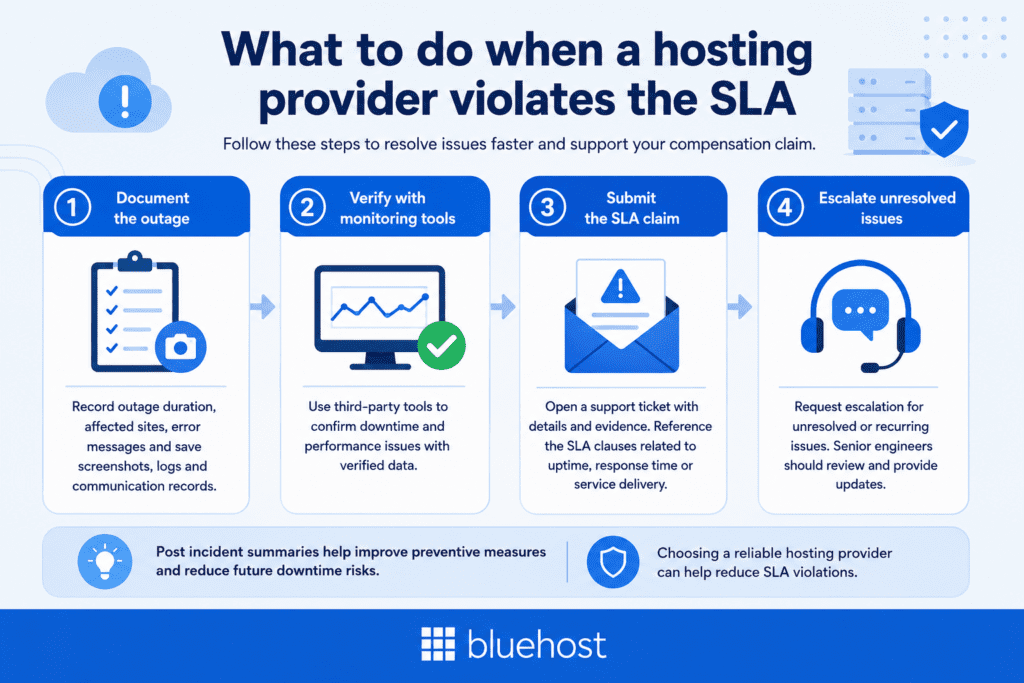
If a hosting provider fails to meet its SLA commitments, taking the right steps can help you resolve issues faster and support any compensation claim.
Step 1: Document the outage
Record the outage duration, affected client sites, error messages and infrastructure related problems as soon as service disruptions appear. You should also save screenshots, server logs and communication records connected to downtime, DNS issues or failed hosting services.
Step 2: Verify with third-party monitoring tools
Use proactive monitoring tools to confirm downtime events, network level failures and website availability issues across hosting environments accurately. Third-party monitoring reports help agencies identify root cause details and support compensation claims with verified performance data during disputes.
Step 3: Submit the SLA claim
Open support tickets with your hosting provider and include outage timelines, affected services and documented infrastructure related evidence clearly. Reference the exact hosting SLA clauses connected to uptime guarantees, response time commitments or service delivery failures within your claim.
Most hosting providers require claims within a limited reporting period before service credits or compensation applies for verified downtime incidents.
Step 4: Escalate unresolved issues
Request escalation paths when infrastructure problems remain unresolved or support teams fail to provide timely updates during critical incidents. Experienced senior engineers should review repeated outages, server failures or recurring performance problems affecting multiple client sites consistently.
Post incident summaries can also help agencies improve preventive measures and reduce future downtime risks across growing hosting environments. While knowing how to respond to SLA violations is important, choosing a reliable hosting provider can help reduce those situations altogether.
Choosing a hosting partner your agency can trust
Choosing the right hosting provider directly affects your agency’s service delivery, client confidence and long-term operational stability. As your portfolio grows, you need hosting infrastructure that can handle traffic spikes, high availability requirements and ongoing support demands consistently.
A strong hosting SLA should support both your technical requirements and the client expectations your agency manages every day.
What a strong hosting SLA should include
- Clear uptime guarantees backed by reliable infrastructure and proactive monitoring systems.
- Transparent exclusions explaining how scheduled maintenance, force majeure events and third-party services affect compensation policies.
- Defined P1 response time commitments with escalation paths for critical outages and infrastructure-related service disruptions.
- 24/7 human support with trained engineers capable of resolving complex hosting and network-level issues quickly.
- High availability infrastructure designed to support multiple client sites, eCommerce websites and high traffic hosting environments.
Why Bluehost Agency Hosting fits agency hosting needs
Bluehost Agency Hosting is designed for agencies managing growing client portfolios and performance focused hosting environments at scale. Our platform combines enterprise infrastructure, proactive monitoring and global CDN integration to improve website speed and operational reliability consistently.
- Multiple-site management tools designed for agencies handling multiple client sites across different hosting environments.
- Cloud-backed infrastructure built for high traffic websites, traffic spikes and scalable hosting performance requirements.
- Global CDN integration helping agencies improve website speed, reduce latency and support better user experiences globally.
- Free website migrations allowing agencies to move client websites without extended downtime or complicated infrastructure changes.
- 24/7 human support with trained experts helping agencies resolve technical issues and reduce time troubleshooting problems.
Ultimately, a strong hosting SLA is not just about uptime and support. It helps your agency build stronger client relationships through consistent service and reliability.
Also read: Top 10 Agency Hosting Security Features That Matter in 2026
Build client trust with the right hosting SLA
A strong hosting SLA helps your agency maintain reliable service delivery, faster incident response and better communication during unexpected outages. As your portfolio grows, dependable hosting becomes critical for managing multiple client sites, eCommerce platforms and high traffic websites consistently.
The right hosting provider should offer transparent SLA commitments, proactive monitoring and experienced support teams available during critical infrastructure issues. You should also evaluate uptime guarantees, exclusion policies, response times and infrastructure reliability before choosing any hosting solution carefully.
Bluehost Agency Hosting combines enterprise infrastructure, global CDN integration and scalable cloud services built for growing agencies and client demands. With 100% network uptime and 24/7 human support, agencies can manage client websites with greater confidence and operational stability.
FAQ
A hosting SLA, or service level agreement, defines the service standards your hosting provider guarantees for websites and infrastructure services. It usually includes uptime guarantees, response times, support coverage, maintenance policies and compensation terms for service disruptions or outages.
The three common SLA types are customer-level SLAs, service-level SLAs and multi-level SLAs used across larger service environments. Customer-level agreements focus on individual clients, while service-level agreements cover specific hosting or infrastructure-related services separately.
Agencies should look for high availability hosting with strong uptime guarantees and transparent service delivery commitments from providers. For agencies managing critical client sites, 99.99% uptime or higher provides stronger reliability and reduced downtime exposure across websites.
P1 issues involve complete outages, while P2 issues affect important website functionality without causing full service disruptions completely. P3 issues include minor performance problems, while P4 requests usually involve general support or account related assistance tasks.
Agencies should document downtime carefully, collect monitoring records and submit support tickets within the provider’s required reporting timeframe. Most hosting providers require customers to reference exact SLA clauses before service credits or compensation applies after verified outages.
Most hosting providers exclude scheduled maintenance, force majeure events and unsupported third party services from uptime guarantee calculations. You should also review exclusions involving plugin conflicts, customer code changes, DNS issues and emergency maintenance related outages carefully.

Write A Comment