 ChatGPT,
 Claude,
 Gemini,
 Grok — all four for

Choosing between managed Magento hosting vs self-managed Magento VPS comes down to one thing: How much control you want over your store’s infrastructure.
Magento is powerful, but it is also resource-intensive. Running it efficiently requires the right server setup, continuous optimization and careful handling of performance layers like caching, search and database operations.
This is where the difference matters.
- Managed Magento hosting handles maintenance, updates and server optimization for you
- Self-managed Magento VPS gives you full control over configuration, performance tuning and scaling
Neither is universally better. The right option depends on your technical expertise, operational bandwidth and long-term growth plans.
In this guide, you’ll learn:
- What is managed Magento hosting
- What is a self-managed Magento VPS
- Key differences in control, performance and cost
- How to choose the right setup for your store
What is managed Magento hosting?
Managed Magento hosting is a hosting setup where the provider takes care of the technical and operational aspects of running your Magento store.
Instead of managing the server yourself, the hosting provider handles:
- Server setup and configuration
- Performance optimization (caching, database tuning, indexing support)
- Security updates and patching
- Monitoring and uptime management
This allows you to focus on running your store, while the provider manages the infrastructure behind it.
What is a self-managed Magento VPS?
A self-managed Magento VPS is a virtual private server where you run your Magento store with full control over the infrastructure and you are responsible for managing it.
Unlike managed hosting, there is no provider handling your setup, updates, or optimization. You get dedicated resources and complete flexibility, but all technical responsibility stays with your team.
With a self-managed Magento VPS, you are not just hosting your store. You are managing the entire environment that powers it.
This includes:
- Configuring the server stack (OS, PHP, web server)
- Setting up caching, search and database layers
- Managing updates, patches and security
- Monitoring performance and fixing issues
- Scaling resources as traffic and catalog size grow
This level of control is critical for Magento, where performance depends heavily on how well the environment is configured.
Key features of managed Magento hosting vs self-managed Magento VPS
Most hosting comparisons miss the point. For Magento, the real difference is not storage or bandwidth. It is who owns the environment, who does the work and how much control you have over performance and cost over time.
Quick comparison table
| Factor | Managed Magento hosting | Self-managed Magento VPS |
| Updates & patches | Provider-managed | Fully self-managed |
| Server tuning | Pre-configured | Fully customizable |
| Stack control | Limited | Full root access |
| Performance flexibility | Standard optimization | Advanced tuning possible |
| Scaling | Easy, provider-led | Manual, controlled |
| Cost over time | Higher, predictable | Lower, but effort-driven |
Below is a detailed, decision-focused comparison based on what actually impacts Magento stores.
1. Patches, updates and ongoing maintenance
Magento is not a “set it and forget it” platform. Regular updates, security patches and dependency management are critical to avoid performance issues and vulnerabilities.
Managed Magento hosting
- Provider handles Magento patches, OS updates and infrastructure maintenance
- Updates are tested before deployment in most setups
- Lower operational burden and reduced risk of missed patches
- Less flexibility in timing or customizing updates
Self-managed Magento VPS
- You manage Magento updates, extensions and server patches
- Full control over update timing, testing and rollback strategy
- Requires structured processes for version control and monitoring
- Higher risk if updates are delayed or misconfigured
What this means: If your team lacks a defined update workflow, managed hosting reduces risk. If you need controlled deployments, VPS gives you that flexibility.
2. Server tuning and security hardening
Magento performance depends heavily on how well the server is configured. Misconfigured caching, database, or search layers can slow down the entire store.
Managed Magento hosting
- Pre-tuned environment optimized for common Magento use cases
- Security hardening handled at the provider level (firewalls, patching, monitoring)
- Limited ability to fine-tune beyond preset configurations
Self-managed Magento VPS
- You configure:
- Database optimization (MySQL tuning)
- Caching layers (Redis, Varnish)
- Search services (Elasticsearch/OpenSearch)
- Full control over security:
- Firewall rules
- Access controls
- SSL and compliance configurations
- Performance depends on your team’s expertise
What this means: Managed hosting gives you a stable baseline. VPS allows deep optimization, which is essential for large or complex stores.
3. Control over the Magento stack
Magento is highly customizable, but only if your hosting environment allows it.
Managed Magento hosting
- Limited control over:
- PHP versions and extensions
- Web server configurations (Apache/Nginx)
- Advanced caching and search configurations
- Deployment workflows may follow provider-defined processes
- Restrictions can slow down custom development
Self-managed Magento VPS
- Full root access to configure:
- PHP versions, extensions and runtime settings
- Web server stack (Apache, Nginx, hybrid setups)
- Caching layers (Redis, Varnish)
- Search engines (Elasticsearch, OpenSearch)
- Cron jobs, indexing schedules and deployment pipelines
- Supports custom workflows, integrations and advanced setups
What this means: If your store relies on custom integrations or performance tuning, VPS removes platform limitations.
4. Performance flexibility
Magento performance is not static. It changes based on catalog size, traffic, extensions and indexing activity.
Managed Magento hosting
- Optimized for standard Magento workloads
- Performance improvements are limited to what the provider allows
- Less flexibility for handling edge cases like heavy indexing or custom modules
Self-managed Magento VPS
- Full control to optimize for:
- Large catalogs with thousands of SKUs
- High traffic spikes and seasonal demand
- Complex indexing and database operations
- Ability to fine-tune every layer of the stack
- Performance directly tied to how well the system is configured
What this means: Managed hosting is predictable. VPS gives you higher performance potential, but only if configured correctly.
5. Scaling effort and growth management
As your Magento store grows, your infrastructure needs to handle more traffic, products and transactions.
Managed Magento hosting
- Scaling is simpler and often handled by the provider
- Minimal planning required for resource upgrades
- Limited control over how scaling is implemented
Self-managed Magento VPS
- You control when and how to scale:
- Upgrade CPU, RAM and storage
- Optimize architecture before scaling
- Requires planning for:
- Traffic spikes
- Catalog growth
- Resource allocation
- More control over performance-to-cost balance
What this means: Managed hosting is easier to scale. VPS gives you more strategic control over scaling decisions.
6. Total cost over time (TCO)
Cost is not just about monthly pricing. It includes infrastructure, maintenance and team effort.
Managed Magento hosting
- Higher monthly cost due to included management services
- Predictable pricing with fewer operational variables
- Lower internal resource cost
Self-managed Magento VPS
- Lower infrastructure cost since you are only paying for resources
- More cost-efficient at scale for technical teams
- Additional cost in:
- DevOps time
- Maintenance effort
- Monitoring and troubleshooting
What this means: Managed hosting trades higher pricing for convenience. VPS trades time and expertise for long-term savings.
Day-to-day responsibilities of managed hosting vs self-managed VPS
The real difference between managed Magento hosting and a self-managed Magento VPS shows up in what your team needs to handle day to day.
Magento is not lightweight. It requires continuous tuning, monitoring and updates to run efficiently. The question is simple: who is responsible for all of that work?
Here’s a clear breakdown:
Comparison: Technical responsibilities
| Area | Managed Magento hosting | Self-managed Magento VPS |
| Server setup | Handled by provider | Fully your responsibility (OS, web server, PHP, DB) |
| Magento installation | Pre-configured or assisted | Manual or one-click, but you manage setup |
| Updates & patching | Provider-managed | You handle Magento, OS and security updates |
| Performance tuning | Pre-optimized environment | You configure caching, DB, search, indexing |
| Security management | Provider handles hardening & monitoring | You manage firewall, access, patches, compliance |
| Stack control | Limited control | Full root access and complete customization |
| Monitoring & uptime | Provider monitors and resolves issues | You set up monitoring and fix issues |
| Scaling resources | Simplified, provider-assisted | Manual planning and execution |
| Deployment workflows | Provider-defined or limited | Fully customizable workflows |
| Required expertise | Low to moderate | High (DevOps or experienced developers) |
What this means for your team
Self-managed Magento VPS is built for teams that want full control and can actively manage performance, security and scaling.
Managed Magento hosting works best if you want to reduce operational effort and do not have dedicated infrastructure expertise.
Checklist for Magento 2 hosting requirements
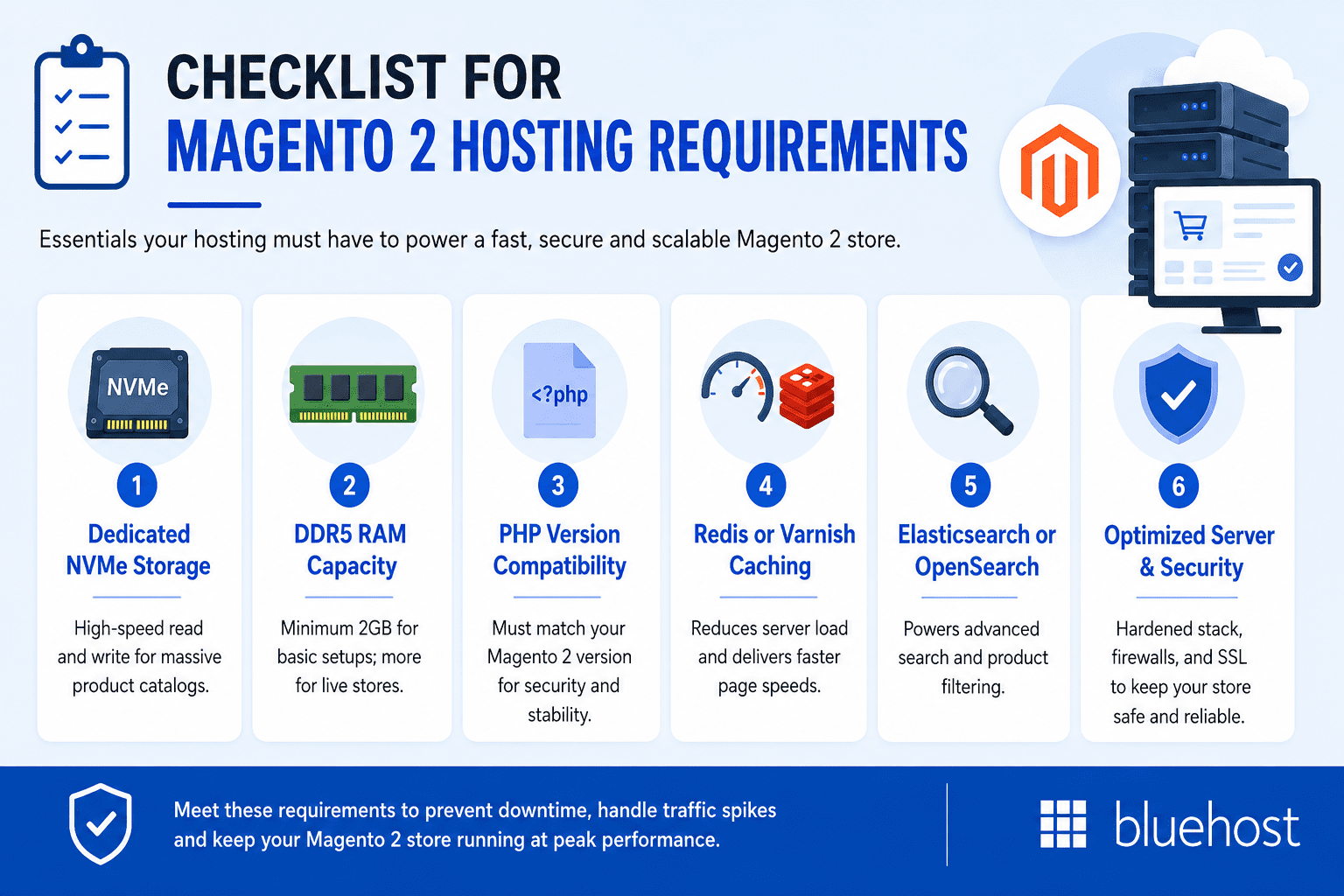
Figuring out how to choose Magento hosting requires matching your hardware to the platform’s demanding resource needs. The debate between managed Magento hosting vs self-managed Magento VPS often comes down to who configures these exact specifications. Understanding what a self-managed Magento VPS actually runs under the hood clarifies why you cannot cut corners on infrastructure. Without the right stack, your store will suffer from slow checkouts and database crashes during traffic spikes.
- Dedicated NVMe storage: Provides the high-speed read and write capabilities necessary for massive product catalogs
- DDR5 RAM capacity: Requires a minimum of 2GB for basic setups but demands significantly more for live eCommerce environments
- PHP version compatibility: Must align perfectly with your specific Magento 2 release to maintain security and stability
- Redis or Varnish caching: Bypasses database queries to deliver lightning-fast page load speeds to shoppers
- Elasticsearch or OpenSearch: Powers the complex catalog filtering and instant search results customers expect
One of the core benefits of a self-managed Magento VPS is the freedom to allocate these resources dynamically. Hitting these baseline technical requirements prevents costly downtime and keeps your eCommerce engine running at peak capacity.
Where self-managed VPS wins (and where it doesn’t)
A self-managed Magento VPS gives you unmatched control and flexibility, but it also comes with real operational responsibility.
Instead of looking at benefits in isolation, here’s a balanced view of where it excels and where it can become a challenge:
Comparison: Benefits vs limitations of self-managed magento VPS
| Area | Where self-managed VPS wins | Limitations to consider |
| Control & customization | Full control over PHP, server stack, caching, search and workflows | Requires strong technical expertise to configure and maintain |
| Performance optimization | Deep tuning for caching, indexing and database performance | Misconfiguration can lead to slow performance or instability |
| Cost structure | Pay only for infrastructure, no managed-service overhead | Hidden costs in time, DevOps effort and maintenance |
| Vendor flexibility | No lock-in, full ownership of environment and data | Responsibility for migrations, backups and environment consistency |
| Security management | Full control over security policies and compliance | Manual patching, monitoring and malware handling required |
| Support level | Independence from provider limitations | No application-level or Magento-specific support |
| Scaling | Flexible scaling based on your strategy | Manual planning required during traffic spikes |
| Reliability | Can be highly stable if optimized correctly | Higher risk of downtime without proper monitoring |
What this means in practice
Self-managed Magento VPS is powerful, but it is not “easier” hosting. It is ownership of your infrastructure.
- You gain control, flexibility and cost efficiency
- You take on maintenance, monitoring and troubleshooting
For technical teams, this trade-off is worth it because it allows deeper optimization and better long-term scalability.
For non-technical teams, these responsibilities can quickly turn into bottlenecks, especially during:
- Traffic spikes
- Security incidents
- Performance issues
A self-managed Magento VPS is the right choice if you want to build and control your environment at a granular level.
But it only works well if your team can handle the operational side consistently.
Where managed Magento hosting makes more sense
Managed Magento hosting is built for simplicity. It removes the operational burden of running Magento infrastructure, making it a better fit for teams that want to focus on growth instead of backend management.
Here are the scenarios where it clearly makes more sense:
No in-house developer or Sysadmin
If your team does not have dedicated technical expertise, managing a Magento VPS can quickly become overwhelming.
Managed hosting:
- Handles server setup, updates and optimization
- Reduces dependency on technical hiring
- Minimizes risk of misconfigurations
Why it matters: Magento requires ongoing tuning. Without expertise, performance and stability can suffer.
Limited time for maintenance
Running Magento efficiently requires continuous effort:
- Applying updates
- Monitoring performance
- Fixing issues
Managed hosting removes this workload by handling maintenance at the provider level.
Why it matters: If your team is focused on marketing, sales, or operations, this saves significant time and effort.
History of downtime or performance issues
If your store has faced:
- Slow load times
- Crashes during traffic spikes
- Stability issues due to poor configuration
Managed hosting provides:
- Pre-optimized environments
- Ongoing monitoring
- Faster issue resolution
Why it matters: A stable environment directly impacts conversions and customer experience.
Preference for convenience over control
Not every business needs deep infrastructure control.
Managed Magento hosting is ideal if you:
- Prefer a plug-and-play setup
- Do not need custom server-level configurations
- Want predictable performance without manual tuning
Why it matters: You trade flexibility for simplicity, which is often the right decision for non-technical teams.
Managed Magento hosting is the right choice when your priority is:
- Speed of operation
- Reduced technical complexity
- Reliable performance without hands-on management
If you want to spend less time managing infrastructure and more time growing your store, managed hosting is the practical option.
Is your team ready for self-managed Magento VPS?
A self-managed Magento VPS gives you control, but it also demands consistent technical ownership.
Before choosing this setup, it’s important to evaluate whether your team can handle the operational responsibility that comes with it.
Use this quick checklist to assess your readiness:
Self-assessment checklist
- Access to DevOps or technical expertise
You have a developer or DevOps resource who can manage server setup, performance tuning and troubleshooting when issues arise.
- Comfortable with server configuration
Your team can work with Linux environments, configure web servers, manage databases and handle caching layers like Redis or Varnish.
- Need for customization and integrations
Your store requires custom workflows, third-party integrations, or specific performance tuning that standard managed setups may restrict.
- Managing large catalogs or traffic spikes
You are dealing with high SKU counts, heavy indexing, or unpredictable traffic and need control over how resources are allocated and optimized.
- Cost optimization goals
You want to reduce long-term hosting costs by avoiding managed service fees and optimizing infrastructure based on actual usage.
How to interpret this
- If you checked most of these → A self-managed Magento VPS is likely a strong fit
- If you checked only one or two → Managed Magento hosting may be a safer and more efficient option
A self-managed Magento VPS is not just a hosting choice. It is an operational commitment.
- Choose it if your team can actively manage and optimize the environment
- Avoid it if you want a hands-off, low-maintenance setup
Managed Magento hosting vs self-managed Magento VPS: How to choose
By now, the difference is clear. The decision is not about features, it is about how much control you want vs how much responsibility your team can handle.
Use the framework below to make a practical decision.
Choose managed Magento hosting if convenience matters more than control
Managed hosting is the right choice when your priority is simplicity and speed.
It works best if:
- You do not have in-house server or DevOps expertise
- You want the provider to handle updates, security and performance tuning
- You prefer a stable, pre-optimized environment over deep customization
- Your focus is on running the business, not managing infrastructure
In short: Choose managed Magento hosting if you want faster operations with minimal technical overhead.
Choose self-managed Magento VPS if control and flexibility matter more
A self-managed VPS is built for teams that want to own and optimize their environment.
It works best if:
- You have technical expertise to configure and manage the stack
- You need custom performance tuning, integrations, or workflows
- You want full control over caching, search and deployment processes
- You are optimizing for long-term infrastructure efficiency
In short: Choose self-managed Magento VPS if you want maximum control and customization.
Base the decision on your team, not just your store size
A common mistake is choosing hosting based only on traffic or catalog size.
In reality, the better decision comes from evaluating your team’s capability:
- Technical skill level → Can your team manage servers and optimization?
- Time availability → Do you have bandwidth for maintenance and troubleshooting?
- Customization needs → Do you need flexibility beyond standard setups?
- Growth plans → Will you need deeper performance control as you scale?
A small but technical team can benefit from VPS.
A large but non-technical team may still need managed hosting.
Use this simple rule of thumb��
If you want a quick decision:
- Choose managed Magento hosting if you want less operational responsibility and faster setup
- Choose self-managed Magento VPS if you want more control and can confidently manage the environment
There is no one-size-fits-all answer.
- Managed hosting reduces complexity and risk
- Self-managed VPS unlocks flexibility and long-term control
The right choice depends on whether your team is ready to own the infrastructure or outsource it.
What to look for in a Magento 2 web host
| Free SSL | Included | Included |
| Storage type | NVMe storage | Dedicated NVMe storage |
| Customer support | 24/7 expert support | Hardware restarts and restores |
| Reliability | Built-in failover | Custom scalable architecture |
| Security | Automated malware removal | User-controlled firewalls and patches |
Figuring out how to choose Magento hosting requires looking past the monthly price and evaluating the underlying infrastructure. A side-by-side look at managed vs unmanaged Magento hosting reveals that eCommerce sites require distinct performance capabilities to succeed.
Technical features like built-in failover (where data is automatically mirrored across three distinct devices so your site never goes down) protect your revenue during sudden traffic spikes. Basic hosting simply lacks the power to keep a heavy application like Magento running smoothly.
Understanding exactly what a self-managed Magento VPS is helps clarify why technical teams prefer it over standard shared plans. The core benefits of a self-managed Magento VPS include isolated compute power, dedicated NVMe storage and total administrative control without paying for managed service overhead.
Ultimately, whether you are looking at managed Magento hosting vs self-managed Magento VPS, picking a provider with enterprise-grade hardware and unmetered bandwidth gives you the foundation to build with confidence.
If self-managed Magento VPS is the right fit, here is what Bluehost includes
If you have decided that a self-managed Magento VPS aligns with your team’s capabilities, the next step is choosing infrastructure that supports performance without adding unnecessary friction.
Bluehost positions its Magento VPS offering for technical teams that want control, flexibility and scalable performance without dealing with complex setup barriers.
Built for teams that want direct control over the Magento environment
Bluehost Magento VPS is designed for developers and technical operators who prefer managing their own stack.
- Full ownership of setup, tuning and maintenance
- No restrictions from managed layers or predefined configurations
- Flexibility to build an environment tailored to Magento workloads
This makes it a strong fit for teams that want to run Magento on their own terms.
Core infrastructure for Magento workloads
Magento requires consistent performance across database operations, indexing and traffic spikes. Bluehost provides infrastructure built for these demands:
- Dedicated NVMe SSD storage and DDR5 RAM for faster read/write operations
- Scalable VPS tiers to support growing workloads
- Unmetered bandwidth for handling traffic without limits
- Free SSL for secure transactions
This ensures your store can handle high traffic and large catalogs without performance bottlenecks.
Control and customization features
With Bluehost VPS, you are not limited by platform constraints.
- Full root access to configure the entire server environment
- Freedom to optimize PHP, web server, caching and database layers
- Support for custom workflows, extensions and third-party integrations
This level of control is critical for Magento stores that require advanced optimization and flexibility.
Faster setup for self-managed deployments
Self-managed does not have to mean slow setup.
- One-click Magento installation to get started quickly
- Simplified onboarding from plan selection to launch
- Reduced setup friction without limiting customization
You get the benefit of quick deployment with full control retained.
A practical option for growing stores
As your Magento store scales, your infrastructure needs to keep up.
- Suitable for stores expecting catalog expansion and traffic growth
- Handles resource-intensive workloads like indexing and database operations
- Allows teams to scale resources as needed without platform migration
This makes it a reliable option for long-term growth and performance stability.
Key features and benefits
- One-click Magento installation
- Dedicated NVMe SSD storage and DDR5 RAM
- Full root access
- Scalable VPS tiers
- Free SSL and unmetered bandwidth
- 30-day money-back guarantee
Bluehost Magento VPS pricing plans
| Plan | vCPU | RAM | Storage | Starting price (Monthly) |
| NVMe 2 | 1 Core | 2 GB DDR5 | 50 GB NVMe | $2.09 |
| NVMe 4 | 2 Cores | 4 GB DDR5 | 100 GB NVMe | $4.18 |
| NVMe 8 | 4 Cores | 8 GB DDR5 | 200 GB NVMe | $8.36 |
| NVMe 16 | 8 Cores | 16 GB DDR5 | 450 GB NVMe | $17.67 |
Note: Pricing may vary based on billing term and promotions.
Bluehost Magento VPS is built for teams that want:
- Full control over their Magento environment
- Performance-focused infrastructure
- Scalable resources without platform limitations
If you are ready to manage your own environment, it gives you the foundation to optimize, scale and grow without restrictions.
Final thoughts
Choosing between managed Magento hosting and a self-managed Magento VPS comes down to control vs convenience. If your team can handle server management, performance tuning and security, a self-managed VPS gives you flexibility, customization and long-term cost efficiency. If not, managed hosting offers simplicity and stability.
The decision should be based on your team’s capabilities, not just your store size.
At Bluehost, we design our Magento VPS to give you full control without unnecessary setup friction. You get the infrastructure, flexibility and scalability needed to run Magento your way.
Ready to take control of your Magento environment? Explore our Bluehost Magento VPS and get started today.
Frequently asked questions
Investing in managed Magento hosting provides significant value for businesses that lack a dedicated technical team. These services handle security patches, server optimizations and software updates. This approach allows your team to focus on growing the eCommerce store instead of troubleshooting infrastructure issues.
To run Magento 2 effectively, you need a Linux-based server with at least 2GB of RAM, a compatible PHP version and a database like MySQL. For live eCommerce environments, we recommend increasing RAM, using NVMe or SSD storage and implementing caching tools such as Redis to ensure fast page loads.
While technically possible to use a VPS, doing so without server administration skills often leads to security vulnerabilities and poor site performance. A self-managed VPS requires manual configuration and maintenance. For most beginners, a managed hosting plan offers a more reliable and secure experience for an eCommerce store.
Monthly costs for hosting typically range from $5 for basic setups to over $100 for premium environments. A self-managed Magento VPS is usually the most affordable option. Managed hosting carries a higher price because the provider includes specialized support, automated security and performance tuning in the package.
Managed hosting includes expert support for security patches and performance optimization, which simplifies store management. Unmanaged hosting provides full root access and total control over the server environment. The choice depends on whether you prefer the convenience of expert assistance or the flexibility of manual configuration.

Write A Comment