



Key highlights
- Discover strategic tips to select a business domain that builds instant brand authority, customer confidence and SEO potential.
- Learn to avoid unprofessional mistakes—like using hyphens or complex spellings—that can confuse clients and dilute your brand identity.
- Leverage advanced tools like the Bluehost AI Domain Name Generator to brainstorm unique, trademark-safe names for your company.
- Secure your digital market share by registering defensive domains, preventing competitors from capitalizing on your brand traffic.
- Find actionable solutions if your primary choice for a business domain is already owned.
Selecting a domain name is one of the most significant branding decisions you will make for your business. It acts as your digital headquarters—often the first interaction a potential client or partner has with your company.
A strategic domain choice establishes instant credibility, enhances professional trust and supports your marketing efforts. Conversely, a poor choice can lead to customer confusion, lost leads and expensive rebranding down the line.
In a competitive digital marketplace, availability is just one piece of the puzzle. The most effective business domains are concise, brandable and scalable. They do more than just direct traffic; they reinforce your unique value proposition and help you stand out in a saturated industry.
This guide covers 15+ expert strategies to help you secure a domain name engineered for business growth and SEO performance, along with common pitfalls to avoid.
How to Pick a Good Domain Name: Quick Summary
Choosing a domain name requires balancing memorability, brandability and SEO value. Keep it short, simple and easy to spell. Prioritize a .com extension when possible, avoid numbers and hyphens and ensure it aligns with your brand identity. Check availability across social media platforms for consistent branding.
15+ expert tips to choose a business domain name
Now that the strategic value of a domain is clear, let’s explore the actionable steps to choosing the perfect digital address for your enterprise.
- Register with a reputable registrar
- Leverage domain name generators
- Keep it concise and professional
- Ensure it is easy to spell and pronounce
- Prioritize brandability over description
- Avoid hyphens and numbers
- Select the appropriate extension (.com, .inc, etc.)
- Integrate keywords strategically
- Plan for future scalability
- Conduct trademark research
- Audit the domain’s history
- Focus on memorability
- Align with social media handles
- Target local markets if applicable
- Protect your intellectual property
- Test the name verbally
- Secure the name immediately
- Purchase defensive variations
- Consider premium domains as an asset
1. Use domain name generators
Struggling to find a name that captures your business essence? Domain name generators are excellent tools for brainstorming professional options. They combine your core business keywords with available extensions and variations to provide immediate solutions.
For instance, a financial consultant might input “wealth” and “strategy” to receive professional suggestions like [WealthApex].com or [StratVest].com.
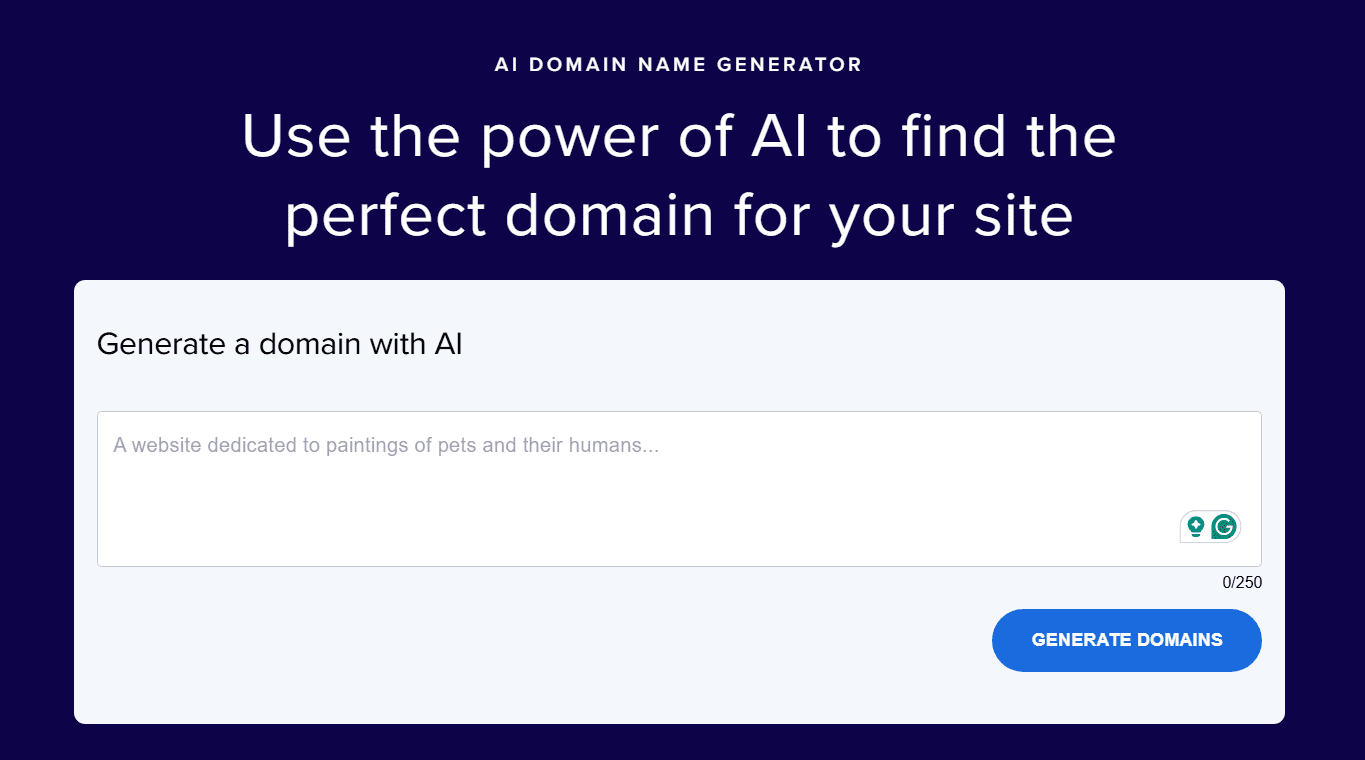
The Bluehost AI Domain Name Generator enhances this process by using artificial intelligence to suggest industry-relevant, brandable names while checking real-time availability. This allows you to secure a sophisticated business domain instantly.
2. Keep it short and simple
In business, brevity is key. Short domains are easier to type, remember and fit on business cards. Research shows that top-performing websites typically have domains with around 6 to 14 characters. Lengthy addresses increase the risk of user error and can dilute your brand impact.
For example, [zoom].com is a powerful corporate asset, whereas [highqualityvideoconferencing].com is cumbersome. Aim for one or two punchy words that stick in the mind of your investors and customers.
3. Make it easy to spell and pronounce
Word-of-mouth marketing is crucial for business growth. If a client cannot spell your domain after hearing it during a meeting or podcast, you lose traffic. Ambiguous spellings create friction and potential trust issues.
For instance, [fiverr].com works because it is phonetically intuitive despite the creative spelling, whereas a name like [phynancial].com creates unnecessary barriers. Validate your choice by asking colleagues to spell it after hearing it once.
4. Prioritize brandability
A “brandable” domain is unique and distinct, acting as a vessel for your company’s reputation. Unlike generic domains that simply describe a service, brandable names allow you to build a proprietary identity in the marketplace.
Consider [Amazon].com; it doesn’t describe “online books,” yet it is a global powerhouse. In contrast, [buybooksonline].com is generic and difficult to protect legally. Choose a name that can evolve into a recognized trademark.
5. Avoid hyphens and numbers
Hyphens and numbers often signal low quality or spam to savvy consumers. They disrupt the flow of the URL and are frequently misunderstood when spoken aloud (e.g., “is that the number 4 or the word four?”). Stick to alphabetic characters to maintain a corporate, professional image.
For example, [cloudservices].com projects authority, while [cloud-services-247].com appears temporary and less trustworthy.
6. Choose the right domain extension
While .com remains the gold standard for corporate trust, specific Top-Level Domains (TLDs) can communicate your industry niche effectively. Choosing the right suffix helps categorize your business instantly.
Strategic TLD options for business:
- .com → The default choice for global commercial enterprises.
- .shop or .store → Ideal for eCommerce and retail brands.
- .co → A modern, recognized alternative for startups and tech companies.
- .org → Essential for nonprofits and industry associations.
- Country codes (ccTLDs) like .uk or .ca → Build local trust for regionally focused operations.
7. Add keywords (sparingly)
Including a relevant keyword can signal your business function to search engines and visitors, but it should never compromise the name’s flow. Overstuffing keywords can make your business look like a low-quality affiliate site.
For example, [AustinPlumbing].com clearly defines a service and location, whereas [Best-Cheap-Plumbing-Services].com undermines credibility. Balance SEO intent with professional branding.
8. Think long-term
Your domain should accommodate business scaling. Avoid names that pigeonhole you into a single product line or geography if you have expansion plans. A flexible name saves you from the costly and complex process of rebranding later.
For example, starting as [JoesBurgers].com might limit you if you expand into a full-service franchise, whereas [JoesKitchen].com offers more room for growth.
9. Check for trademarks and conflicts
Legal due diligence is non-negotiable. Registering a domain that conflicts with an existing trademark can lead to cease-and-desist letters, domain seizure and legal fees. Always verify availability before launching.
Check databases like the USPTO or local equivalents to ensure your chosen name doesn’t infringe on another company’s intellectual property.
10. Review domain history
If purchasing a pre-owned domain, ensure it has a clean history. A domain previously used for spam or illegal activities may carry search engine penalties that hamper your SEO efforts.
Use tools like the Wayback Machine or Whois history to vet the domain. A clean digital record is essential for a healthy business launch.
11. Keep it memorable
Memorability lowers your customer acquisition costs. A sticky name encourages direct traffic and return visits. If your domain is catchy, your marketing budget works harder for you.
For example, [Uber].com is distinctive and unforgettable. [CityRideShareApp].com is descriptive but forgettable.
12. Match your social handles
Brand consistency across platforms builds trust. Your domain name should ideally match your handles on LinkedIn, X (Twitter), Instagram and other relevant channels. Discrepancies confuse customers.
Before registering, check availability across social networks. If [YourBrand].com is available but the handle is taken, consider if a consistent variation (like @YourBrandHQ) is acceptable.
13. Target your local area
For brick-and-mortar businesses or local service providers, geo-targeted domains can be a powerful SEO advantage. Including your city or region helps attract high-intent local customers.
For example: [MiamiLegal].com signals immediate relevance to local clients compared to a generic name. This strategy is highly effective for law firms, contractors and real estate agencies.
14. Protect your brand
Defensive registration is a smart business move. Secure variations of your domain—such as common misspellings or alternative extensions—to prevent competitors or bad actors from diverting your traffic.
Major brands often register the .net and .inc versions of their .com address to ensure total brand control.
15. Test it out loud
This is often called the “radio test.” If you advertise your business on a podcast or radio spot, will listeners know how to spell it? If you have to spell it out (“That’s ‘K’ as in kite…”), your domain is too complex.
Ensure your business name is phonetically obvious to maximize the effectiveness of audio and word-of-mouth advertising.
16. Act fast before it’s gone
Digital real estate is finite. Thousands of business domains are registered daily. If you identify a name that fits your brand strategy, secure it immediately. Hesitation can result in losing the asset to a competitor or domain speculator.
Registering for a multi-year term also signals stability to search engines and locks in your pricing, protecting your business from renewal hikes. Bluehost includes a free domain for the first year with all hosting plans, making it easy to secure your chosen domain name while keeping initial costs low. The platform provides everything you need in the control panel to quickly create or transfer new domains and manage them, allowing you to act on your domain decisions quickly and reliably.
Domain privacy protection is also available to prevent identity theft, spam and phishing attacks by masking the personal information associated with your domain name.
Secure your business identity today—delays can be costly.
17. Purchase multiple domain names
Owning a single domain leaves your brand vulnerable. By acquiring variations (like plural forms, common typos or .net/.org versions), you build a protective moat around your business identity.
For example, if you operate [EliteConsulting].com, securing [EliteConsulting].net ensures a competitor cannot set up shop next door digitally.
You can redirect these domains to your primary site, ensuring that any typed variation leads customers straight to your business.
18. Buy premium domain names if necessary
Sometimes the perfect business name is already owned. In such cases, purchasing a premium domain is a worthwhile capital investment. These are high-value, short and often keyword-rich domains available for resale.
While the upfront cost is higher, the long-term ROI in terms of instant authority, trust and SEO advantage can be substantial for a serious business.
Also read: Domain Pointing: Step-by-Step Guide to Connecting Your Website
19. Register your domain with the right company
Your registrar acts as the custodian of your online property. Choose an ICANN-accredited provider known for security and support. Ideally, use a provider that integrates hosting and domain management, simplifying your tech stack.
For example, Bluehost offers seamless domain registration bundled with enterprise-grade hosting, ensuring your business stays online and secure. Robust support and auto-renewal features are critical for business continuity.
Also read: Your Guide to Finding the Best Domain Registrar
What to do if your desired domain is taken?
If your ideal business domain is unavailable, strategic alternatives can save your brand launch without compromising professionalism:
- Add a professional modifier – If “[ApexTech].com” is taken, try “[ApexTechSolutions].com” or “[ApexTechGlobal].com.”
- Leverage niche extensions – If the .com is gone, a specific TLD like “.agency,” “.finance,” or “.tech” can actually reinforce your industry specialization.
- Attempt acquisition – If the domain is inactive, use WHOIS records to contact the owner. Many domains are held by investors willing to sell for the right price.
- Use AI for rebranding – Use a domain generator to find available synonyms or creative variations that might be even stronger than your original idea.
- Invest in the premium option – Treat the domain purchase as a startup cost. If the name is critical for your brand equity, the premium price is an asset investment.
How to choose a domain registrar
Choosing the right domain registrar is just as important as selecting your domain name itself. Start by verifying that any registrar you consider is ICANN-accredited, which ensures they meet industry standards for domain management and security. Look for transparent pricing structures that clearly display both initial registration costs and renewal rates—hidden renewal pricing is a major red flag. Your registrar should offer essential security features including domain lock to prevent unauthorized transfers, two-factor authentication for account access and straightforward transfer controls when you need to move your domain.
Evaluate the registrar’s management tools and support infrastructure. A quality provider will offer intuitive DNS management that allows you to easily configure your [businessname].com domain records without technical headaches. Privacy protection should be available to shield your personal contact information from public WHOIS databases. Access to knowledgeable support—whether through chat, phone or tickets—matters when you encounter issues. If you plan to build a website, verify that the registrar integrates smoothly with hosting platforms and website builders, ideally offering both services under one account for simplified management.
Watch for warning signs that indicate a subpar registrar: deliberately obscured renewal pricing, complicated transfer procedures buried in help documentation, weak security options or unresponsive customer service. The best registrars make domain ownership straightforward and secure, empowering you to focus on building your business rather than wrestling with administrative obstacles.
How to choose a domain for business?
Your domain acts as the cornerstone of your brand’s digital presence. Unlike a personal blog, a business domain must balance marketing appeal with legal safety and technical scalability.
Checklist for business domain selection:
- Align with Brand Strategy: Ensure the name reflects your core offering or value proposition. It should sound professional in a boardroom and catchy in an advertisement.
- Maximize Clarity: Avoid clever spellings that require explanation. If you have to spell it out every time you say it, it’s a liability.
- Professional Formatting: Keep it clean—no hyphens, no numbers, no slang.
- Strategic Extensions: Use .com for global reach or industry-specific TLDs (.consulting, .store) to define your niche immediately.
- SEO & Branding Balance: Use keywords if they fit naturally, but prioritize a name that can become a recognized brand authority.
- Legal Safety: Always perform a trademark search to avoid litigation and ensure you can legally operate under the name.
Why choosing a domain for business is important?
Your domain is a high-leverage business asset. The right choice amplifies your marketing efforts, while the wrong one creates friction. A strategic domain:
- Instantly establishes professional credibility and industry authority.
- Reduces marketing costs by being easy to remember and share.
- Supports SEO efforts by signaling relevance to search engines.
- Protects your brand equity from competitors and copycats.
- Builds consumer trust, leading to higher conversion rates.
- Enhances the effectiveness of email marketing ([email protected] vs generic Gmail).
- Supports long-term business valuation and asset growth.
- Ensures brand consistency across all digital and physical channels.
4 things to consider when picking your perfect domain name
Before diving into the detailed strategies below, it helps to have a clear framework. When evaluating any domain name, focus on these four foundational pillars to ensure your choice supports both immediate launch needs and long-term business success:
- Brand fit: Your domain should instantly communicate what your business represents. Whether you choose [brandname].com or something more descriptive, ensure it aligns with your company identity and reinforces the impression you want to make on first-time visitors.
- Usability: The best domain names are effortless to say, type and spell. If someone hears your domain on a podcast or in conversation, they should be able to type it correctly on their first attempt without confusion or second-guessing.
- Trust signals: Your domain extension and overall professionalism matter. While .com remains the most recognized and trusted option, choosing the right TLD for your industry—and avoiding anything that looks suspicious or makeshift—helps establish immediate credibility with potential customers.
- Long-term resilience: Think beyond your current product or service. Your domain should accommodate business growth, new offerings and geographic expansion. Additionally, consider securing defensive variations to protect your brand from competitors capitalizing on your traffic.
These four pillars work together to create a domain foundation that serves you well for years to come. The expert tips that follow will help you execute on each of these principles with specific, actionable strategies.
How Bluehost makes your domain search easy
Finding the perfect domain name for your business doesn’t have to be complicated. Bluehost simplifies the entire domain search process with an intuitive search tool designed specifically for users who want to get online quickly without technical hassles.
When you visit Bluehost, you’ll find a prominent domain search bar right on the homepage. Simply type in your desired domain name or keywords related to your business. Within seconds, Bluehost’s powerful search engine checks availability across multiple domain extensions including .com, .net, .org and dozens of industry-specific options.
Here’s how to search for your domain using Bluehost:
Step 1: Navigate to the Bluehost domains page and locate the domain search box at the top of the page.
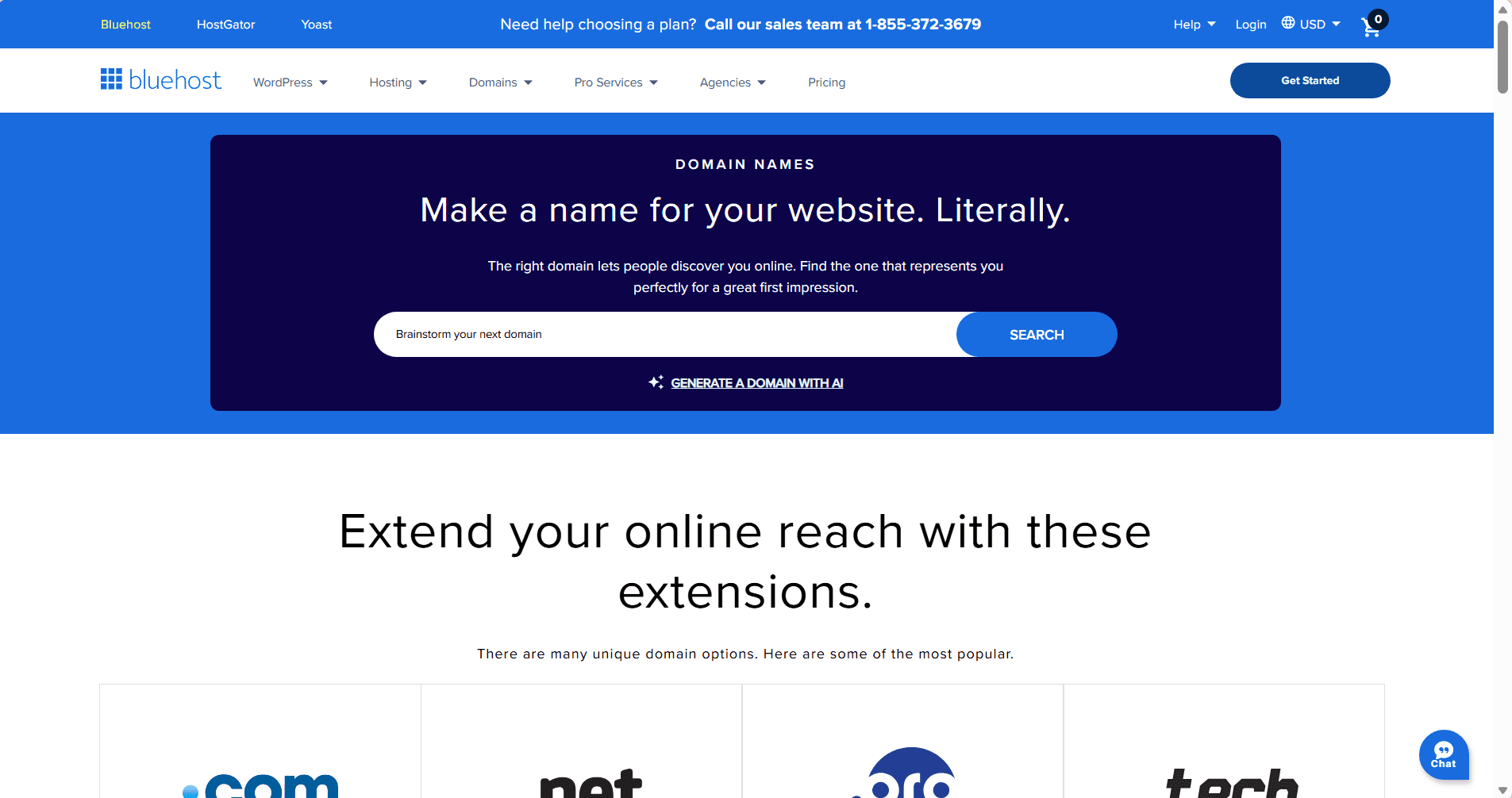
Step 2: Enter your preferred domain name or business keywords into the search field.

Step 3: Click the search button to instantly see availability results.
Step 4: Review the available options, including alternative suggestions if your first choice is taken.
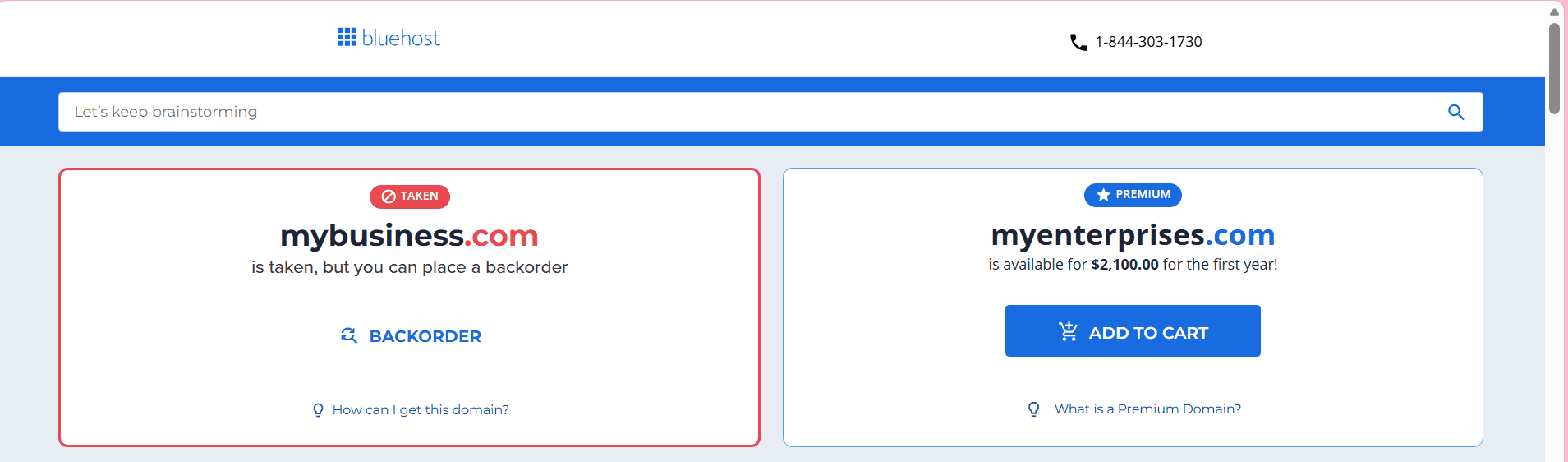
Step 5: Select your preferred domain and add it to your cart.
Step 6: Choose a hosting plan to get your free domain for the first year.
What makes Bluehost’s domain search truly easy is the intelligent suggestion engine. If your ideal domain is unavailable, you’ll immediately see relevant alternatives with different extensions or slight variations. Plus, with every hosting plan, you receive a free domain name for your first year, eliminating the need to purchase separately. The entire process takes just minutes and you’ll have full DNS management capabilities right from your Bluehost control panel.
Bluehost AI domain name generator
Choosing the right domain name doesn’t have to be overwhelming. Bluehost’s AI-powered domain name generator removes the stress from finding a domain name for your brand. Simply enter a brief description of your business and search. Our intelligent tool instantly generates a variety of unique domain names to choose from, perfectly suited to your business needs. Whether you’re looking for domain tips or need help selecting a great domain, this free domain name generator streamlines the entire process. You’ll get creative suggestions that align with your brand identity, making domain selection simple and efficient. Pick a good domain name that captures your business essence in seconds.
Final thoughts
Choosing the right domain name is an investment in your business’s future. It sets the tone for your brand, influences customer trust and impacts your ability to rank in search engines. By prioritizing brevity, clarity and legal safety, you lay a solid foundation for digital success.
However, the best business names move fast. Every day, thousands of domains are registered and your ideal choice may not be available tomorrow. Procrastination is a competitive disadvantage.
Take action now. Use the Bluehost AI Domain Name Generator to identify available, high-impact business domains and secure your brand’s home on the web before someone else does.
FAQs
To select a strong business domain, focus on brevity, professional tone and ease of spelling. Avoid hyphens and numbers. Ensure the name aligns with your brand strategy, includes relevant keywords for SEO without overstuffing and is legally safe to use (trademark free). Consider your long-term expansion plans to ensure the name doesn’t limit your growth.
While .com is the standard for corporate authority, other TLDs are excellent for specific business models: .co (tech/startups), .shop/.store (eCommerce), .consulting or .agency (services) and .org (nonprofits). Local businesses should strongly consider ccTLDs like .uk, .ca or .in to boost local SEO trust.
Domain registration is the process of leasing a web address (like [YourCompany].com) from an accredited registrar. It grants you exclusive rights to use that address for your website and professional email. Providers like Bluehost often bundle domain registration with hosting services to simplify your business launch.
Yes, many hosting providers, including Bluehost, offer a free domain name registration for the first year when you purchase a business hosting plan. This reduces your initial startup costs. Always verify renewal rates and ensure full ownership rights are included.
Use a professional domain search tool provided by a registrar. Enter your desired business name to see if it is available for registration. If taken, advanced tools like the Bluehost AI search will suggest relevant, brandable alternatives that help you maintain your professional image.
Selecting the right domain name requires balancing memorability, brand alignment and SEO considerations. Focus on names that are short, easy to spell and clearly communicate your business purpose. Avoid numbers, hyphens and complex spellings that could confuse potential visitors. Your domain should be distinctive enough to stand out while remaining intuitive for your target audience.
When selecting a domain name for your blog, focus on simplicity and memorability. Choose a name that reflects your blog’s niche, is easy to spell and resonates with your target audience. Avoid hyphens, numbers or complex spellings. Incorporate relevant keywords naturally while keeping the name brandable and distinctive within your blogging category.



Write A Comment