 ChatGPT,
  Claude,
  Gemini,
  Grok — all four for
Reimage Your Server for OpenLiteSpeed & WordPress Installation
OpenLiteSpeed + WordPress includes everything you need to get a fast, reliable website up and running on your Bluehost Self-Managed VPS or Virtual Dedicated Server (VDS). OpenLiteSpeed helps your site load quickly and handle traffic surges, while WordPress makes it easy to build pages, publish content, and customize your website without needing any advanced technical skills. OpenLiteSpeed + WordPress can be installed and set up in a matter of minutes with the one-click installer.
How to Reimage Your Server for OpenLiteSpeed and WordPress Installation
This applies to both VPS and VDS.
- You can install only one application using the one-click installer.
- To change or delete your application, follow the guide: How to Change an Application. Create a backup of your existing applications or templates.
- To keep your current template, install the new application manually using SSH. Follow the same steps for both Self-Managed VPS and Virtual Dedicated Server (VDS). The system automatically selects the recommended operating system for OpenLiteSpeed and WordPress.
- Log in to your Bluehost Portal.
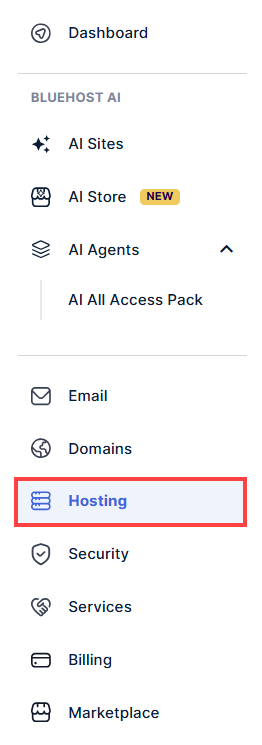
- In the left-hand menu, click the Hosting tab.
- Click the Manage button on the hosting package you want to reimage.

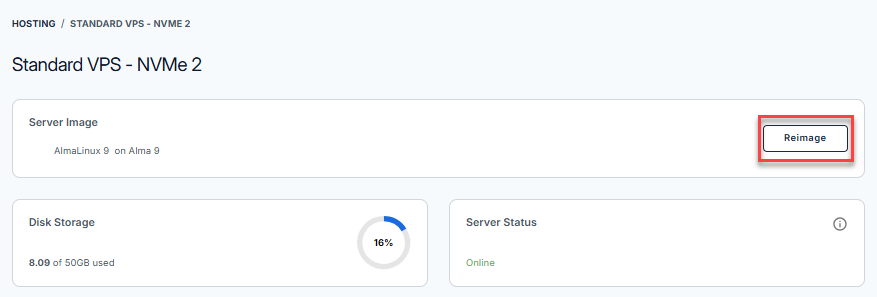
- Click the Reimage button.
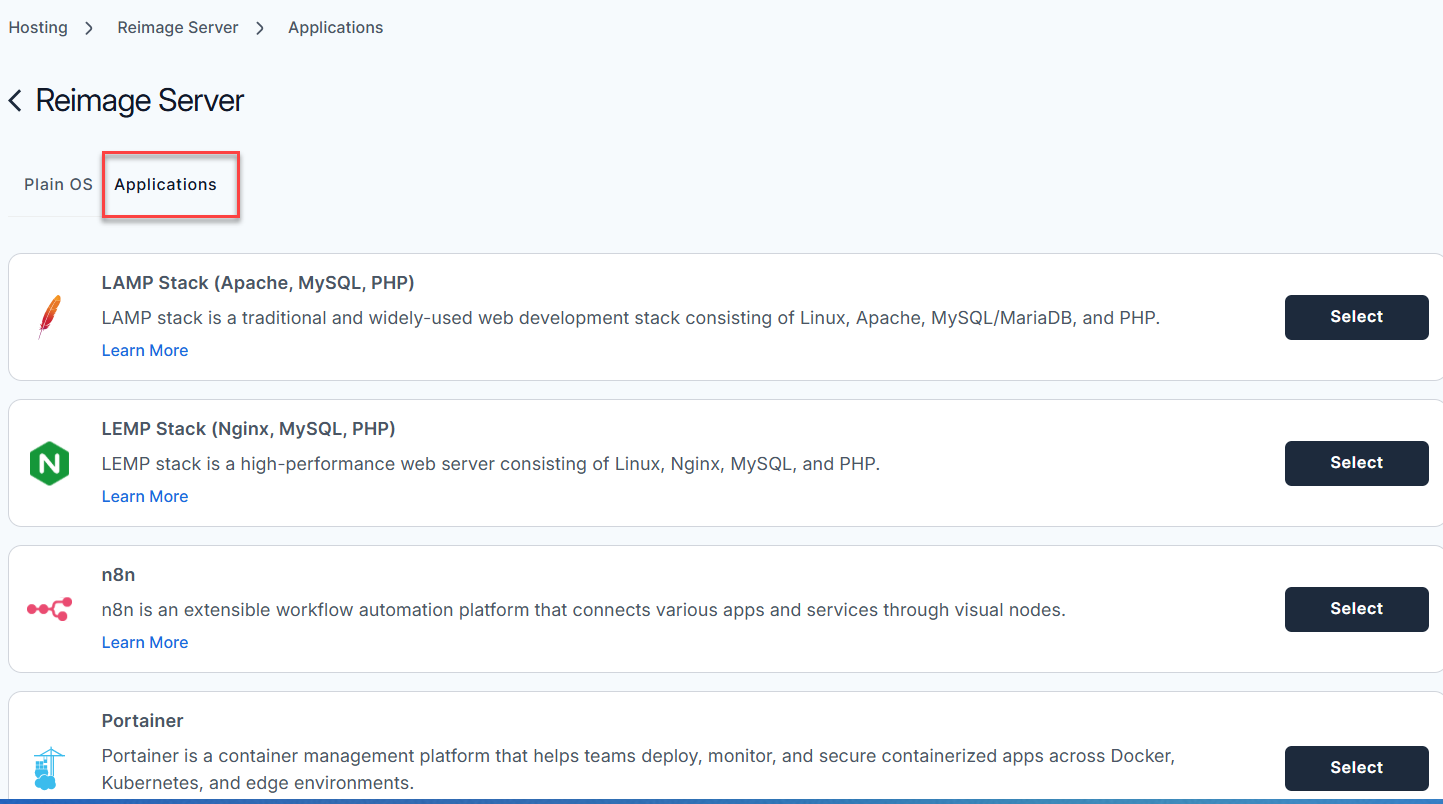
- Select the Applications tab.
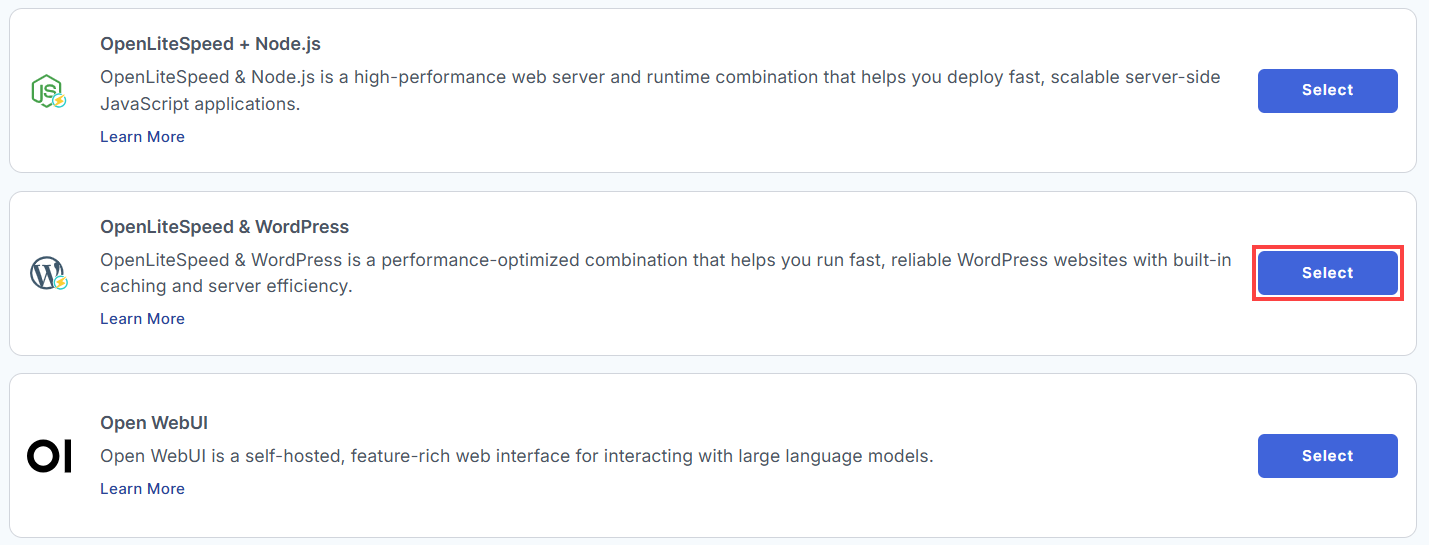
- From the list, locate OpenLiteSpeed & WordPress and click Select.
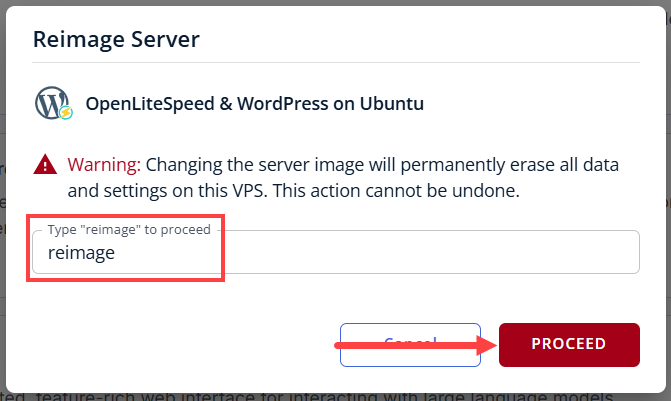
- To confirm, type "reimage" and then click Proceed to start the process.
- Wait a few minutes while the installation completes.

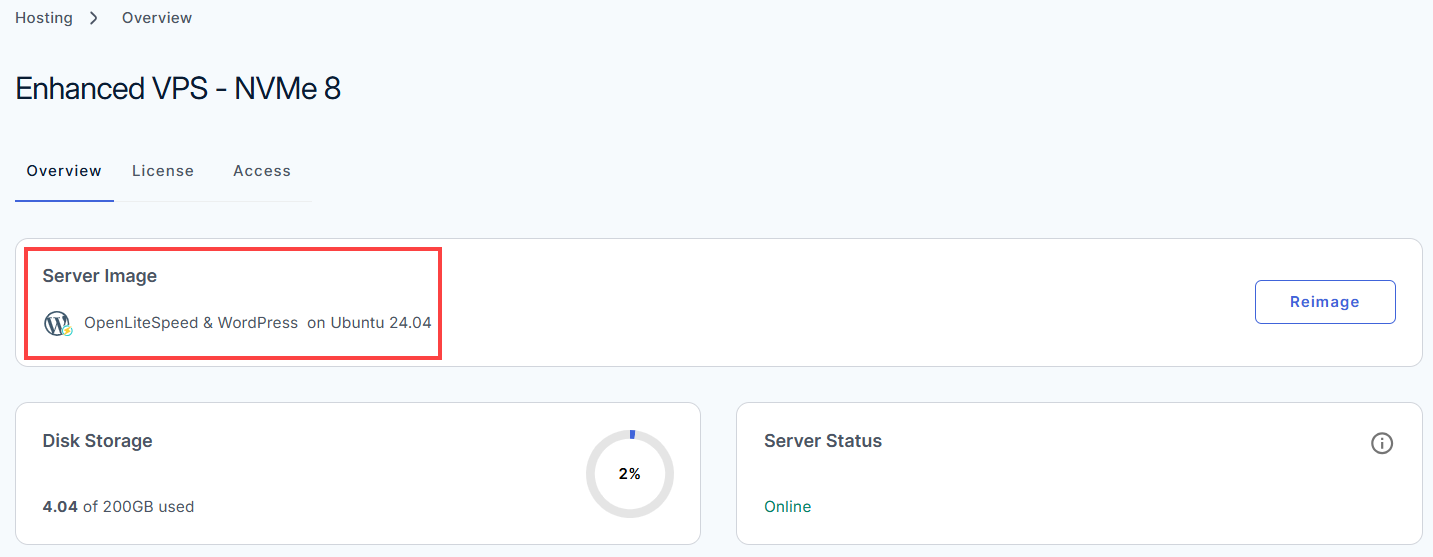
- Once completed, you will see OpenLiteSpeed & WordPress listed in the Server Image section.
Getting Started with OpenLiteSpeed and WordPress
- OpenLiteSpeed Web Server: Think of this as the welcoming front desk of your website. It instantly greets your visitors, answering standard requests (like images and design files) in milliseconds while seamlessly guiding more complex requests to PHP.
- LSPHP (LiteSpeed PHP): This is the engine room that processes the core code of your WordPress site. Because it uses special LiteSpeed technology, it can process your posts, pages, and plugins significantly faster than traditional web servers.
- MariaDB Database: This is your digital vault. It securely stores all of your website's vital information—including your written posts, user accounts, and layout settings. For maximum security, this vault is completely hidden from the outside internet and will only communicate internally with your own server.
- UFW Firewall: This is your digital security guard. It monitors all incoming network traffic and blocks unauthorized access, ensuring only legitimate web visitors and your secure administrative connections are allowed through.
- Log in to your Bluehost Portal.
- In the left-hand menu, click the Hosting tab.
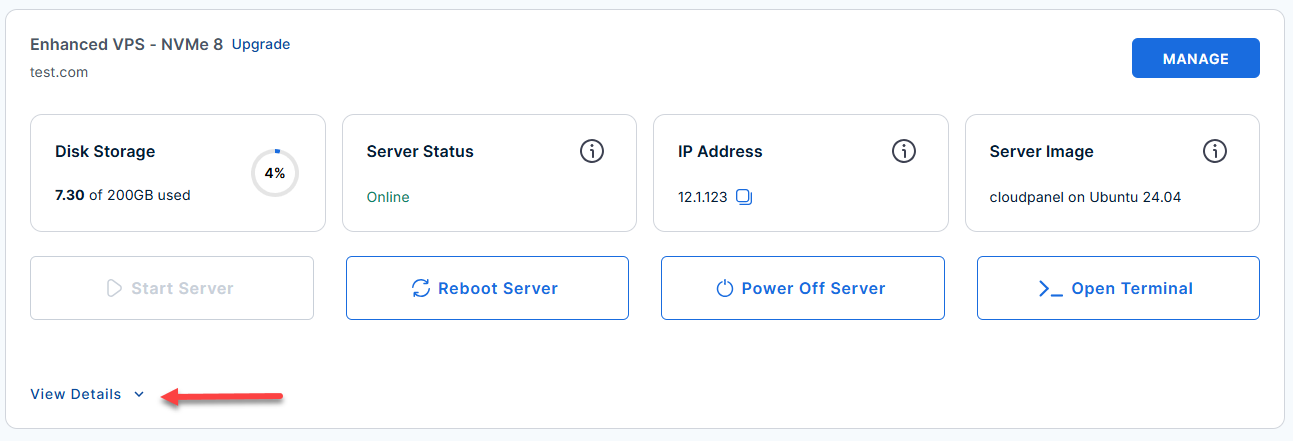
- Locate the server you want to manage, then click View Details in the bottom-left corner to expand the section and access additional server information.
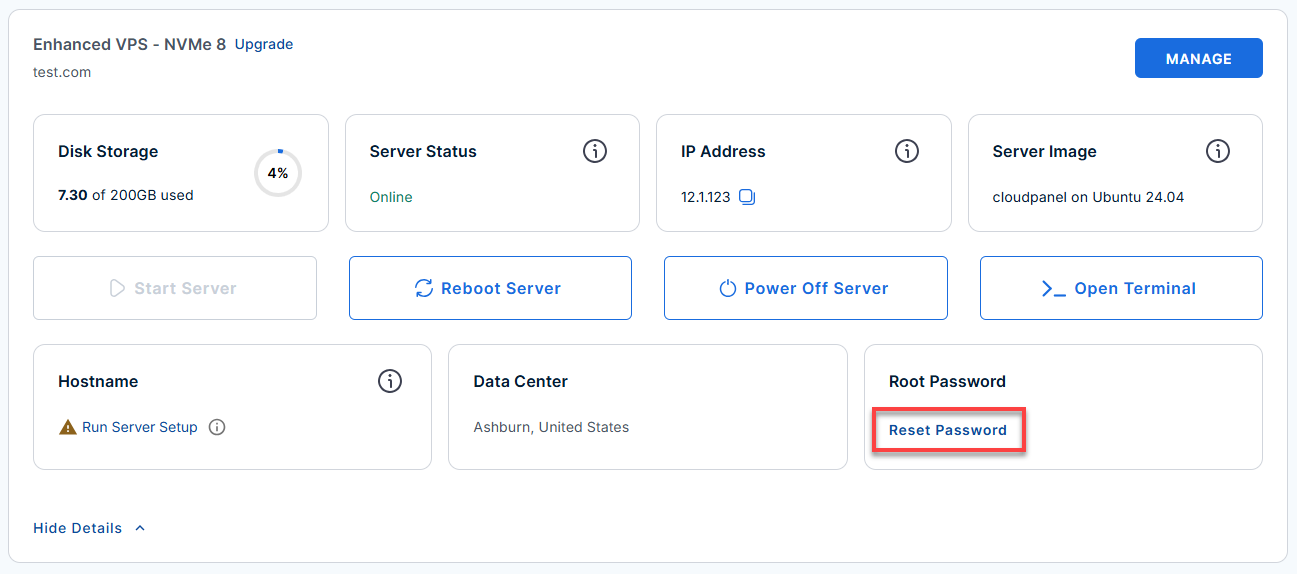
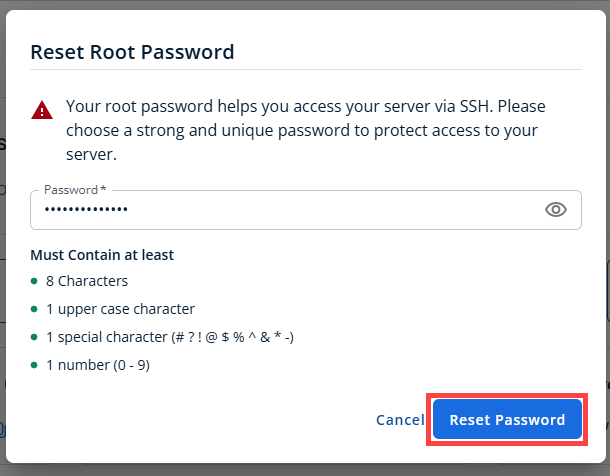
- Click the Reset Password.
- In the pop-up window, type your new root password, then click Reset Password again to confirm and save the changes.
- Connect to your VPS via SSH.
Open your computer's terminal (or an SSH client like PuTTY) and run the following command to log into your server as the administrator, using your server's public IP address:Replaceyour_server_ipwith your actual server IP address.
Follow the prompts and enter the new root password you created in the step above.ssh root@your_server_ip - Retrieve your unique passwords.
For your security, our system automatically generates random, strong passwords during the first boot. Run this command to view them:cat /root/.app_passwordsExample Output:
root@server-123456:~# cat /root/.app_passwords OLS_ADMIN_PASS=mJkS7mux3hFQQzHgmMAtest WP_DB_PASS=Sm4MmaJN7udGV88P6AcTTEST MYSQL_ROOT_PASS=HUR6165dNavXZ44Mz1fEVjLC>WP_ADMIN_PASS=r9NkvbTESTmWsnVcMeQjrlK - Open your preferred web browser and navigate to the initialization page:
http:///wp-admin/install.phpFollow the on-screen prompts to configure your actual website:
- Enter your Site Title.
- Create a WordPress Admin Username.
- Create a WordPress Password (make sure to save this; it is completely separate from your server passwords).
- Enter your Email address and finish the setup.
Depending on how quickly your server configures itself, you might see a message stating "Already Installed" when you visit the setup URL. Don't worry—this just means our automated setup script has already taken care of the initial configuration for you!Here is how to log in:
- Click the Log In button on that page to go to your WordPress sign-in screen.
- Enter the administrator credentials you retrieved from your password file in Step 6
ssh root@your_server_ip.Replaceyour_server_ipwith your actual server IP address.Example output:
Welcome to Ubuntu 24.04.4 LTS (GNU/Linux 6.8.0-124-generic x86_64)
********************************************************************************
  WordPress + OpenLiteSpeed Stack
  Firewall: Ports 22, 80, 443, 7080 open

  Access URLs:
    WordPress       : https://12.3.4.456
    WordPress Admin : https://12.3.4.456/wp-admin
    OLS Admin Panel : https://12.3.4.456:7080

  Credentials:
    OLS Admin User  : admin
    OLS Admin Pass  : mJkS7mux3hFQQzHgmMAtest
    DB Name         : wordpress
    DB User         : wpuser
    DB Pass         : Sm4MmaJN7udGV88P6AcTTEST

  SSL             : Let's Encrypt (Trusted)
  Auto Renew      : Every 12 hours via cron

  Key Paths:
    WordPress files : /var/www/html/wordpress
    Credentials     : /root/.app_passwords
    Boot log        : /var/log/onboot.log
    Logs            : /var/log/litespeed/

  Quick Commands:
    systemctl {status|restart} lsws
    systemctl {status|restart} mariadb
    tail -100 /var/log/litespeed/error.log

  For full details: /root/README.md
  To remove this MOTD: rm -f /etc/update-motd.d/99_ols_wp
********************************************************************************
- Once the installation is complete, you can manage and view your site using these URLs:
- To view your live website: http://<your-server-ip>
- To log in and manage WordPress: http://<your-server-ip>/wp-admin
- If you need to change server-level configurations, tweak PHP settings, or manage your cache settings, you can access the server's control panel:
- Navigate to: http://<your-server-ip>:7080
- Log in with the username: admin
- Use the password you found in Step 7 (the value for OLS_ADMIN_PASS).
Quick Troubleshooting Commands
If your website isn't loading, paste these commands into your SSH terminal to check if the background services are running properly:
- Check the Web Server:
systemctl status lsws
- Check the Database:
systemctl status mariadb
- View Error Logs:
tail -100 /var/log/litespeed/error.log
Additional Information and Example Documentation Output
You can run cat /root/README.md to see more information and useful commands:
Example Output:
root@server-123456:~# cat /root/README.md
# OpenLiteSpeed & WordPress

## Description

OpenLiteSpeed & WordPress is a performance-optimized combination that helps you run fast, reliable WordPress websites with built-in caching and server efficiency. OpenLiteSpeed's native WordPress caching plugin works alongside WordPress to reduce page load times, handle higher traffic, and lower server resource consumption compared to standard web server configurations.

## Image contents

This template installs and configures:

- OpenLiteSpeed web server
- LSPHP (LiteSpeed PHP)
- WordPress (latest) via WP-CLI
- MariaDB local database service
- UFW firewall rules for SSH, HTTP, HTTPS, and OLS Admin
- WordPress at `/var/www/html/wordpress`
- OpenLiteSpeed config at `/usr/local/lsws/`
- Logrotate configuration at `/etc/logrotate.d/openlitespeed-wordpress`
- App password store at `/root/.app_passwords`

## Services

| Service       | Ports | Purpose                        |
| ------------- | ----- | ------------------------------ |
| OpenLiteSpeed | 80    | Web server serving WordPress   |
| OLS WebAdmin  | 7080  | OpenLiteSpeed admin panel      |
| MariaDB       | 3306  | Database backend for WordPress |
| OpenSSH       | 22    | Remote access                  |

Ports are protected using UFW.


## OpenLiteSpeed configuration

The default OpenLiteSpeed configuration is at `/usr/local/lsws/conf/httpd_config.conf`.

Key settings include:

- Virtual host config: `/usr/local/lsws/conf/vhosts/wordpress/conf/vhconf.conf`
- Document root: `/var/www/html/wordpress`
- PHP handler: LSPHP via LiteSpeed SAPI
- Admin panel port: `7080`
- Admin username: `admin`
- Admin password: `OLS_ADMIN_PASS` -- replaced at first boot by the per-instance cloud-init script

The systemd service unit is `lsws` and starts OpenLiteSpeed as the `lsadm` user.

## WordPress configuration

WordPress is installed at `/var/www/html/wordpress`.

Key settings in `/var/www/html/wordpress/wp-config.php`:

- `DB_NAME = wordpress`
- `DB_USER = wpuser`
- `DB_PASSWORD` -- replaced at first boot by the per-instance cloud-init script
- `DB_HOST = localhost`

## First-time access (How to use)

SSH into your server using your cloud provider credentials and the server public IP:

ssh root@<your-server-ip>

Get the generated passwords:

cat /root/.app_passwords

After the VM boots, complete the WordPress setup at:

http://<your-server-ip>/wp-admin/install.php

Fill in:

- Site title
- Admin username
- Password (save this!)
- Email

Access the OpenLiteSpeed admin panel at:

http://<your-server-ip>:7080

Login credentials:

- Username: `admin`
- Password: value from `grep OLS_ADMIN_PASS /root/.app_passwords`

## Useful commands

Check OpenLiteSpeed service:

systemctl status lsws

Check MariaDB service:

systemctl status mariadb

View OpenLiteSpeed error log:

tail -100 /var/log/litespeed/error.log

View systemd logs:

journalctl -u lsws -n 100 --no-pager

Show generated passwords:

cat /root/.app_passwords

Verify listening ports:

ss -tulnp

## Validation tests

The template includes validation checks that verify:

- `lsws` and `mariadb` are enabled and active
- `/usr/local/lsws/conf/httpd_config.conf` exists
- `/var/www/html/wordpress/wp-config.php` exists
- first-boot script exists and is executable
- OpenLiteSpeed is listening on port 80
- `curl -I http://127.0.0.1/wp-admin/install.php` returns HTTP 200
- LSPHP processes are running (`ps aux | grep lsphp`)
- logrotate config passes dry run (`logrotate -d /etc/logrotate.d/openlitespeed-wordpress`)

## Notes

- `OLS_ADMIN_PASS` is the OpenLiteSpeed WebAdmin password. It is different from the WordPress administrator password you create in the setup wizard.
- MariaDB listens on localhost only and is not exposed externally.
- Logs are centralized under `/var/log/litespeed/`, `/var/log/wordpress/`, and `/var/log/mysql/`.

## Manage

- WordPress: http://{server_ip}
- OLS Admin Panel: http://{server_ip}:7080

## Links

- OpenLiteSpeed documentation: https://openlitespeed.org/docs/
- WordPress documentation: https://wordpress.org/documentation/
- WP-CLI documentation: https://wp-cli.org/
Summary
OpenLiteSpeed + WordPress makes it easy to launch a high-performance website on your Bluehost Self-Managed VPS or Virtual Dedicated Server (VDS). By using the one-click installer, you can quickly deploy a WordPress environment powered by OpenLiteSpeed and start building your website right away.