 ChatGPT,
  Claude,
  Gemini,
  Grok — all four for
Purchase a Self-Managed VPS with Cloudron Installation
Cloudron is a powerful platform that provides companies and individuals with easy, secure management of web applications on their server environment. Cloudron enables you to deploy, update, and manage over 60 pre-tested apps with a single click, blending seamlessly into your workflow. Cloudron is user-friendly and customizable, making server management simple even for those without extensive technical knowledge.
Why Use Cloudron?
Cloudron keeps your private data safe by running your apps inside secure, isolated containers. It automates updates, backups, DNS, SSL, and user management, so you can enjoy the full power of self-hosted apps without compromising your digital security or spending time on system administration.
Uses of Cloudron
There are many applications of Cloudron in different fields:
- Secure Automations: Run web apps, file sharing, and collaboration tools safely inside isolated containers.
- Smart Approvals: Manage user access and permissions for sensitive apps and workflows from a single dashboard.
- Custom Integrations: Deploy apps like WordPress, Nextcloud, GitLab, Rocket.Chat, and more, connecting your server to your favorite platforms.
- Safe Data Handling: Back up and migrate apps securely, analyze and manage data without risking leaks or hacks.
- Enterprise Development: Build and manage corporate tools, documentation, and communication platforms with strict access controls.
This versatility makes Cloudron a valuable asset for anyone looking to deploy secure, automated web applications with total peace of mind.
System Requirements
Before deploying, ensure your server meets the following minimum hardware requirements. For a stable production deployment, we recommend using higher specifications than the minimum requirements.
- Do not purchase a server that only meets the minimum requirements. The minimum specifications represent the software's bare survival threshold and do not account for operating system overhead or production workloads. Running with only 2 vCPUs, 3 GB RAM, and 20 GB disk space can result in severe performance slowdowns, system freezes, or unexpected crashes during traffic spikes.
- For a stable deployment, we recommend using at least 4 vCPUs, 8 GB DDR5 RAM, and 200 GB NVMe storage. While lower specs might be sufficient for basic installation, consider allocating additional disk space if you plan to store recordings, logs, or other application data.
| Resource | Minimum | Recommended |
|---|---|---|
| RAM | 3 GB | 8 GB DDR5 |
| Disk | 20 GB | 200 GB NVMe |
| CPU | 2 vCPUs | 4 vCPUs |
How to Purchase a Self-Managed VPS with Cloudron Installation
To get started with Cloudron on Bluehost, you first need to purchase a Self-Managed VPS plan. Follow the steps below:
 New to VPS or not sure where to start? No worries! At the top of the Self-Managed VPS purchase page, you’ll see the Pre-configured Setup section. This handy feature is perfect if you’re feeling a bit unsure—just pick the type of project you want, like WordPress Site, AI Agent/Claude Code, Dev/Staging, or eCommerce Store. We’ll take care of the rest by automatically filling in the best plan, operating system, and template for you.
- Super simple for beginners or anyone who just wants a quick setup
- Instantly get the recommended settings for your project
- Skip the guesswork and save time
- You can still customize things later if you want
- In your browser, go to https://www.bluehost.com/vps-hosting.
- Click the Choose Plan button under your preferred VPS hosting plan.
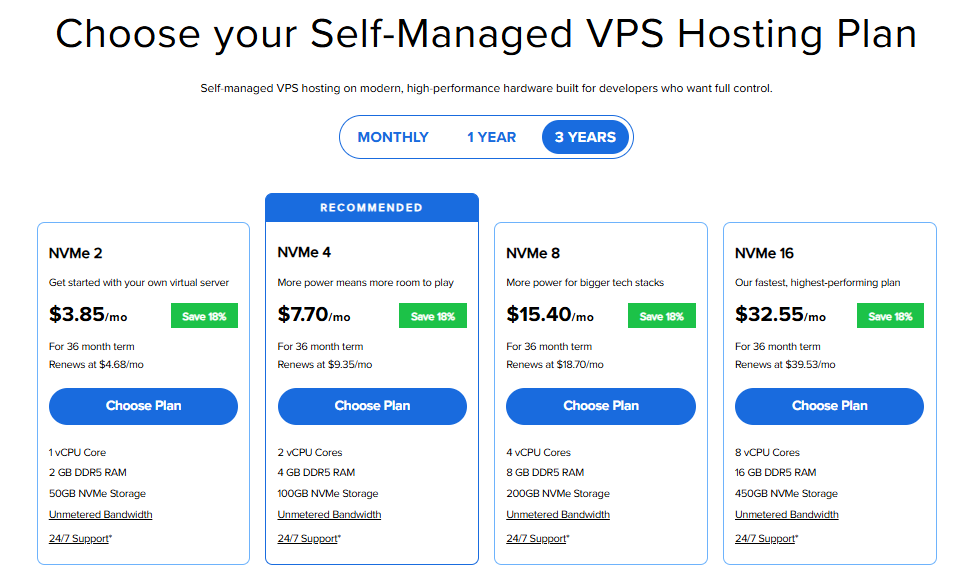
Important: Pricing is subject to change—please visit https://www.bluehost.com/vps-hosting for the current introductory/sign-up offer for Bluehost VPS Hosting. For the most up-to-date renewal pricing, visit your Bluehost Portal Renewal Center.
- Select your preferred Data Center location.

- On the Cart page, you can configure your server to fit your needs in the following section:
- Hardware:
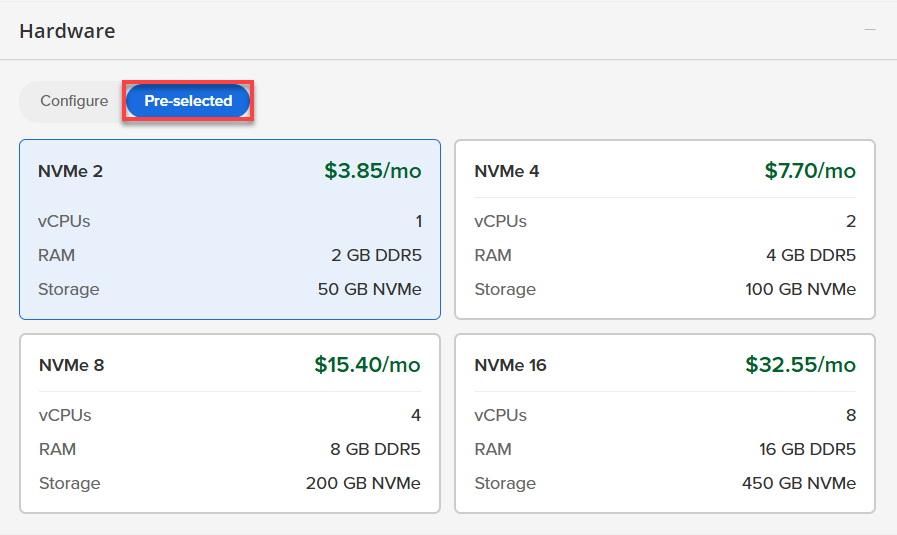
- Pre-selected:
You can select a different Self-Managed VPS plan in this section.
- Configure:
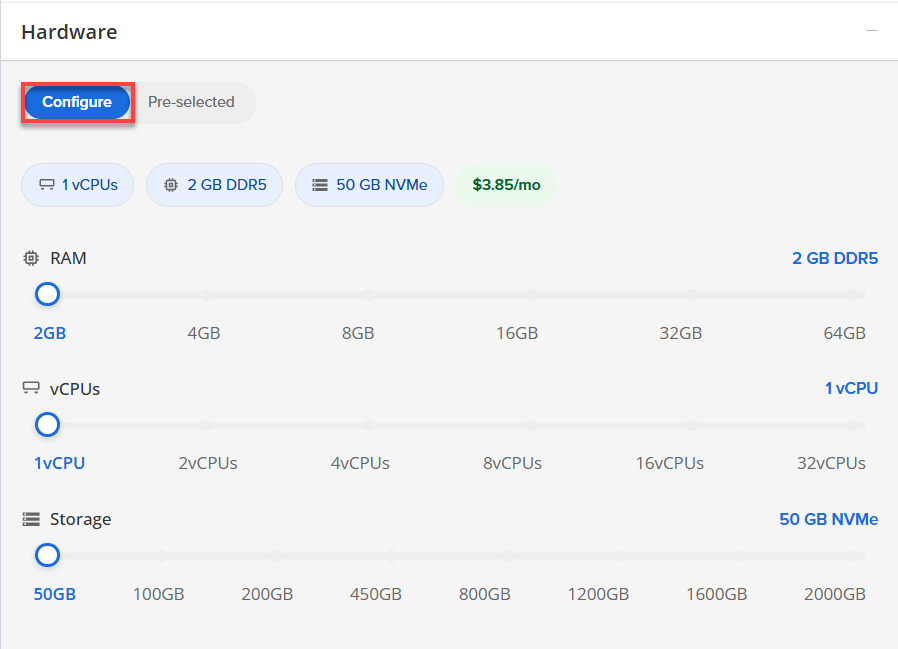
Click Configure to customize your package.
Note that your changes help customize your plan, and the overall cost will adjust accordingly to fit your needs.
- Pre-selected:
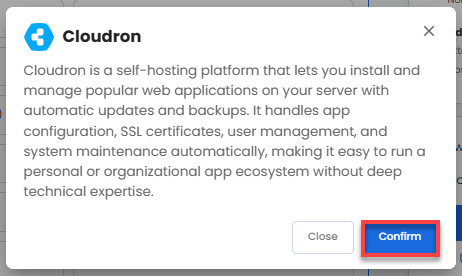
- Software:
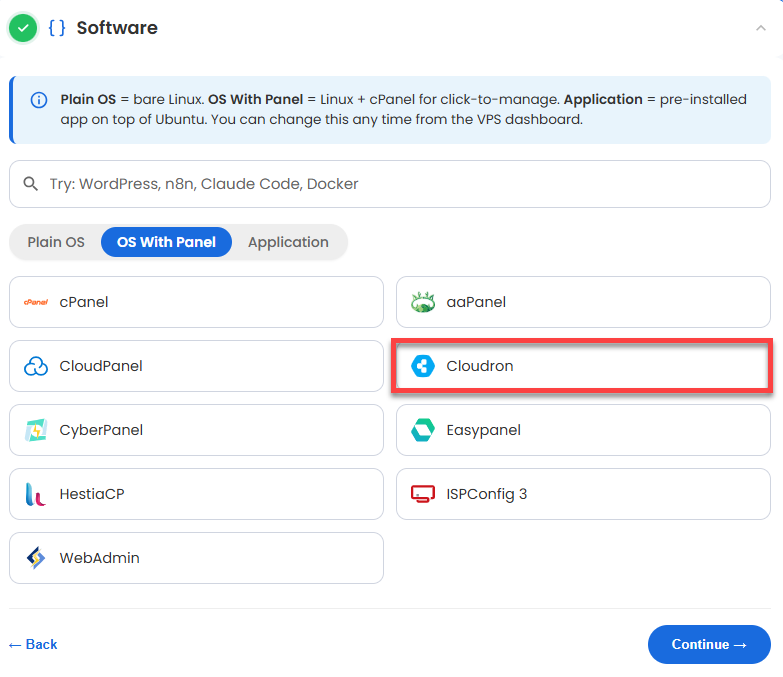
If the selected plan does not meet the app's minimum requirements, the app will be grayed out.
- Click on the OS With Panel.
- Choose Cloudron.
- Click Confirm to continue.
- Hardware:
- Add-Ons:
- Premium Support:
You can add Premium Support here, which gives you priority access to expert assistance and faster response times.

- Premium Support:
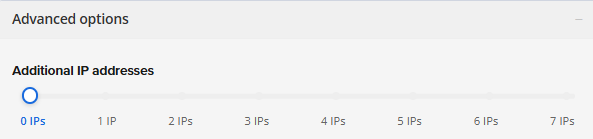
- In the Advanced options:
- Extra IP's: You can add extra IP addresses for an additional fee.
Pricing changes based on how many IPs you add. - Hostname: Assign a custom hostname to easily identify your server. This is optional.
- Extra IP's: You can add extra IP addresses for an additional fee.
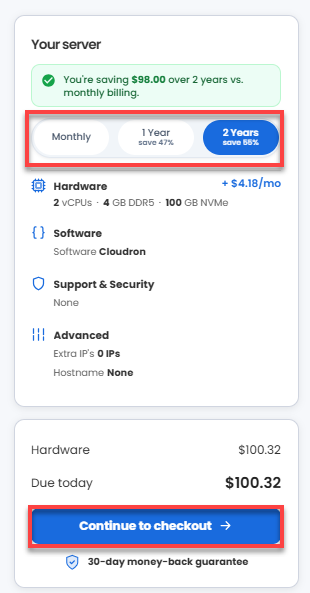
- Select your preferred billing term and view your Order Summary. Click the Continue to Checkout button to proceed.
- Do the following on the Checkout page:
If you're new with Bluehost:
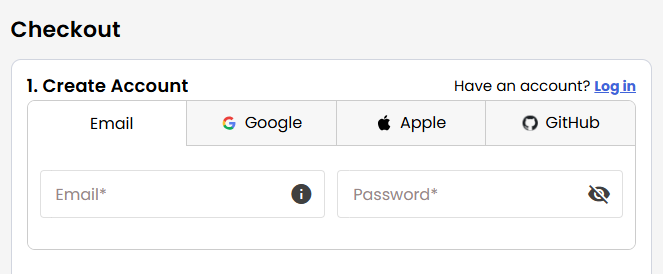
- Create your Bluehost account by using your email address or by connecting with your Google, Apple, or GitHub account — whichever you prefer!
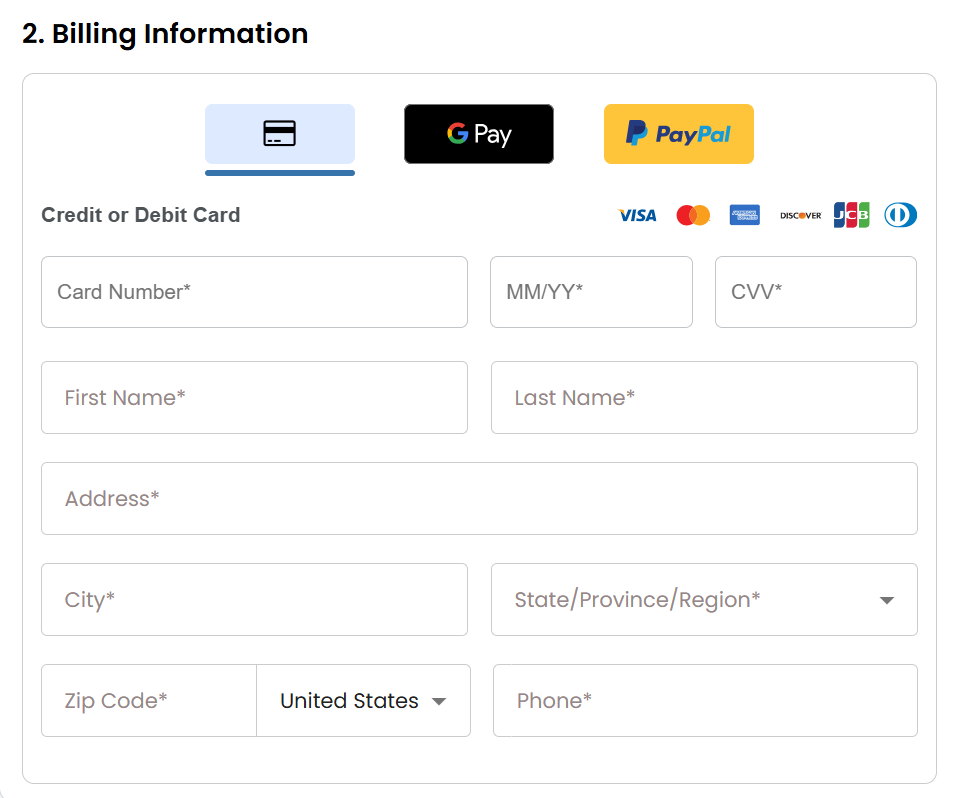
- Select your preferred payment method: credit card, Google Pay, or PayPal. Enter your billing information.
If you have an account with us, you will see your Bluehost login details when you are logged into your Bluehost Portal. If you are not logged in, please click the Log In link.
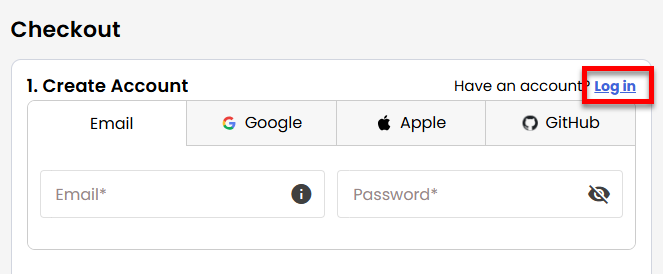
- Create your Bluehost account by using your email address or by connecting with your Google, Apple, or GitHub account — whichever you prefer!
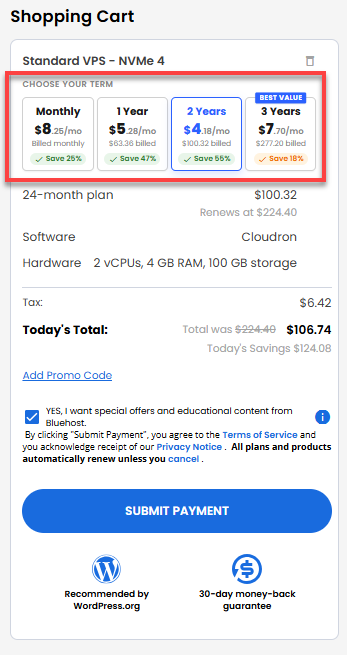
- In the Shopping Cart section, you can still adjust your billing term if needed.
- Review the items in your cart, add a Promo Code if you have one, and then click Submit Payment to complete the purchase.
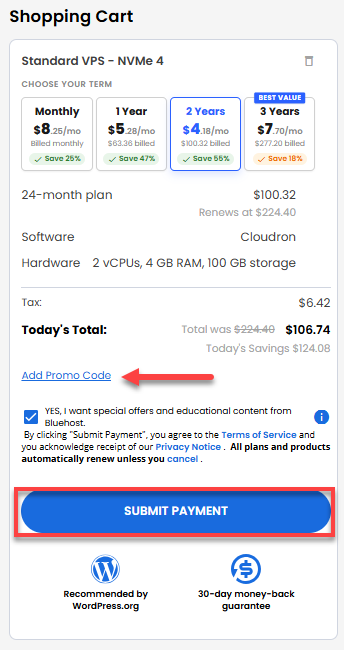
After completing the purchase, your VPS hosting will begin provisioning. You can access and manage your new VPS hosting in the Hosting tab of your Bluehost Portal.
How to Setup your Cloudron Server
Prerequisites:
- A domain name (e.g., yourdomain.com).
- An account with a supported DNS provider.
- An API Token from your DNS provider.
After installation completes:
- Log in to your Bluehost Portal.
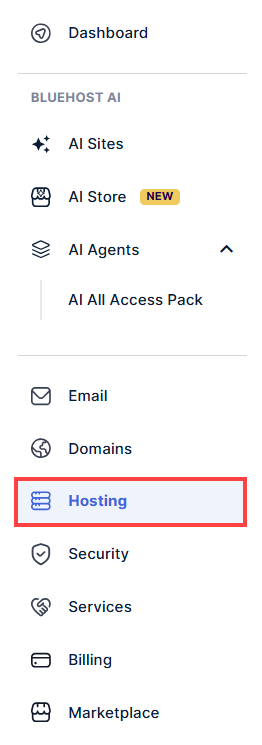
- In the left-hand menu, click the Hosting tab.
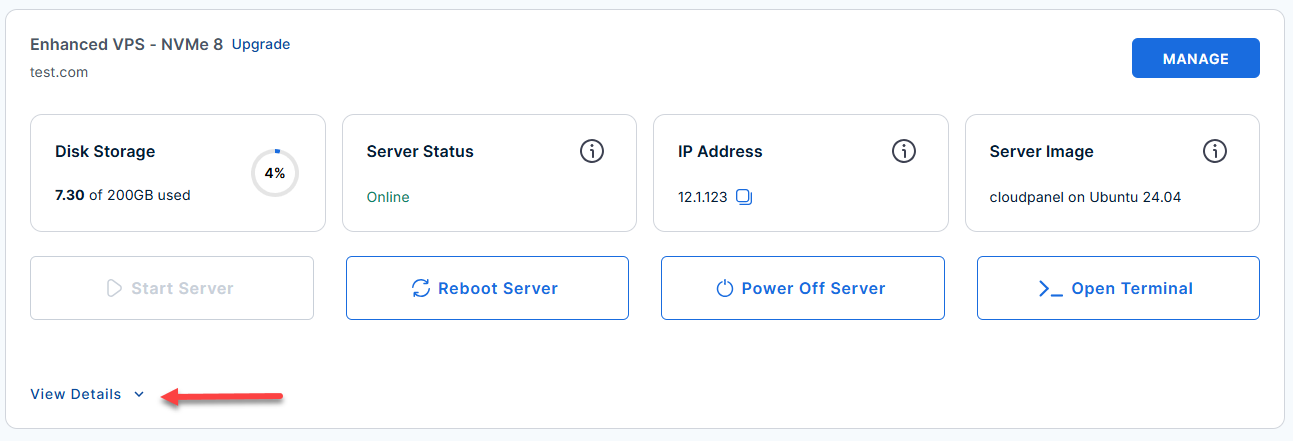
- Locate the server you want to manage, then click View Details in the bottom-left corner to expand the section and access additional server information.
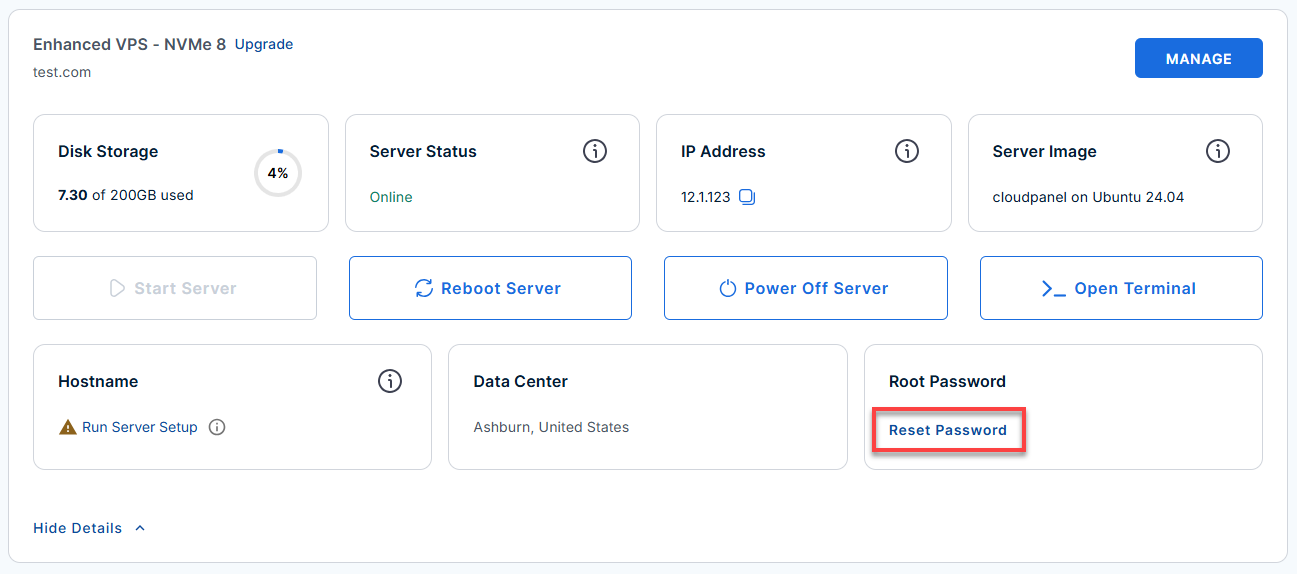
- Click the Reset Password.
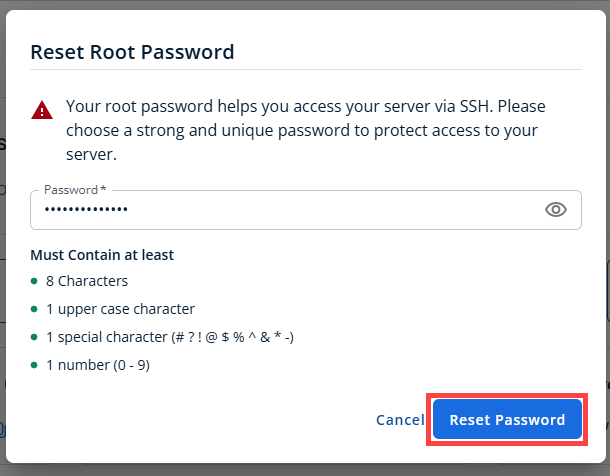
- In the pop-up window, type your new root password, then click Reset Password again to confirm and save the changes.
- Connect to your VPS via SSH.
Use your VPS IP and credentials with an SSH client, follow the prompts, and enter your root password when asked:Replaceyour_server_ipwith your actual server IP address.ssh root@your_server_ip - Server and Network Configuration
Example Output:cat /var/log/onboot.log
Last login: Sat Jun 20 20:54:21 2026 from 123.45.678.910 root@server-123456:~# cat /var/log/onboot.log [2026-06-20 20:41:18] Starting onboot script [2026-06-20 20:41:18] Disabled Cloudron MOTD: 92-cloudron [2026-06-20 20:41:18] Onboot script completed successfully root@server-123456:~# - Open Firewalls (Cloud Provider Specific)
Do NOT enable UFW (
ufw enable). Cloudron manages its own internal firewall using iptables. Enabling UFW will break its container networking.- If you are on AWS EC2: Go to your AWS Console → Security Groups, and ensure Ports 80 (HTTP) and 443 (HTTPS) are open to the world (0.0.0.0/0).
- If you are on Oracle Cloud: The script should handle this. If you can't reach the setup page shortly, force-open the OS firewall by running:
iptables -I INPUT -p tcp --dport 80 -j ACCEPT iptables -I INPUT -p tcp --dport 443 -j ACCEPT netfilter-persistent saveroot@server-123456:~# iptables -I INPUT -p tcp --dport 80 -j ACCEPT iptables -I INPUT -p tcp --dport 443 -j ACCEPT netfilter-persistent save run-parts: executing /usr/share/netfilter-persistent/plugins.d/15-ip4tables save run-parts: executing /usr/share/netfilter-persistent/plugins.d/25-ip6tables save root@server-123456:~# - Configure Your DNS Records
- Log into your DNS provider's dashboard and add two A Records pointing to your server's public IP:
Replace
your-server-public-ipwith your actual server IP address.Type Name Value / Points to TTL A @ your-server-public-ip Auto / 14400 A * your-server-public-ip Auto / 14400
- Log into your DNS provider's dashboard and add two A Records pointing to your server's public IP:
Access your Cloudron Dashboard
After the configuration completes:
- Log In via Your Browser:
Replace
your-server-ipwith your actual server IP address.https://your-server-ipImportant!- Make sure you use https:// and include the trailing slash after your panel path.
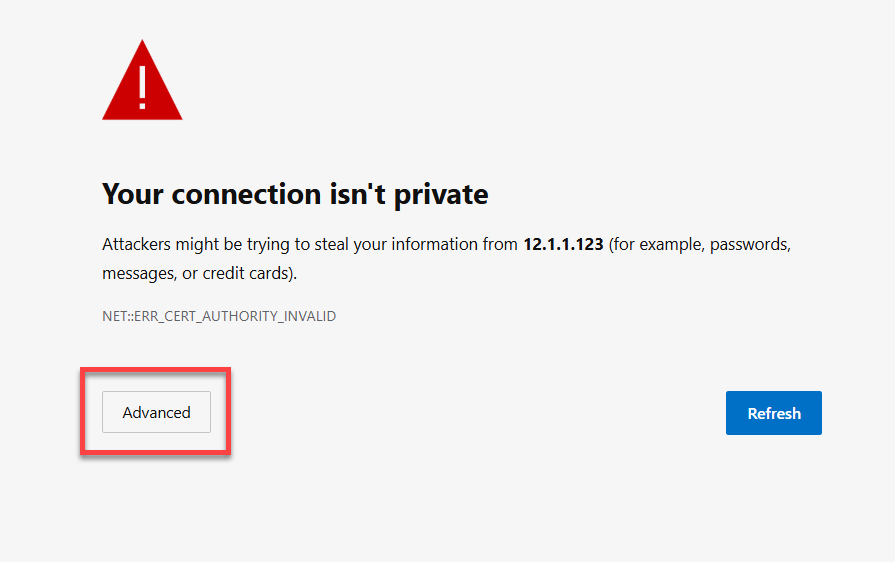
- Bypass the Browser Security Warning.
Cloudron uses a temporary self-signed SSL certificate, your browser will flag it. Click Advanced and then Proceed/Continue to bypass it safely.
- Link Your Domain & DNS API
On the setup screen, fill out the configuration form:
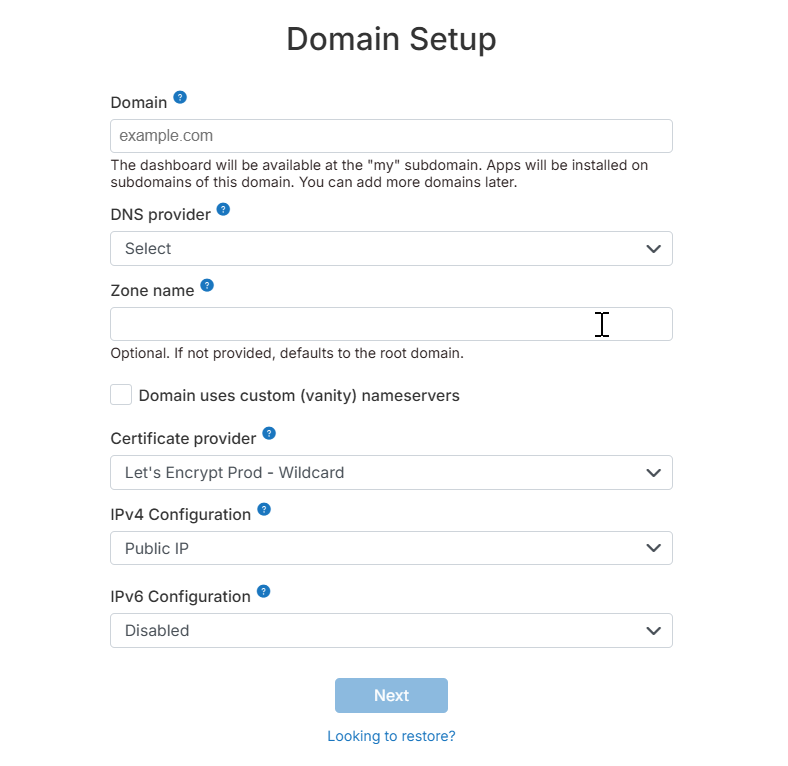
- Domain: Enter your root domain (e.g., yourdomain.com).
- DNS Provider: Select your provider from the dropdown.
- API Token: Paste the API key/token you generated during Phase 1.
- Certificate Provider: Leave it on Let's Encrypt Prod - Wildcard.
- IPv4 Configuration: Select Public IP.
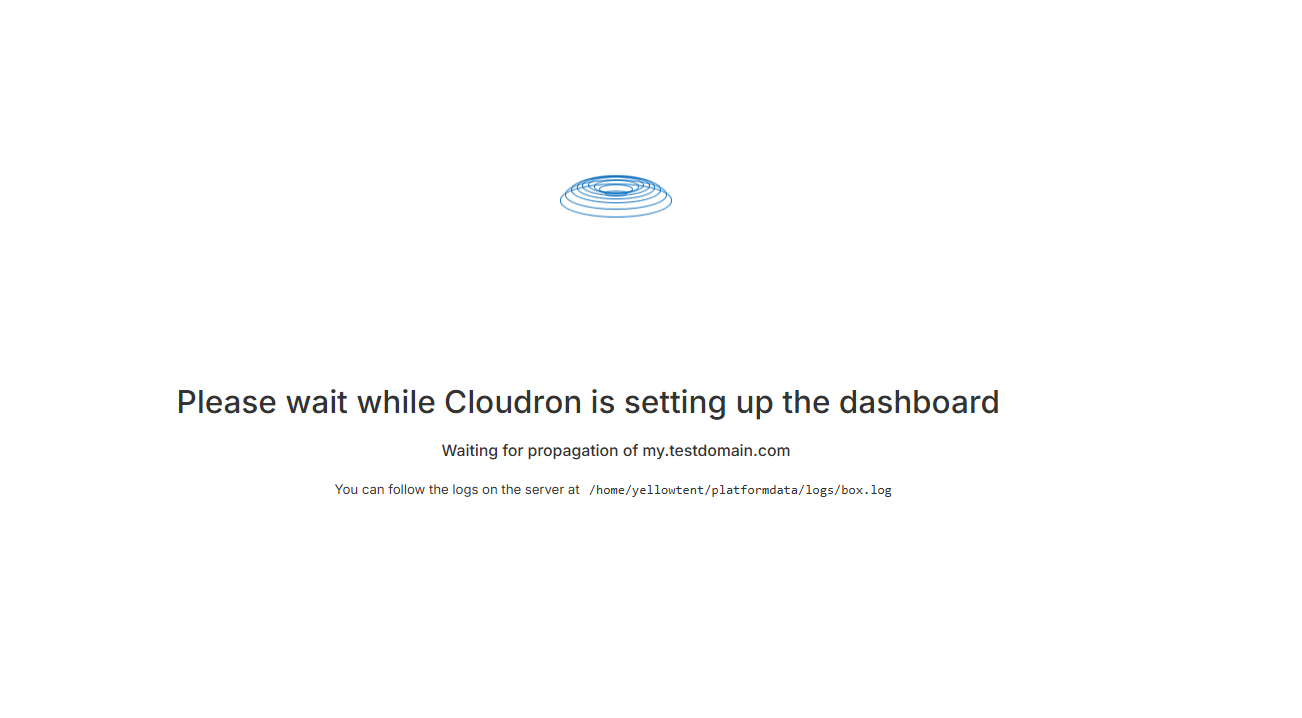
Once done, Cloudron will now automatically communicate with your DNS provider, create the necessary management subdomains, and provision an SSL certificate. This takes about 2–3 minutes.
- Create the Admin Account
Once the DNS validation succeeds, your browser will automatically redirect to a secure URL:
https://my.yourdomain.comFill out the final form to create your master admin account:
- Enter your Name, Username, and a strong Password.
- Enter a valid Email Address (Let’s Encrypt will send SSL expiration warnings here if anything ever fails to auto-renew).
Click Create admin.
- Verification
You are now logged into your Cloudron Dashboard!
- To Install Apps: Go to the built-in App Store, click an app (like WordPress or Nextcloud), and give it a subdomain. Cloudron handles the rest.
- Future Dashboard Access: You will always access your server administration portal at:
https://my.yourdomain.com
- If you ever need to check if the background system services are running happily via SSH, you can run:
Example Output:systemctl status box
    ● box.service - Box
         Loaded: loaded (/etc/systemd/system/box.service; enabled; preset: enabled)
         Active: active (running) since Sat 2026-06-20 20:41:16 UTC; 2h 13min ago
        Process: 2388 ExecReload=/bin/kill -HUP $MAINPID (code=exited, status=0/SUCCESS)
       Main PID: 1251 (MainThread)
          Tasks: 11 (limit: 2332)
         Memory: 196.1M (max: 400.0M available: 203.8M peak: 200.6M)
            CPU: 5.683s
         CGroup: /system.slice/box.service
                 └─1251 node /home/yellowtent/box/box.js

    Jun 20 20:41:20 server-123456.testingdomain.com sudo[1533]: pam_unix(sudo:session): session opened for user root(uid=0)>
    Jun 20 20:41:20 server-123456.testingdomain.com sudo[1533]: pam_unix(sudo:session): session closed for user root
    Jun 20 22:17:04 server-123456.testingdomain.com sudo[2380]: pam_unix(sudo:session): session opened for user root(uid=0)>
    Jun 20 22:17:04 server-123456.testingdomain.com sudo[2380]: pam_unix(sudo:session): session closed for user root
    Jun 20 22:17:04 server-123456.testingdomain.com sudo[2385]: pam_unix(sudo:session): session opened for user root(uid=0)>
    Jun 20 22:17:04 server-123456.testingdomain.com systemd[1]: Reloading box.service - Box...
    Jun 20 22:17:04 server-123456.testingdomain.com sudo[2385]: pam_unix(sudo:session): session closed for user root
    Jun 20 22:17:09 server-123456.testingdomain.com systemd[1]: Reloaded box.service - Box.
    Jun 20 22:31:21 server-123456.testingdomain.com sudo[2471]: pam_unix(sudo:session): session opened for user root(uid=0)>
    Jun 20 22:31:21 server-123456.testingdomain.com sudo[2471]: pam_unix(sudo:session): session closed for user root
Additional Information and Example Documentation Output
You can run cat /root/README.md to see more information and useful commands:
    root@server-123456:~# cat /root/README.md
    # Cloudron

    ## Description

    Cloudron is a self-hosting platform that lets you install and manage popular web applications on your server with automatic updates and backups. It handles app configuration, SSL certificates, user management, and system maintenance automatically, making it easy to run a personal or organizational app ecosystem without deep technical expertise.

    ## Before You Begin

    You will need the following before starting setup:

    1. **A registered domain name** (e.g. `mycompany.com`) -- purchase from
       Namecheap, GoDaddy, or Porkbun. Cheap `.xyz` or `.online` domains
       cost $1-2/year.
    2. **Wildcard DNS configured** -- create a wildcard `A` record pointing
       `*.yourdomain.com` -> your server's public IP. This is required for
       Cloudron to create subdomains for each app automatically.
    3. **A DNS provider API key** so Cloudron can automatically manage DNS
       records. Cloudflare is recommended (free). Point your domain nameservers
       to Cloudflare, then create an API token with Zone -> DNS -> Edit permissions.
    4. **An admin email address** -- used for Let's Encrypt SSL certificate
       provisioning. Use a valid email you have access to.

    > Cloudron requires a real domain because it automatically provisions
    > wildcard SSL certificates and creates subdomains for every app you install
    > (e.g. `wordpress.yourdomain.com`, `nextcloud.yourdomain.com`).
    > This cannot be bypassed in production use.

    ---

    ## Minimum Resources

    Cloudron requires more resources than a typical single-app image due to its
    container orchestration, Docker engine, and built-in services (nginx, MySQL,
    mail server, etc.).

    | Resource | Minimum |
    |----------|---------|
    | CPU      | 2 vCPUs |
    | RAM      | 3 GB    |
    | Disk     | 20 GB   |

    ---

    ## How to Use

    #### Step 1 -- Wait for First Boot to Complete

    After launching the instance, the first-boot script runs automatically in the
    background. It opens ports 80 and 443 via iptables and prepares the system for
    Cloudron setup. This takes about 2 minutes. You can verify it completed:

    ```bash
    cat /var/log/onboot.log
    ```

    #### Step 2 -- Point Your Domain to This Server

    Before opening the setup UI, add these DNS records at your DNS provider:
    ```
    Type: A  |  Name: *  |  Value: your-server-ip  |  TTL: Auto
    Type: A  |  Name: @  |  Value: your-server-ip  |  TTL: Auto
    ```
    The wildcard record is required -- Cloudron automatically creates a subdomain
    for every app you install (e.g. `wordpress.yourdomain.com`).

    #### Step 3 -- Open the Cloudron Setup UI

    Open your browser and go to:
    ```
    http://your-server-ip
    ```

    You will see the Cloudron first-time setup wizard. If the page does not load,
    wait another minute and try again.

    #### Step 4 -- Enter Your Domain and DNS Credentials

    Fill in the setup form:
    - **Domain** -- your registered domain (e.g. `mycompany.com`)
    - **DNS Provider** -- select your provider (Cloudflare recommended)
    - **API Token** -- your DNS provider API token
    - **Certificate provider** -- leave as `Let's Encrypt Prod - Wildcard`
    - **IPv4 Configuration** -- leave as `Public IP`

    Click **Next**. Cloudron will create the required DNS records and provision
    a wildcard SSL certificate automatically. This may take 2-3 minutes.

    #### Step 5 -- Create Your Admin Account

    Once DNS and SSL are configured, Cloudron redirects you to
    `https://my.yourdomain.com`. Fill in your name, email, username, and
    password, then click **Create admin** to access your dashboard.

    > Use a real email address -- Let's Encrypt sends certificate renewal
    > notices to this address.

    ---

    ### Oracle Cloud Deployment

    Oracle Cloud has an additional OS-level firewall that blocks ports 80 and 443
    even after opening them in the Security List. This image handles this
    automatically on first boot -- no manual iptables commands are needed.

    If ports are still blocked after booting, SSH in and run:

    ```bash
    iptables -I INPUT -p tcp --dport 80 -j ACCEPT
    iptables -I INPUT -p tcp --dport 443 -j ACCEPT
    netfilter-persistent save
    ```

    Then follow Steps 2-5 above.

    ---

    ### AWS EC2 Deployment

    #### Step 1 -- Open Security Group Ports

    Open these ports in your EC2 Security Group before accessing the setup page:

    | Port | Protocol | Source    | Purpose                    |
    |------|----------|-----------|----------------------------|
    | 22   | TCP      | Your IP   | SSH access                 |
    | 80   | TCP      | 0.0.0.0/0 | Cloudron setup UI + HTTP   |
    | 443  | TCP      | 0.0.0.0/0 | HTTPS for apps + dashboard |

    **Steps:**
    1. Go to EC2 -> Instances -> select your instance -> Security tab
    2. Click the Security Group link -> Edit inbound rules
    3. Add HTTP (port 80) and HTTPS (port 443) with source Anywhere (0.0.0.0/0)
    4. Save rules

    ## Accessing the Dashboard

    Cloudron has no default username or password. Your admin credentials are
    created by you during the first-boot setup wizard (Step 5 above). If you
    have not completed setup yet, open `http://your-server-ip` to begin.

    After setup, your Cloudron dashboard is always at:
    ```
    https://my.yourdomain.com
    ```

    Each app you install gets its own subdomain automatically:
    - WordPress -> `https://wordpress.yourdomain.com`
    - Nextcloud -> `https://nextcloud.yourdomain.com`
    - Gitea -> `https://git.yourdomain.com`

    Cloudron acts as an OAuth/OIDC provider -- once logged into the dashboard,
    you are automatically signed into all hosted apps.

    ---

    ## DNS Provider API Keys

    | Provider     | How to get credentials                               |
    |--------------|------------------------------------------------------|
    | Cloudflare   | My Profile -> API Tokens -> Create Token (Zone:Edit)  |
    | AWS Route 53 | IAM -> Users -> Create Access Key + Secret Key         |
    | GoDaddy      | developer.godaddy.com -> API Keys                    |
    | Namecheap    | Profile -> Tools -> API Access                        |
    | DigitalOcean | API -> Generate New Token                            |

    Full list: [DNS Provider docs](https://docs.cloudron.io/domains/#dns-providers)

    ---

    ## Services

    | Service  | Ports   | Purpose                                      |
    |----------|---------|----------------------------------------------|
    | Cloudron | 80, 443 | Setup UI, dashboard, and hosted applications |
    | OpenSSH  | 22      | Remote SSH access                            |

    > Do NOT enable UFW -- Cloudron manages its own firewall via iptables.
    > Enabling UFW will conflict with Cloudron's internal port management.

    ---

    ## Image Contents

    - Cloudron 8+ (currently 9.1.6, installed via official installer)
    - Docker CE (latest stable, upgraded post-install)
    - Ubuntu 24.04 with all security patches applied at build time

    > Cloudron bundles and manages its own versions of nginx and Node.js
    > internally. These are updated via Cloudron's own update mechanism.

    ---

    ## Known Limitations

    - Remaining Trivy vulnerabilities are in Cloudron's bundled Node.js
      dependencies and Docker CE binaries compiled with Go stdlib. These are
      managed by Cloudron and Docker upstream respectively and will be resolved
      in their future releases.
    - Cloudron requires a real domain name -- it cannot be accessed via IP
      address alone in production use.

    ---

    ## Validation Tests

    ```bash
    perl /root/app_test/main.t
    ```

    Runs 11 checks: `box.service` enabled and unit file present, first-boot script
    executable, logrotate config present, log directory exists, README copied to
    `/root/README.md`, MOTD executable, Docker binary and service available, port 80
    listening, and Cloudron box service active.

    ## Useful Commands (via SSH)

    ```bash
    # Check Cloudron status
    systemctl status box

    # Restart Cloudron
    systemctl restart box

    # View Cloudron logs
    journalctl -u box -n 100 --no-pager

    # View first-boot log
    cat /var/log/onboot.log
    ```

    ---

    ## Links

    **Cloudron**

    * Home: [cloudron.io](https://www.cloudron.io/)
    * Documentation: [docs.cloudron.io](https://docs.cloudron.io/)
    * App Store: [Cloudron App Store](https://www.cloudron.io/store/)
    * DNS Providers: [Supported DNS Providers](https://docs.cloudron.io/domains/#dns-providers)
    * Community Forum: [forum.cloudron.io](https://forum.cloudron.io/)
    root@server-123456:~#
Summary
With Cloudron, you will be able to leverage everything that comes with a secure and customizable server environment offered by Bluehost through the Self-Managed VPS Hosting. Here, you can benefit from enhanced data management, workflow integration, and many more benefits associated with Cloudron. With this tutorial, you will be all set to create your VPS and make the most of Cloudron.