 ChatGPT,
 Claude,
 Gemini,
 Grok — all four for

Key highlights
- Understand domain squatting and its legal protections through ICANN’s UDRP and the Anticybersquatting Consumer Protection Act frameworks in 2026.
- Explore real-world domain squatting cases involving major brands and understand the legal and practical steps they used to recover squatted domains and protect their trademarks.
- Recognize common domain squatting tactics and scams, including typosquatting and brand impersonation schemes.
- Discover practical brand protection steps, such as securing domain variations, enabling renewals and monitoring domains to reduce the risk of domain squatting.
You finally lock in a domain name that feels right for your brand. It matches your business, your emails and your website. Then one day, you notice something odd. A domain that looks almost the same as yours is live. Same name, small tweak. Maybe a missing letter. Maybe a different extension.
Sometimes it’s just parked with ads. Other times, it’s actively pretending to be you. This is domain squatting and in 2026, it’s not some rare edge case anymore. It’s something businesses run into far more often than they expect.
The tricky part is that not every similar domain is automatically illegal and not every case ends the same way. That’s why understanding what domain squatting actually means today, In this guide, we’ll break down what domain squatting is in 2026, the legal implications behind it and the practical steps you can take to protect your domain before it becomes someone else’s leverage.
What is domain squatting in 2026?
Domain squatting in 2026 refers to the practice of registering, holding or using domain names that closely resemble an existing brand, business or trademark, usually with the intent to profit from confusion. The person registering the domain typically has no real connection to the brand and no genuine plan to build something legitimate on it.
What’s changed over the years is how deliberate this practice has become. Domain squatters actively watch new business launches, expiring domains and trademark filings, then move fast once they spot an opportunity. Similar domain names can now be registered in bulk within minutes, which makes early brand protection is more important than ever.
In many cases, a squatted domain isn’t meant to host a real website at all. Instead, it’s commonly used to:
- Sell the domain back at an inflated price
- Divert traffic to ads, competitors or unrelated sites
- Impersonate a brand for phishing or scam activity
Domain squatting is widely considered unethical and, in many cases, illegal. Laws such as the Anticybersquatting Consumer Protection Act (ACPA) in the U.S. and ICANN’s Uniform Domain-Name Dispute-Resolution Policy (UDRP) provide legal recourse for businesses and individuals affected by it.
How domain squatting works today?
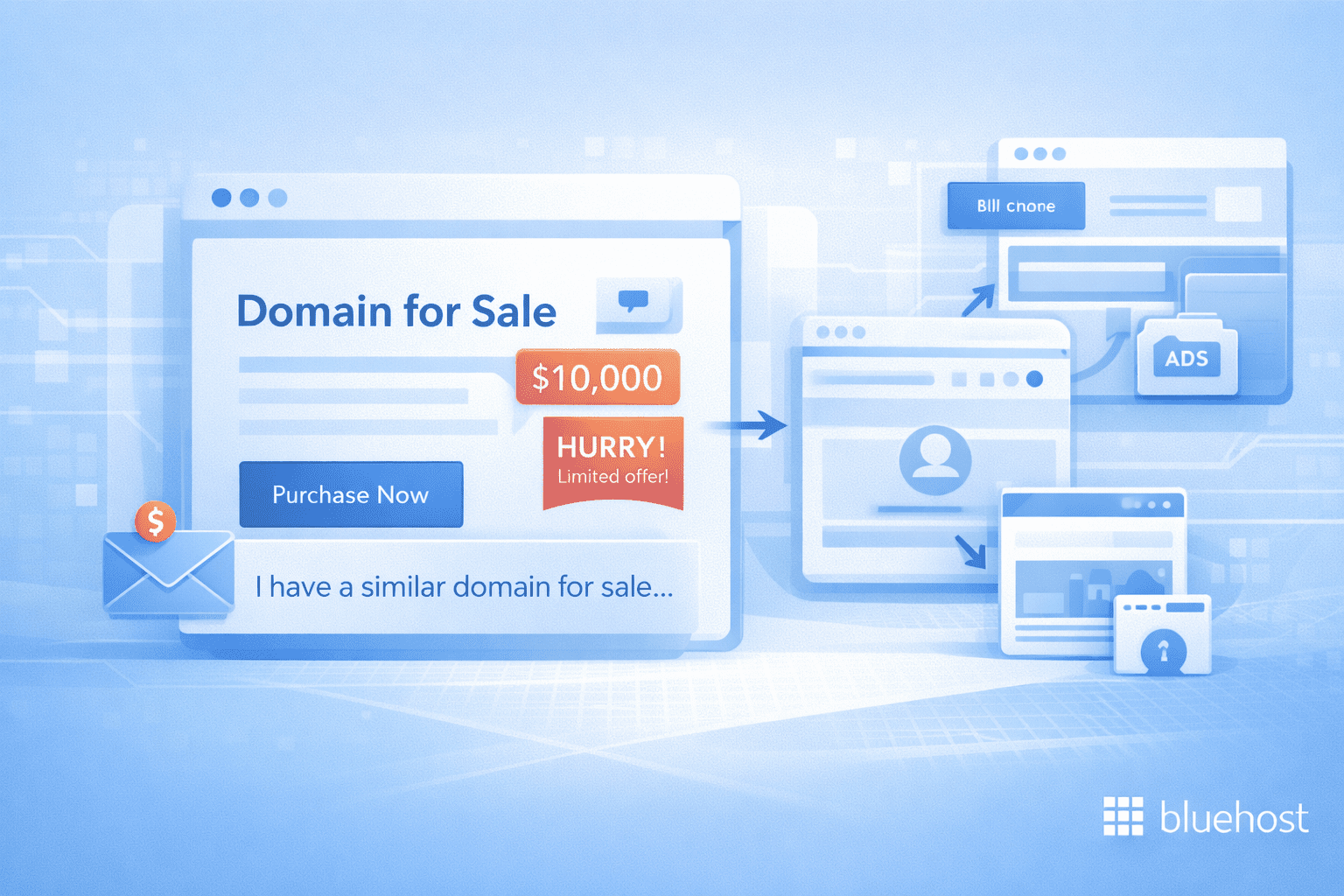
Domain squatting typically follows a predictable pattern. Squatters first identify potential targets by monitoring trending terms, tracking expiring domains or researching established brands without strong domain protection. They may use automated tools to scan for valuable domain names that are about to expire or spot emerging businesses that haven’t secured all relevant domain variations.
Once a target is identified, squatters quickly register confusingly similar domain names. This might include common typos like [yourband].com instead of [yourbrand].com, adding extra words like [yourbrand]online.com or using different extensions such as [yourbrand].net or [yourbrand].biz. These variations are designed to capture traffic from users who mistype your domain or aren’t sure of the correct extension.
After registration, squatters typically set up simple “for sale” landing pages or redirect traffic to generate revenue. They monetize these domains through several methods: selling the domain back to you at an inflated price, displaying advertisements to earn click revenue, using affiliate redirects to earn commissions or in worst cases, running phishing schemes to steal user data.
Warning signs you’re encountering a squatted domain:
- Generic “domain for sale” parked page with minimal content
- Inflated asking price with urgent purchase pressure
- Copycat website design that mimics your legitimate site
- Suspicious emails offering to sell you a domain similar to yours
- Redirects to competitor sites or unrelated advertisements
Types of domain squatting businesses should watch for
Domain squatting manifests in several distinct forms, each targeting different vulnerabilities in your online presence.
- Typo squatting: This targets simple typing mistakes. Squatters register domains with missing letters, extra characters or slight spelling errors, knowing users often type URLs from memory. These domains are commonly used for ads, redirects or, in more serious cases, data collection scams.
- Combo squatting: Combo squatting adds everyday words to a brand name to make the domain look useful or official. Domains with terms like “login,” “support,” “shop” or “deals” can easily mislead users into trusting them, which makes this tactic popular for fake support pages and scam promotions.
- TLD squatting: This happens when a squatter registers the same brand name under different domain extensions while the business only owns one. If users guess the wrong extension, they may end up on a squatted site without realizing it, slowly draining traffic and credibility.
- Domain hijacking: It targets expired domains or exploits transfer vulnerabilities, allowing squatters to claim ownership when renewal lapses. This results in immediate loss of web presence, email and years of SEO equity. Enable automatic renewal and lock your domain registration.
- Brand impersonation: This is the most harmful type. These domains are designed to look and feel like the real brand, often copying layouts, logos and messaging. They’re commonly used in phishing emails, fake login pages and payment scams, putting customers directly at risk.
Also read: Secure Your Domain 2026: Protection Tips & Best Practices
What are the legal consequences of domain squatting?
Domain squatting is considered illegal, especially when performed with a bad faith intent. The unethical practice can lead to severe legal consequences. Several countries have laws to protect a domain owner from malicious actors who register domain names with malicious intent. Legal actions against domain squatters typically involve proving bad faith registration and seeking ownership transfer or financial damages.
The key legal frameworks governing domain squatting include:
- Uniform Domain-Name Dispute-Resolution Policy by ICANN
- Anticybersquatting Consumer Protection Act in the USA
ICANN’s Uniform Domain-Name Dispute-Resolution Policy (UDRP)
The Uniform Domain-Name Dispute-Resolution Policy (UDRP) is a global process created by the Internet Corporation for Assigned Names and Numbers (ICANN) to handle domain name disputes involving trademark abuse. It applies to most generic top-level domains (gTLDs) like .com, .net and .org, as well as many country-code domains that have adopted the policy.
UDRP exists to address cases where a domain name has been registered in bad faith and unfairly targets an existing trademark. Instead of going through a full court case, trademark owners can file a complaint through an approved arbitration provider such as the World Intellectual Property Organization (WIPO).
To succeed in a UDRP complaint, the trademark owner must prove all three of the following:
- The domain name is identical or confusingly similar to a trademark or service mark the complainant owns
- The registrant has no legitimate rights or interests in the domain name (for example, they are not commonly known by it and are not using it for a genuine business)
- The domain was registered and is being used in bad faith, such as for resale at a high price, misleading users, impersonating a brand or disrupting a competitor’s business
These criteria are strict. If even one of them cannot be proven, the complaint will fail.
If a UDRP complaint is successful, the panel may order one of two outcomes:
- Transfer of the domain name to the trademark owner
- Cancellation of the domain name
UDRP does not award financial damages. Its purpose is to resolve ownership disputes, not to punish the registrant financially.
One reason UDRP is widely used is speed. Most cases are resolved within 60 to 75 days, according to WIPO case statistics, making it significantly faster than traditional litigation.
Anticybersquatting Consumer Protection Act in the USA
The Anticybersquatting Consumer Protection Act (ACPA) is a U.S. federal law enacted in 1999 to address domain squatting that targets trademarks with bad faith intent. Unlike UDRP, which is an arbitration process, ACPA allows trademark owners to take disputes to court.
ACPA applies when someone registers, traffics in or uses a domain name that is identical or confusingly similar to a distinctive or famous trademark, with the intent to profit from it. The U.S. Trademark law 15 U.S. Code § 1125(d) is enforced when domain squatting causes serious commercial harm or when arbitration isn’t enough.
To succeed under ACPA, a trademark owner must generally prove:
- They own a valid trademark that was distinctive or famous at the time the domain was registered
- The domain name is identical or confusingly similar to that trademark
- The registrant acted with bad faith intent to profit from the trademark
Courts look at several factors to determine bad faith, including whether the registrant has any legitimate use for the domain, whether they’ve registered similar trademark-based domains before and whether the domain was offered for sale to the trademark owner at an unreasonable price.
(Source: ACPA Bad Faith Factors – https://www.law.cornell.edu/uscode/text/15/1125)
One key difference between ACPA and UDRP is the potential outcome. Under ACPA, courts can order:
- Transfer or cancellation of the domain name
- Statutory damages of up to $100,000 per domain name
- Injunctions to prevent further misuse
Because of the possibility of financial penalties, ACPA is usually reserved for more serious cases such as repeated squatting, large-scale impersonation or situations involving fraud, phishing or consumer harm.
ACPA cases also tend to take longer than UDRP proceedings. Lawsuits can stretch over months or even years, depending on complexity, jurisdiction and whether the defendant contests the claim. For that reason, many businesses start with UDRP and turn to ACPA only when arbitration doesn’t resolve the issue or when damages matter.
Domain squatting cases and legal precedents
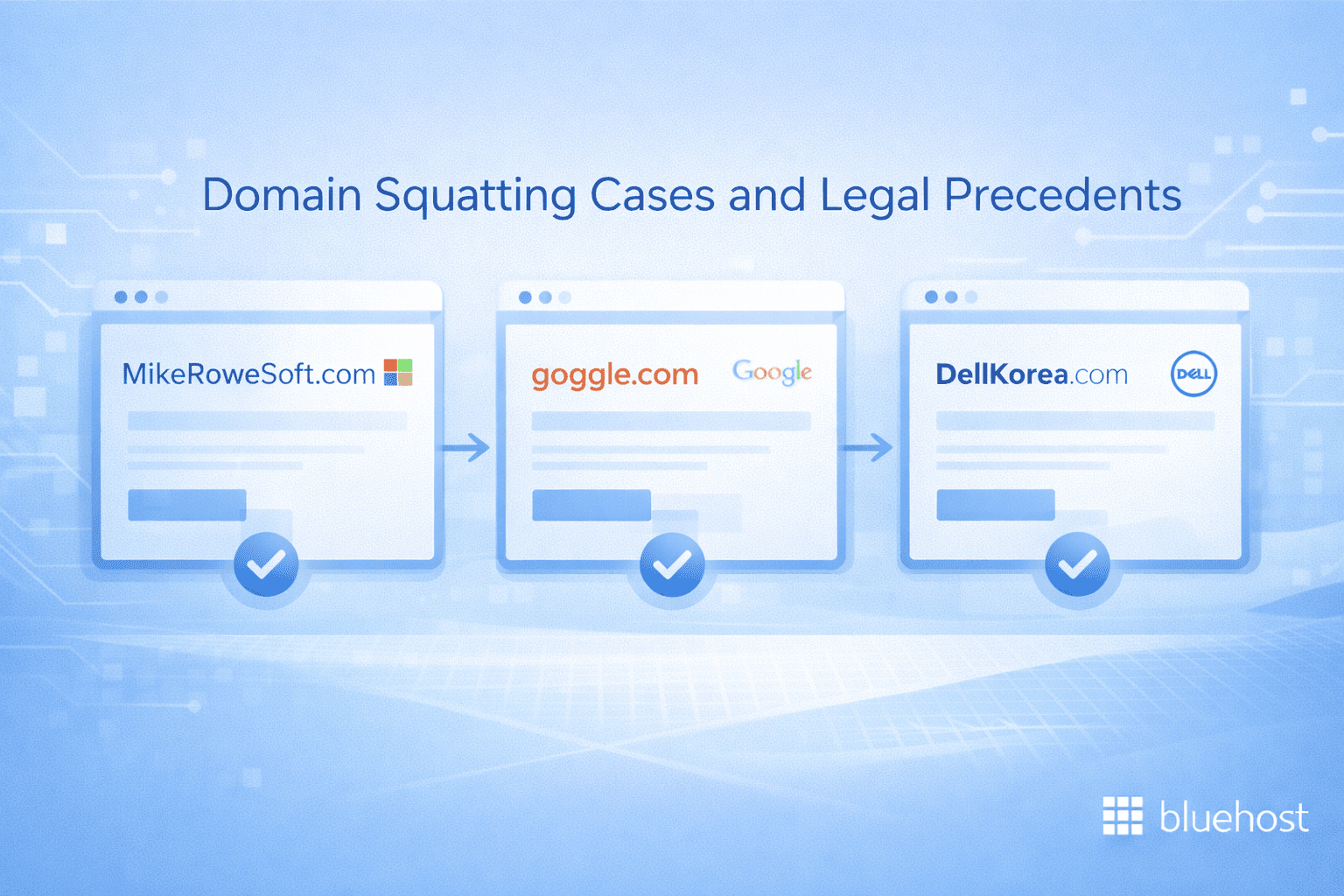
Real-world cases show how domain squatting is evaluated in practice and where courts and arbitration panels draw the line between clever naming and trademark abuse.
1. Microsoft (MikeRoweSoft.com)
One of the earliest and most talked-about cases involved a Canadian teenager who registered MikeRoweSoft.com, a phonetic play on “Microsoft.” While the registrant argued it was his personal name, Microsoft claimed the domain was confusingly similar to its trademark and could mislead users. The dispute was resolved outside of court and the domain was transferred to Microsoft.
(Case reference: https://en.wikipedia.org/wiki/Microsoft_v._MikeRoweSoft)
Why it matters: Even when a domain is based on a real name or wordplay, it can still be considered infringing if it creates confusion with a well-known trademark.
2. Google (goggle.com)
The domain goggle.com was a typo variation of Google’s primary domain. Instead of being harmless, the site distributed malware and exploited users who mistyped the URL. Because the domain clearly targeted user confusion and caused harm, Google successfully reclaimed it.
(Background reference: https://malware-history.fandom.com/wiki/SpySheriff)
Why it matters: Typo squatting tied to malware or scams strengthens claims of bad faith and accelerates enforcement under both UDRP and national laws.
3. Dell (DellKorea.com)
In this case, a third party registered DellKorea.com, suggesting an official regional presence of Dell in South Korea. Dell challenged the registration, arguing trademark infringement and consumer deception. The U.S. District Court ruled in Dell’s favor, ordering the domain to be transferred.
(Case coverage: https://www.cnet.com/tech/tech-industry/dell-wins-case-against-cybersquatter/)
Why it matters: Adding geographic terms to a trademark does not make a domain legitimate. Courts often view this as an attempt to impersonate an official brand entity.
Risks of domain squatting for businesses and individuals
There can be severe consequences for businesses and individuals, leading to financial losses, reputational harm and security threats. When someone registers an internet domain name similar to a legitimate business or personal brand, it can mislead customers, erode trust and even expose users to cyber threats.
1. Damages brand reputation
A squatted domain can mislead customers into believing they are interacting with a legitimate business, only to find themselves on a fraudulent or wrong website. This can lead to:
- Customer confusion – Visitors may mistake the fake site for the official one, damaging trust in the brand.
- Negative associations – If the squatter uses the domain for scams, counterfeit sales or explicit content, it can harm the company’s public image.
- Lost credibility – A business may appear negligent for not securing relevant domain names, leading to doubts about its professionalism.
2. Potential financial losses
Domain squatting can lead to direct and indirect financial damages, including:
- High buyback costs – Businesses may be forced to purchase their domain back at an inflated price.
- Lost revenue – If customers mistakenly visit the squatted domain instead of the official site, businesses can lose sales opportunities.
- Legal expenses – Taking legal action against domain squatters through UDRP or ACPA lawsuits can be costly.
3. Security threats
Some domain squatters are involved in malicious activities, leading to significant cybersecurity risks:
- Phishing attacks – Fraudulent websites can mimic real brands to steal login credentials, payment details or personal information of the brand.
- Malware distribution – Some squatted domains may distribute viruses or malicious software.
- Data breaches – If customers unknowingly provide sensitive information on a fake site, it could lead to identity theft or financial fraud.
Also read: WHOIS Domain Lookup for Agencies: Master Registration & Security
How to protect your brand from domain squatting
You don’t need a complicated strategy to protect your domain. Most issues with domain squatting happen because a few basic steps were missed early on. Taking care of these upfront usually helps reduce problems later.
1. Register key domain variations early
Once you settle on a brand name, it helps to secure the obvious variations right away. Common spelling mistakes, missing letters or extra characters are often the first ones squatters go after. You may never actively use these domains and that’s fine. Owning them early simply reduces the chances of someone else using them against your brand.
Before registering anything, it also helps to check what’s actually available. Bluehost’s AI domain name generator helps explore availability and generate alternative name ideas early. This makes it easier to spot gaps early, instead of finding out later that a close alternative has already been taken.
2. Secure multiple TLDs
Relying on just one domain extension can create confusion. Many users type what feels right rather than checking the exact extension. If you only own one version, it leaves room for someone else to register the rest. Securing a few common extensions and any relevant country domains helps keep traffic directed to the right place.
In some cases, you may find that a key domain variation or extension is already taken. When that happens, Bluehost’s premium domains are worth exploring. Premium domains are typically short, memorable names that have already been registered but are available for purchase, often making them a practical way to secure a strong alternative or close match when the standard version is no longer available.
Securing a few common extensions, along with any relevant country domains, helps keep traffic pointed in the right direction and reduces the chances of users ending up on the wrong site.
Also read: Top-Level Domain Extensions 2026: Complete TLD Guide
3. Enable auto-renewal and domain locking
Missed renewals are one of the most common reasons brands lose control of a domain. Auto-renewal helps make sure your domain does not expire quietly in the background.
Domain locking adds another layer of protection by restricting unauthorized transfers or changes. It is a simple setting, but it helps prevent avoidable issues that can quickly turn into much bigger problems.
Bluehost also offers Domain Privacy to keep your personal domain information out of public WHOIS records. This reduces unwanted exposure and reduces public exposure of your contact details, which can lower unwanted outreach and targeting. All of these settings are managed directly from your Bluehost account, so once they are enabled, they work quietly without requiring constant attention.
4. Monitor domains and trademarks
Spotting domain squatting early makes a real difference. When similar domains are caught soon after registration, it is usually easier to address the issue before it starts affecting traffic, customers or email.
Bluehost offers Domain Protection to help safeguard your domain ownership and reduce common risks associated with expiration and exposure. This makes it easier to stay aware of potential look-alike registrations and act before they turn into a larger problem.
Protecting your brand from domain squatting is mostly about staying organized and proactive. With registration, renewals and protection settings managed together, Bluehost helps reduce risk without adding extra complexity as your business grows.
Also read: Why Domain Privacy Protection is Essential for Website Security
Why choose Bluehost for domain protection?
Bluehost is a long-standing domain and hosting provider that millions of website owners rely on to manage their online presence. It is also one of the few hosting companies officially recommended by WordPress.org. That recommendation, along with its large user base, gives Bluehost a level of credibility many businesses look for when choosing where to register and protect their domain.
Protecting your domain is not about one feature. It is about having the basics handled well, in one place, without gaps that squatters can take advantage of. Bluehost focuses on making domain protection practical and manageable, especially as your business grows.
Here is how we offer continuous support:
- Registration with multiple domain extensions: Bluehost allows you to secure multiple variations of your domain name, including generic, country-specific and niche-specific extensions.
- Privacy protection: Bluehost’s Domain Privacy + Protection helps keep your personal or business contact details out of public WHOIS records, which can reduce spam and unwanted outreach. By limiting public exposure, it also reduces the chances of bad actors identifying your domain as an easy target. Bluehost also provides a WHOIS lookup tool that lets you check domain availability and view ownership details when a domain is already registered. This makes it easier to spot similar domains early and decide whether further action is needed.
- Automatic domain renewal: Expired domains are a common target for domain squatters. Bluehost offers automatic domain renewal to help prevent accidental expiration and maintain continuous ownership of your domain. This reduces the risk of losing a domain due to missed reminders or payment issues.
- Advanced DNS management: Bluehost’s DNS management guide allows you to have full control over how your domain is linked to your website, email and other online services. DNS management gives you visibility and control over how your domain connects to services, while domain locks and account security prevent unauthorized changes.
By choosing Bluehost domain, you’re not just registering a domain. You’re setting up the core protections that help keep your brand name under your control, reduce the risk of domain squatting and make ongoing domain management easier as your business grows. With registration, renewals, privacy and DNS settings handled in one place, it becomes simpler to stay organized and avoid gaps that can lead to bigger problems later.
Final thoughts
Domain squatting is a serious issue as it can rapidly tarnish your brand’s reputation. There can be legal consequences of domain squatting. However, you don’t have to be a victim of domain squatting. By following preventative measures, you can protect yourself from the domain and cybersquatters.
A proactive method to protect your domain and brand reputation is to secure your domain name with a trusted provider like Bluehost. We provide secure domain registration, privacy protection, automatic renewal and advanced DNS management for your company’s safety.
Secure your domain early and manage everything in one place with Bluehost Domains.
FAQs
Domain squatting and cybersquatting are often used interchangeably, but they have a key difference. Domain squatting refers to registering a domain name without intending to use it, often to sell it at a higher price later. Cybersquatting specifically targets trademarked names, with the intent to profit from or harm the rightful owner.
Yes, domain squatting can be illegal in the United States under ACPA. If a person registers a domain to profit from someone else’s trademark, the rightful owner can take legal action.
You can check if someone is squatting on a domain similar to yours by using domain lookup tools like Bluehost’s domain search to check for similar domains. You can also use WHOIS lookup tools to find out who owns the domain and whether they have a legitimate reason for registering it. Services like domain monitoring tools alert you if someone registers a name resembling yours.
There are several legal consequences of domain squatting and trademark infringement through which you can reclaim it. You can file a UDRP complaint, take legal action under ACPA, negotiate with the owner or use domain backordering services. If the squatted domain expires, services like Bluehost’s domain registration can help you secure it before anyone else.
You can’t prevent domain squatting entirely, but you can significantly reduce your risk. Think of it less as total prevention and more as layering protections that make your brand a harder target.

Write A Comment