 ChatGPT,
 Claude,
 Gemini,
 Grok — all four for
Key highlights
- Understand what is SEO and how it helps your business attract high-intent organic traffic that can grow steadily over time.
- Discover what social media marketing is and why it delivers faster short-term visibility, stronger brand awareness and higher audience engagement compared to SEO across major platforms.
- Explore how does SEO work by looking at crawling, indexing and ranking and see why strong optimization leads to long-term compounding returns.
- Compare how does social media marketing work with search-driven discovery to understand what is the difference between SEO and social media marketing in terms of speed, reach and content lifespan.
- Choose the right mix in the SEO vs social media marketing debate, and support your growth with Bluehost Full Service + SEO.
Businesses spend billions on digital marketing every year, but most still wonder exactly where to focus their efforts.
Usually, it boils down to one big choice: SEO vs social media marketing.
Both are excellent for boosting traffic and growing a brand, but they work in totally different ways and see results at different speeds. By getting a clear picture of how SEO vs social media marketing compare, you can allocate your budget more effectively and build a strategy that actually works for you.
Lets dive in!
What is SEO (Search engine optimization)?
SEO stands for search engine optimization. It is the process of improving your website so it ranks higher in search engine results pages (SERPs). Higher rankings mean more visibility and more organic traffic without paying for each click. SEO focuses on content quality, technical website performance and authority building.
Also read: SEO Basics and Marketing Fundamentals
What are the core elements of SEO?
Now that we have defined what is SEO, lets break it down into the main areas that influence how your website performs in search results. Each element plays a distinct role in improving visibility, usability and overall search rankings.
- Optimizing content, keywords, title tags and meta descriptions.
- Improving site speed, mobile usability and crawlability.
- Building backlinks and online authority from external sources.
- Optimizing for location-based searches and Google Business Profile.
- Creating high-quality, keyword-optimized content that serves user intent.
What are the key benefits of SEO?
Before we understand how does SEO work, it’s important to understand the key benefits of SEO. SEO does more than increase rankings. It helps businesses attract qualified traffic, build trust and generate sustainable growth over time.
- Drives consistent, free organic traffic over time.
- Builds long-term visibility without recurring ad spend.
- Establishes credibility and topical authority in your industry.
- Targets users with high purchase intent at the right moment.
- Delivers compounding returns as your content portfolio grows.
How does SEO work?
Understanding how SEO works helps you build a smarter content strategy. Search engines follow a structured three-step process to deliver relevant results to users every time a query is entered.
How search engines crawl, index and rank content?
A big part of understanding how does SEO work is knowing how search engines process website content before showing it in results. This process determines whether your pages are discovered, stored and ranked for relevant searches.
- Crawling: Search engine bots scan your website to discover new and updated pages.
- Indexing: Bots store and organize your content in a massive searchable database.
- Ranking: Algorithms analyze hundreds of factors to determine page order in results.
When a user enters a query, Google retrieves the most relevant indexed pages. It then ranks them based on quality, relevance and authority signals.
What are the main ranking factors that influence SEO performance?
Once a page is crawled and indexed, several quality signals help determine where it appears in search results. These ranking factors influence how search engines evaluate relevance, authority and overall user experience.
- Content relevance and keyword alignment with search intent.
- Page loading speed and mobile-friendliness across all devices.
- Backlink quality and overall domain authority.
- User experience signals such as bounce rate and dwell time.
- Core Web Vitals scores and technical site health.
What are the essential tools used in SEO?
To improve performance consistently, businesses need the right tools to monitor visibility, fix technical issues and measure results. These SEO tools help turn strategy into actionable, data-driven optimization.
- Google Search Console: Monitors search performance and indexing status.
- Google Analytics: Tracks organic traffic, user behavior and conversions.
- Ahrefs / SEMrush: Conducts keyword research and backlink analysis.
- Screaming Frog: Audits technical SEO issues across your entire site.
- Yoast SEO / Rank Math: Optimizes on-page SEO directly within WordPress.
Also read: SEO vs SEM: Understand Both and Drive More Traffic
What is social media marketing (SMM)?
Social media marketing is the use of social platforms to promote your brand, connect with audiences and drive traffic to your website. Platforms like Instagram, LinkedIn, Facebook and TikTok allow businesses to publish content, run targeted ads and build loyal communities. Social media marketing blends organic content creation with paid promotion strategies.
What are the core elements of social media marketing?
Now that you have understood what is social media marketing, it is useful to look at the core activities that shape how brands connect with audiences online. Each element supports a different part of your strategy, from visibility and engagement to targeting and performance tracking.
- Content creation: Producing posts, reels, stories, videos and infographics for each platform.
- Community management: Responding to comments, messages and reviews consistently.
- Paid social advertising: Running targeted ad campaigns with specific audience parameters.
- Influencer partnerships: Collaborating with creators to expand your brand reach.
- Analytics and reporting: Tracking performance metrics and refining content over time.
What are the key benefits of social media marketing?
Before we get into understanding how does social media marketing work, let’s understand a few key benefits of SMM. Social media marketing helps brands expand reach, build stronger audience relationships and create faster opportunities for engagement and traffic.
- Builds brand awareness rapidly across large and diverse audiences.
- Enables direct, real-time interaction with existing and potential customers.
- Supports targeted advertising with precise demographic and behavioral segmentation.
- Drives referral traffic back to your website and landing pages.
- Humanizes your brand and fosters authentic community trust.
How does social media marketing work?
Understanding how social media marketing works helps you create content that performs. Each platform uses its own algorithm to decide which content reaches which users and when.
How social media platforms distribute and amplify content?
A clear understanding of how does social media marketing work starts with knowing how platform algorithms decide what users see. Content distribution depends on relevance, format and early engagement signals that influence how far a post travels.
- Platforms analyze your content type, format and topic upon publishing.
- Content is initially shown to a small test segment of your audience.
- Strong early engagement signals push content to a wider audience pool.
- Paid promotions bypass organic reach limits and deliver instant visibility.
- Shares and saves amplify content far beyond your existing follower base.
What are the main engagement signals that influence social media performance?
Once content is published, platforms measure how people interact with it to decide whether it deserves wider reach. These engagement signals help determine which posts gain traction and continue appearing in users’ feeds.
- Likes, comments and shares on individual posts.
- Saves and bookmarks indicating high perceived content value.
- Click-through rates on links and call-to-action buttons.
- Video watch time and completion rates across formats.
- Follower growth rate and direct message volume over time.
What are the essential tools used in social media marketing?
Managing social media effectively requires tools that support planning, design, publishing and performance analysis. The right platforms help marketers stay consistent, improve content quality and make smarter campaign decisions.
- Hootsuite / Buffer: Schedule and manage posts across multiple platforms efficiently.
- Canva: Create professional graphics and social media visuals quickly.
- Meta Business Suite: Manage Facebook and Instagram ads in one centralized dashboard.
- Sprout Social: Advanced analytics and social listening for deeper audience insights.
- Later: Visual content planning specifically designed for Instagram and Pinterest.
Also read: Content Marketing vs SEO: How They Work Together
SEO vs social media marketing: What is the difference?
If you are wondering what is the difference between SEO and social media marketing, the answer comes down to how each channel attracts attention, engages audiences and supports business growth.
While both are essential digital marketing channels, they work in different ways and deliver value on different timelines. SEO is designed to capture existing search demand, while social media marketing is better suited for discovery, engagement and real-time visibility.
Understanding SEO vs social media marketing helps businesses choose the right strategy based on their goals, budget and audience behavior. The comparison below breaks down the most important differences across eight key factors.
| Factor | SEO | Social media marketing |
|---|---|---|
| Primary goal | Capture intent-driven traffic from search engines. | Build awareness and engage audiences in real time. |
| Traffic source | Organic visits from search engines like Google and Bing. | Referral traffic from platforms like Instagram, LinkedIn and TikTok. |
| Speed of results | Usually takes 3–6 months, though timelines vary by site authority and competition. | Can generate visibility and engagement within hours. |
| Content lifespan | Content can drive traffic for months or years. | Content often loses momentum within 24–48 hours. |
| Targeting and audience reach | Reaches users actively searching for solutions. | Reaches users based on interests, demographics and behavior. |
| Cost and investment model | Requires upfront investment with compounding long-term returns. | Often depends on ongoing content production and paid promotion. |
| Trust, visibility and brand building | Builds authority through strong search rankings. | Builds trust through direct interaction and community engagement. |
| Metrics for measuring success | Focuses on rankings, traffic, backlinks and conversions. | Focuses on reach, engagement, follower growth and clicks. |
1. SEO vs social media marketing: Primary goal
The primary goal of SEO is to improve visibility in search results and attract users who are already searching for relevant information, products or services. Social media marketing has a different role. It helps brands increase exposure, create conversations and stay top of mind through ongoing engagement.
SEO
- Rank higher in search engines for relevant keywords.
- Capture high-intent users who are more likely to convert.
Social media marketing
- Build brand awareness across targeted audience segments.
- Encourage real-time engagement through posts, stories and campaigns.
2. SEO vs social media marketing: Traffic source
SEO drives traffic from search engines such as Google and Bing, where users actively type in queries and look for answers. Social media marketing drives referral traffic from platforms where users discover content while browsing, scrolling or engaging with their networks.
SEO
- Generates organic traffic from search engine results pages.
- Attracts visitors based on keyword relevance and search intent.
Social media marketing
- Generates referral traffic from social media platforms.
- Brings in users through posts, ads, shares and profile activity.
Also read: SEO vs PPC: Which Drives Better ROI for Your Business
3. SEO vs social media marketing: Speed of results
One of the biggest differences in SEO vs social media marketing is the speed at which results appear. SEO usually takes longer because content must be crawled, indexed and evaluated before rankings improve. Social media marketing can deliver instant visibility, especially when content performs well early or is supported by paid promotion.
SEO
- Usually requires 3–6 months to build measurable momentum.
- Delivers stronger results over time through compounding growth.
Social media marketing
- Can generate engagement and traffic within hours of posting.
- Works well for launches, promotions and short-term campaigns.
4. SEO vs social media marketing: Content lifespan
SEO content generally has a much longer lifespan because it can continue ranking and bringing in traffic long after it is published. Social media content moves much faster, with most posts seeing the majority of their reach shortly after they go live.
SEO
- Blog posts and landing pages can perform for months or years.
- Older content can keep generating traffic when updated regularly.
Social media marketing
- Posts usually peak quickly and decline within a short period.
- Consistent publishing is needed to maintain visibility and reach.
5. SEO vs social media marketing: Targeting and audience reach
SEO reaches people who are actively searching for a solution, which makes it highly effective for intent-based targeting. Social media marketing reaches people based on their interests, demographics and behavior, making it stronger for discovery and audience expansion.
SEO
- Targets users with clear informational or purchase intent.
- Connects with people already looking for relevant solutions.
Social media marketing
- Targets audiences based on interests, habits and demographics.
- Expands reach among users who may not be actively searching yet.
6. SEO vs social media marketing: Cost and investment model
SEO often requires upfront investment in content, technical optimization and ongoing site improvements. The advantage is that returns can grow over time without paying for every visit. Social media marketing may begin organically, but many businesses rely on continuous ad spend and frequent content creation to sustain results.
SEO
- Requires investment in content, optimization and technical work.
- Builds long-term value as rankings and traffic grow steadily.
Social media marketing
- Often depends on recurring spend for paid visibility.
- Needs regular content production to keep engagement active.
7. SEO vs social media marketing: Trust, visibility and brand building
SEO builds trust by helping your business appear prominently when users search for relevant topics, products or services. Strong rankings often signal authority. Social media marketing builds trust in a more human and interactive way by allowing brands to communicate directly with their audience.
SEO
- High rankings reinforce authority and industry credibility.
- Helpful content strengthens trust during the research process.
Social media marketing
- Direct interaction makes brands feel more approachable and authentic.
- Consistent engagement helps build community and brand loyalty.
8. SEO vs social media marketing: Metrics for measuring success
The way success is measured also highlights what is the difference between SEO and social media marketing. SEO performance is tied more closely to search visibility and conversion-focused traffic, while social media performance is often measured through engagement, reach and referral activity.
SEO
- Tracks organic traffic, keyword rankings and backlinks.
- Measures conversions, technical health and search visibility over time.
Social media marketing
- Tracks reach, impressions, engagement and follower growth.
- Measures clicks, referral traffic and audience interaction levels.
In the end, the difference between SEO and social media marketing is not about choosing a universal winner. It is about understanding which channel best supports your goals, audience intent and growth timeline.
Also read: Step-by-Step Guide to Building an SEO Website Structure
SEO vs social media marketing: Which delivers faster results?
Speed of results is one of the most decisive factors in the SEO vs social media marketing debate. The right answer depends entirely on your business timeline and short-term needs.
When social media marketing can generate quicker visibility
- A new product launch requires immediate audience awareness.
- A time-sensitive promotion or event needs rapid, targeted exposure.
- Your brand needs fast community building before organic SEO delivers.
- Paid social ads can drive targeted traffic from day one of a campaign.
Why SEO usually takes longer but builds compounding returns
- Search engines need time to crawl, index and evaluate new content properly.
- Domain authority builds gradually through consistent, quality link acquisition.
- Once pages rank, they attract traffic with minimal ongoing investment.
- SEO compounds: older content keeps ranking as new content strengthens authority.
How to choose based on your timeline and business goals
- Need visibility within weeks? Prioritize social media marketing first.
- Building for 6–12 months ahead? Start investing in SEO now.
- Have budget for both channels? Run them simultaneously for maximum impact.
How do SEO and social media marketing work together?
SEO and social media marketing are not competing strategies. They are complementary channels that actively reinforce each other when used together with a clear plan.
How SEO supports social media marketing?
- High-ranking content gives you proven topics to repurpose across social platforms.
- SEO keyword research reveals what your target audience cares about most.
- Optimized landing pages improve conversion rates from all social media traffic.
How social media marketing supports SEO?
- Social sharing increases content visibility and helps earn natural backlinks.
- Brand searches driven by social activity strengthen your overall SEO authority.
- Engagement data helps you identify which content topics perform best organically.
Why combining both channels creates stronger long-term growth?
- Social media amplifies new content quickly and signals relevance to search engines.
- SEO provides a stable traffic foundation when social media algorithms shift unpredictably.
- Together they cover both intent-driven and discovery-based audience segments at once.
SEO vs social media marketing: Which one is right for your business?
Choosing between SEO and social media marketing depends on your goals, available budget and target audience behavior. Use this simple framework to guide your decision.
Choose SEO if:
- Your audience actively searches for your products or services online.
- You want sustainable, long-term organic traffic without recurring ad spend.
- Your business operates in a niche with substantial search volume potential.
- You have a content team capable of producing consistent, high-quality material.
Choose social media marketing if:
- You need fast brand visibility for a new product or upcoming launch.
- Your brand has visual or lifestyle appeal that performs well on social platforms.
- You want to build a community and drive direct real-time customer interaction.
- Your target audience is highly active on platforms like Instagram or TikTok.
Use both SEO and social media marketing if:
- You want to dominate multiple touchpoints across the full buyer journey.
- Your business needs both short-term visibility and long-term organic growth.
- You have the budget and team capacity to manage both channels effectively.
What are the common mistakes that weaken both SEO and social media marketing results?
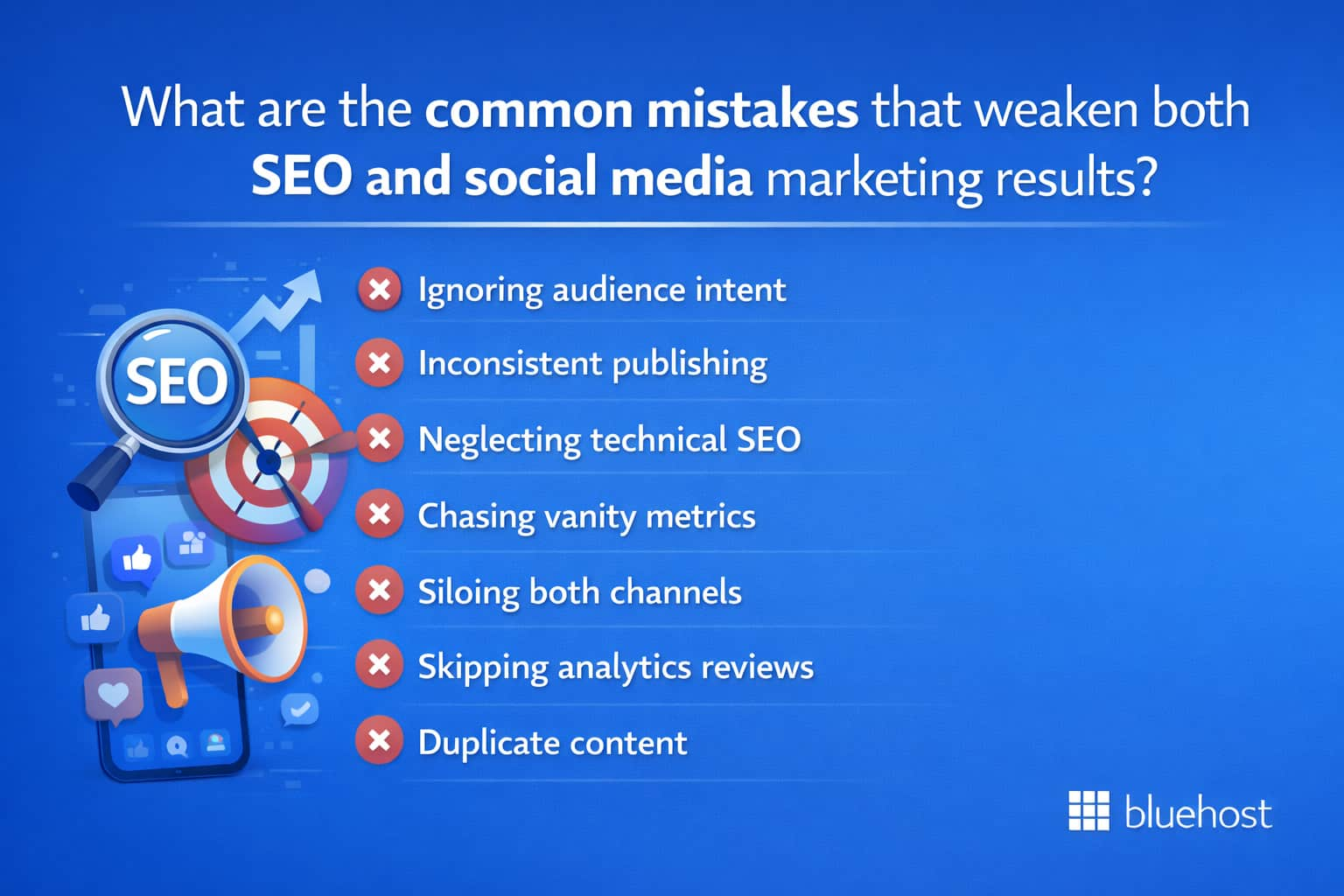
Avoiding these critical mistakes protects your investment and improves performance across both channels significantly.
- Ignoring audience intent: Creating content without understanding what your audience genuinely needs.
- Inconsistent publishing: Posting sporadically weakens both search rankings and social media algorithm reach.
- Neglecting technical SEO: Slow pages and broken links undermine all your content marketing efforts.
- Chasing vanity metrics: Focusing on likes and impressions instead of traffic and actual conversions.
- Siloing both channels: Running SEO and social media completely separately reduces overall marketing effectiveness.
- Skipping analytics reviews: Not monitoring performance regularly means missing critical optimization opportunities.
- Duplicate content: Publishing identical content on multiple pages directly hurts your search engine rankings.
How to build an integrated SEO and social media marketing strategy?
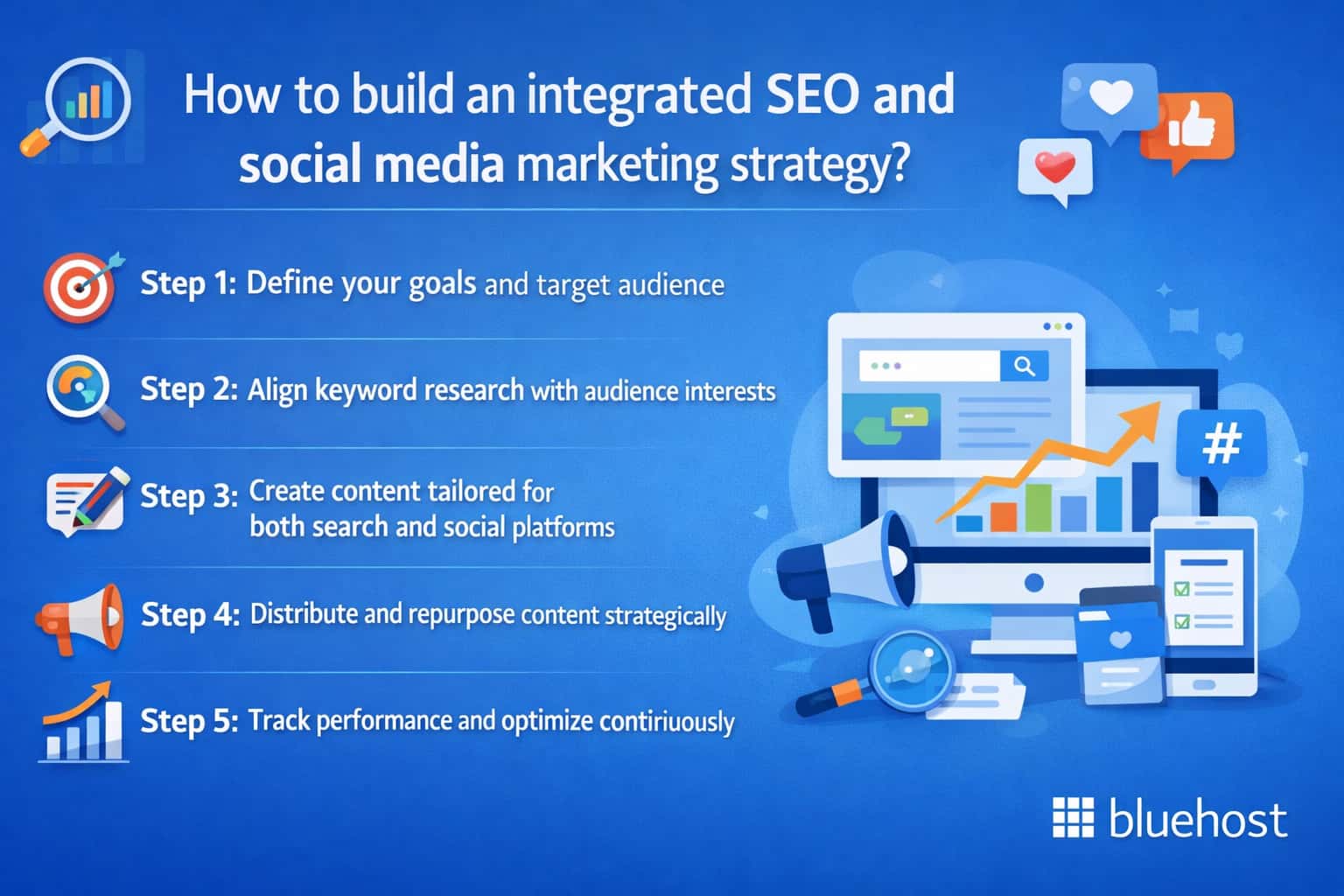
A unified strategy amplifies results from both channels simultaneously. Follow these five practical steps to build yours.
Step 1: Define your goals and target audience
A strong strategy starts with clarity around what you want to achieve and who you want to reach through each channel.
- Set clear, measurable goals for each marketing channel separately.
- Build detailed audience personas based on demographics, behavior and intent.
- Align your marketing goals with specific business outcomes like leads or revenue.
Step 2: Align keyword research with audience interests
The most effective content strategies begin by matching what people search for with what they actively engage with on social platforms.
- Use SEO tools to identify high-volume, low-competition keyword opportunities.
- Cross-reference your keywords with trending topics across relevant social platforms.
- Map keywords to specific content formats and distribution channels strategically.
Step 3: Create content tailored for both search and social platforms
Content performs better when it is designed to satisfy search intent while also being easy to adapt for social media formats.
- Write long-form blog posts fully optimized around your target SEO keywords.
- Repurpose key insights into short-form, platform-native social media content.
- Use visuals, infographics and short videos to maximize social amplification potential.
Step 4: Distribute and repurpose content strategically
Creating great content is only the first step, so distribution and repurposing are essential to extending its reach and value.
- Share every new blog post across all relevant social channels immediately after publishing.
- Break long-form articles into multiple standalone social media posts over several weeks.
- Update and republish older SEO content regularly to maintain and improve rankings.
Step 5: Track performance and optimize continuously
Regular performance analysis helps you understand what is working, where improvements are needed and how to refine your strategy over time.
- Review SEO rankings, organic traffic and keyword positions monthly.
- Monitor social engagement rates and referral traffic weekly.
- A, content formats and posting schedules consistently.
- Adjust your strategy based on real data, never assumptions alone.
How can Bluehost help strengthen your strategy?
To get better results from both SEO and social media marketing, you need more than content and promotion alone. You also need a website that looks professional, supports search visibility and stays updated as your business grows.
Bluehost Full Service + SEO gives you an all-in-one solution that combines custom website design, expert SEO support and ongoing site maintenance, so you can strengthen your online presence without managing every detail yourself.
With Bluehost Full Service + SEO, you get:
- A custom five-page WordPress website with a built-in blog to support your content strategy.
- A kickoff process that includes a project consultation and questionnaire to align your site with your business goals and design preferences.
- Up to five pages of SEO-friendly content with keyword phrases, image alt tags, meta tags and title tags.
- Website analytics that show visits, unique visitors and page views so you can track performance after launch.
- Monthly support from a dedicated online marketing account manager through Pro SEO Support Plus.
This gives you a stronger foundation for long-term SEO growth while also giving your social media traffic a more credible, conversion-focused destination.
It is especially useful if you want expert help building, improving and maintaining your online presence while staying focused on running your business. Explore Bluehost Full Service + SEO today!
Final thoughts
The SEO vs. social media marketing debate has no single definitive winner.
Both channels serve distinct purposes and deliver unique, complementary value. SEO builds sustainable and compounding organic growth over time, while social media marketing builds fast visibility and genuine community engagement. The most effective digital marketing strategy combines both working in harmony.
Start by understanding your audience clearly, setting measurable goals and creating content that serves both search intent and social discovery. To maximize your results and take the technical burden off your shoulders, Bluehost Full Service + SEO offers professional management and expert optimization to ensure your site is built to rank and convert.
Get started with Bluehost Full Service + SEO today and accelerate your digital growth with a team of experts behind you.
FAQs
Both serve different strategic functions. SEO is a long-term play focused on capturing high-intent traffic from search engines, while social media marketing is ideal for building brand awareness and immediate engagement. In the ongoing debate of seo vs social media marketing, the best ROI typically comes from a holistic strategy that uses social media to build an audience and SEO to capture demand when users are ready to convert.
SEO is not being phased out; however, it is undergoing a major evolution. While search engines are integrating generative AI and users are increasingly searching on platforms like TikTok, the fundamental need for businesses to create authoritative, discoverable content remains. SEO is shifting from “keyword matching” to “entity and intent matching,” making it more important than ever for brands to establish topical authority.
The 5:3:2 rule is a content ratio used to maintain a balanced social media feed. It recommends that for every ten posts: five should be curated content from other relevant sources, three should be original content that is educational or promotional for your own brand and two should be personal, “humanizing” posts that help your audience connect with the people behind the business.
It depends on your specific goals and timeline. SEO is ideal for sustainable, long-term organic traffic growth. Social media marketing delivers faster brand visibility and direct audience engagement. Most small businesses benefit from using both channels together in a unified strategy.
SEO typically takes 3–6 months to deliver measurable, consistent results. Highly competitive industries may require longer timelines. Consistent content publishing, technical optimization and link building all speed up the process considerably.
Social media does not directly influence your search engine rankings. However it drives referral traffic, helps earn organic backlinks and increases branded search volume. These indirect signals support and strengthen your overall SEO performance over time.
SEO targets users who are actively searching on search engines with clear purchase or research intent. Social media marketing targets users based on interests, demographics and behavioral signals. SEO delivers long-term compounding results while social media delivers faster but shorter-lived visibility.
Invest in SEO first if you are planning for a 6–12 month growth horizon. Start with social media marketing if you need immediate brand awareness or product launch visibility. Running both simultaneously consistently delivers the strongest overall marketing results for most businesses.
To improve your overall social media marketing strategy, try implementing the 3-3-3 rule for consistent engagement. Each day, focus on three core tasks: engage with three posts from industry leaders, leave three meaningful comments on content from potential followers or clients and initiate three new connections or direct messages. This structured approach helps you build authority and foster relationships without becoming overwhelmed by the platform.

Write A Comment