 ChatGPT,
 Claude,
 Gemini,
 Grok — all four for
Key highlights
- Discover how AI store builders can help you launch faster without starting from a blank template.
- Compare the best AI store builders and platforms by type, features and best-fit business use cases.
- Learn which eCommerce features to check before choosing an AI store builder for your business.
- Understand what kind of post-launch support your AI store builder should offer for daily store management.
- Explore how Bluehost AI Store makes your experience smoother by combining WooCommerce flexibility, AI agents and store management tools.
Launching an online store is easier than it used to be, but choosing the right builder can still feel confusing.
Many platforms claim they can help you build a store with AI. Some only create a basic website layout, while others add eCommerce features like product pages, payments and checkout.
That difference matters more.
A good AI store builder does more than help you go live. It helps you create an online store that is ready to sell, easy to manage and flexible enough to grow with your business.
Here, we have compared the 10 best AI store builders for 2026 and the key features you should check before choosing one for your online store.
TL; DR: Best AI store builders for your online store
If you’re short on time, here is a quick view of features and what each AI store builder is best suited for. Use this table to shortlist the tools that match your store, technical comfort and growth needs.
| Platform | Type | Features | Best for |
| Bluehost AI Store | Conversational AI store builder with WordPress and WooCommerce flexibility | Prompt-to-commerce store creation, AI configured store setup, six AI agents for store management, SEO and AEO optimization, Google and Meta channel sync | Small businesses and first-time online sellers |
| Wix | AI website builder with eCommerce tools | AI site creation, templates, storefront design and AI recommendations with Aria | Design-led small business stores |
| Squarespace | AI website builder with eCommerce features | Blueprint AI, polished templates, product and service selling, analytics and commerce tools | Visual brands, creators and service-product businesses |
| Hostinger | AI website builder with online selling tools | AI setup, product descriptions, and hosting, domain and email on selected plans | Simple online stores that need fast setup |
| Durable | AI business website builder | Quick site creation, SEO, GEO, CRM, bookings and marketing tools | Service businesses that need a simple online presence |
| Lovable | AI app builder | Custom storefronts, app-style eCommerce experiences, prototypes and full-stack builds | Businesses creating custom eCommerce apps or prototypes |
| GoDaddy | AI website builder with commerce plan | AI setup, products, services, appointments, payments and marketing tools | Businesses that need a simple website and store |
| 10Web | AI eCommerce website builder | AI-generated eCommerce sites, WordPress and WooCommerce foundation, AI Co-Pilot and hosting | WordPress users who want AI-assisted store creation |
| Shopify | eCommerce platform with AI tools | Storefront creation, checkout, inventory, sales channels, apps and AI assistant | Growing eCommerce brands with product-heavy stores |
| BigCommerce | eCommerce platform with AI commerce tools | B2B, omnichannel selling, AI copywriting, partner integrations and advanced eCommerce tools | Scaling businesses with complex eCommerce needs |
The table gives you a quick starting point, but the right choice depends on how much support you need beyond the first store draft. Below, we have explained each platform in detail so you can compare easily.
What is an AI store builder?
An AI store builder is a tool that helps you create, set up and manage an online store using artificial intelligence. Instead of starting from a blank template, you can use prompts or guided questions to build your storefront, create product content, organize catalog details and configure key store settings faster.
Many AI store builders also provide tools to generate product descriptions, meta data and other store content automatically to save time. As more eCommerce platforms add AI features, the real difference is how much they help beyond store creation. Before choosing one, compare what each platform offers for building, launching and managing an online store.
10 best AI store builders for small businesses
Choosing the best AI store builder depends on what you need most. If you have a small business, you may need speed and simplicity. In case you are running a product-heavy brand, you may need tools for inventory, fulfillment and support.
So, here we have shared the 10 best AI store builders worth comparing in 2026.
1. Bluehost AI Store
With Bluehost AI Store, we help you build, manage and grow your online store through conversational AI prompts. During our 14-day free trial, you can create and preview your store by answering guided questions about your business, products and brand. Our AI generates your storefront, product listings, copy, images and layouts without code, so you can explore before choosing a plan.
When you are ready to start selling, you can choose our Sell Online plan. Once purchased, our AI configures the eCommerce setup and enables six specialized AI agents to help monitor orders, catalogs, customers, payments and sales channels, surface issues and recommend prioritized actions.
Pros
- No code, no developer required
- Flexible WordPress and WooCommerce foundation
- AI prompt-based store creation and management
- Specialized AI agents for ongoing store tasks
- Customizable store design, layouts, copy and product details
- Multi-channel selling through Google Shopping and Meta Commerce
- Pre-configured Stripe setup for accepting card payments
- Smart AI suggestions for alerts and recommendations
- SEO and AEO optimization for traditional and AI search engines
- Always-on AI chat assistant for support and guidance
- No additional platform transaction fees on store sales
- One bundled ‘Sell Online’ plan includes hosting, free domain for first year and free SSL
Cons
- Free domain for first year on paid plan only
- AI edits may depend on monthly credit limits
- Not designed for advanced custom web apps
Also read: How to Use AI to Create an Online Store for Your Small Business
2. Wix
Wix combines an AI website builder with eCommerce tools for small businesses that want design control. Its AI builder can generate a site from a prompt, while Aria, Wix’s AI agent, helps refine design, content and business tasks. Wix also supports AI product descriptions and recommendations.
Pros
- Drag-and-drop editor
- Customizable templates
- Good storefront design flexibility
- Built-in tools for product and order management
- Useful for design-led small business stores
Cons
- Advanced commerce features may require higher-tier plans
- Some functionality depends on Wix App Market
- Less suited for highly custom eCommerce workflows
- Not built around dedicated store-management AI agents
3. Squarespace
Squarespace offers Blueprint AI for AI-assisted website creation and built-in eCommerce tools for selling products, services, subscriptions and digital content. Its strength is polished design, brand presentation and an all-in-one website experience, making it useful for visual brands, creators and service-product businesses.
Pros
- Polished templates and visual design
- AI-assisted site creation through Blueprint AI
- eCommerce support for products, services and subscriptions
- Useful for visually driven brands
Cons
- AI support focuses more on design than store operations
- Less flexible than open-source ecosystems
- Not ideal for highly custom eCommerce workflows
- Tiered plans for more advanced features
4. Hostinger
Hostinger offers an AI website builder for online stores. It includes online selling tools, hosting, domain and email included on selected plans. The platform helps users create a site from a prompt, set up an online store and generate product descriptions with AI. Chatbot support is available from Kodee.
Pros
- Fast setup for simple stores
- 0% transaction fees
- Supports different payment methods
- Good fit for low-complexity online stores
Cons
- Features vary based on the plans
- No free domain available on starter plan
- Limited fit for advanced catalog management
- Less suited for deep customization
5. Durable
Durable is an AI business website builder designed to help users launch a website quickly and manage basic business needs in one place. It includes tools for SEO, GEO, CRM, bookings, payment processing, marketing automation and AI support. This makes it more useful for service businesses than product-heavy stores.
Pros
- Fast AI website creation
- Offers free plan
- Useful CRM and booking tools
- Good fit for service businesses and solo operators
Cons
- Not built as an eCommerce-first platform
- Limited fit for product-heavy online stores
- Features vary as per plan
- Weaker fit for scaling retail operations
6. Lovable
Lovable is an AI app builder that helps users create apps and websites through conversation with AI. It can create working prototypes, refine them through feedback and deploy custom experiences. It includes storefront and eCommerce templates, but it is not a traditional plug-and-play commerce platform.
Pros
- Useful for app-style store experiences
- Strong for custom eCommerce prototypes
- Flexible for unique workflows
- Good fit for founders and product teams
Cons
- Not a standard AI store builder
- Requires more technical judgment
- Plan cost varies depending on the number of credits
- Less practical for users who want ready-made store management
7. GoDaddy
GoDaddy is known for offering domains and a website builder. It uses Airo AI Builder to help users create a business website from prompts. They offer plans with different features for building website. The free plan allows building unlimited apps or sites; however, you need to upgrade to paid plan for taking your business live.
Pros
- Simple AI-assisted setup
- Offers templates and editing tools
- Commerce plan includes key selling features
- Useful for entrepreneurs, solopreneurs and developers
Cons
- eCommerce features depend on plan level
- Some capabilities are region-specific
- Design control can feel limited
- Less suited for advanced eCommerce operations
8. 10Web
10Web offers an eCommerce AI builder that creates an online store from a business description. It uses WordPress and WooCommerce as the foundation and supports product setup, centralized order handling, customer management, AI product descriptions and AI Co-Pilot for site refinements.
Pros
- AI-generated eCommerce website structure
- Allows importing Figma
- AI Co-Pilot for ongoing edits
- Useful for WordPress-based store creation
Cons
- Needs WordPress understanding
- Store quality depends on prompt and editing quality
- Requires setup decisions after generation
- Limited storage varies as per plan
9. Shopify
Shopify is a dedicated eCommerce platform with AI tools built into the selling workflow. Its website builder supports AI-generated storefronts, while Sidekick works inside Shopify admin to help with design, product copy, pricing, discounts, performance summaries and more. It is a good fit for brands that expect to scale.
Pros
- Offers eCommerce functionality
- AI assistant for admin and store tasks
- Themes and templates available across plans
- Good fit for scaling product-based brands
Cons
- Premium themes can increase total cost
- App-based extensions may add ongoing expenses
- Third-party transaction fees can apply
- Less open than WordPress-based store ownership
10. BigCommerce
BigCommerce is an eCommerce platform for growing businesses with more advanced selling needs. Its AI capabilities include BigAI Copywriter for SEO-friendly product descriptions, along with partner integrations. Some BigAI features are coming soon or limited to specific editions.
Pros
- Good fit for complex eCommerce needs
- Supports B2B and omnichannel growth
- Useful for larger product catalogs
- Built for scaling eCommerce operations
Cons
- May be too advanced for simple starter stores
- Some BigAI features are coming soon or edition-specific
- Setup requires more eCommerce planning
- Less lightweight than AI website builders for small stores
Each platform solves a different problem, so the best choice depends on how you plan to build, sell and manage your store. If you are still unsure which one fits your business, check the practical factors given below to make the decision easier.
How to choose the right AI store builder for your business?
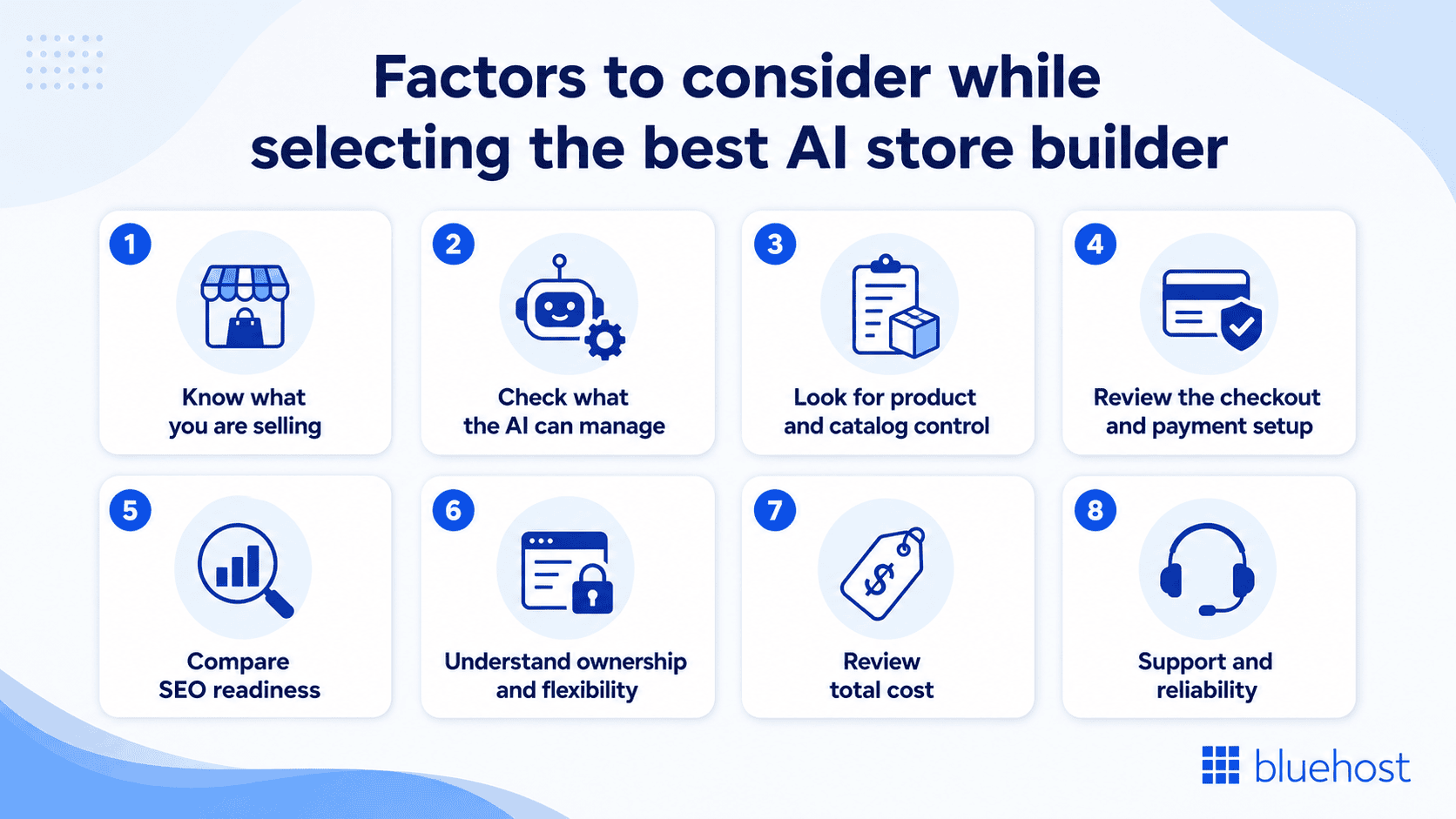
The right choice for an AI store builder comes down to a few things: how much control you want, how large your product catalog is and what amount you’re able to spend monthly. Match a platform’s actual strengths to your daily workload instead of picking based on which one looks the flashiest in a demo video.
- Know what you are selling: A small product catalog, service-based store and multi-category eCommerce business have different needs. If you sell a few products, a simple AI website store builder may work. If you manage inventory, shipping, discounts and repeat customers, choose a platform built for deeper store operations.
- Check what the AI can manage: Some AI tools only generate pages, copy or layouts. Others help with product listings, checking orders, handle customers and more. Hence, choose a builder that supports and manages real eCommerce tasks.
- Look for product and catalog control: Product pages need accurate titles, descriptions, pricing, images, categories and stock details. A good AI eCommerce store builder should make it easier to create, update and optimize products without much manual effort.
- Review the checkout and payment setup: Your store is not ready until customers can complete a purchase smoothly. Check if the platform supports secure payments, tax settings, shipping rules, checkout customization and payment issue visibility before you commit.
- Compare SEO readiness: Your store needs to be found across search engines. Look for in-built SEO tools or plugins that help to optimize product content, metadata, structured data, clean store architecture and more.
- Understand ownership and flexibility: Closed platforms can be easier to start with but may limit control later. WordPress and WooCommerce-based platforms offer more flexibility if you want to customize your store, add integrations or grow beyond basic eCommerce features.
- Review total cost: Look beyond the monthly plan. Check transaction fees, app costs, hosting, SSL, backups, domain, storage and renewal pricing. A low entry price can become expensive once your store needs more features.
- Support and reliability: A store that goes down during a sale costs you real money. So, look at uptime commitments and whether human support is actually available when something breaks.
As you compare platforms, think ahead and ask how much support each builder gives you once your store is live. If you want AI to help with setup, selling and ongoing store management, Bluehost AI Store is built for that next step.
Why is Bluehost AI Store the right choice for launching an online store?
Bluehost AI Store is a strong choice if you are looking to build an online store with AI and manage it with less manual work after launch. We combine AI-guided eCommerce setup with WordPress and WooCommerce flexibility, so your store can start simple and grow with your business.
Here is where our AI Store helps you the most.
- Prompt to commerce setup: We take you from prompt to commerce within a few minutes. You can describe your business, answer guided questions and let our agentic AI help create your store. This reduces the blank-page problem and helps you move from an idea to an online store faster.
- Run store through AI agents: Our six specialized AI agents help manage key store tasks across orders, catalog, customers, payments, channels and coordination. They monitor store activity, surface what needs attention and help you act without moving across multiple dashboards.
- Smart AI suggestions: Our AI goes beyond setup by giving proactive recommendations based on your store data. It can flag low stock, growth opportunities and priority tasks so you know what to fix next.
- Sell everywhere from one place: You can connect Google Shopping and Meta Commerce from one dashboard. Product data syncs automatically, so your listings stay updated across connected channels without repeating the same updates manually. And with Etsy and TikTok Shop planned as upcoming options, your store will have more ways to reach shoppers as you grow.
- SEO and AEO optimization: Our paid plan includes pre-installed Yoast SEO Premium to support search visibility from day one. It helps optimize product descriptions and the metadata that powers discovery across Google, Bing and AI search engines like ChatGPT, Perplexity and Google AI Overviews.
- One bundled plan: Our Sell Online plan brings store creation, hosting, free domain for the first year, pre-configured WooCommerce, free SSL, weekly backups and AI tools into one package. You also get 20 AI credits every month, plus 10 AI credits for creation in the first month. So, you can build, refine and update your store with guided AI support as you grow.
Your store can be ready before your launch plan is. Start building for free, preview the experience and upgrade when you are ready to start selling.
Final thoughts
The best AI store builder is the one that stay by your side even after building your online store. It is the one that fits how you plan to build, sell, manage and run your business online.
If you are looking to launch with zero technical complexities and go live with ease, choose Bluehost AI Store for your business. With our prompt-based store creation, WooCommerce flexibility and ongoing AI agents support for store management, Bluehost AI Store helps you launch manage and grow with confidence.
Want to launch your online store with less manual setup? Start building with a 14-day free trial and upgrade when you are ready. Try our Bluehost AI Store today.
FAQs
Yes. AI can help set up an online store by creating store pages, product listings, copy, images and layouts. Our Bluehost AI Store goes further by helping configure products, payments and shipping. You can also easily run and manage your store from day one with the help of our specialized AI agents through natural conversations.
An AI website builder primarily helps create site pages, content and layouts. An AI store builder adds eCommerce capabilities and tools for ongoing store operations.
Yes. Some platforms let you build an online store through a free plan or trial. With Bluehost you get a 14-day free trial that lets you create, customize and preview your store using conversational prompts. When you are ready to publish and start selling, you can upgrade to our Sell Online plan.
The best option depends on how much support you need after launch. Bluehost AI Store is a strong choice for small businesses and first-time sellers who want to build and manage a WooCommerce store with less manual work. Our specialized AI agents help oversee products, orders, customers, payments and sales channels, while our Always-on AI chat assistant supports day-to-day decisions.
A high-converting online store needs clear product pages, fast checkout, secure payments, simple navigation, mobile-friendly design and visible trust signals. Accurate product information, transparent shipping details and strong SEO also help customers find products and complete purchases.
Choose an AI online store builder if you want faster setup, guided configuration and help with day-to-day store management. A traditional eCommerce platform may work better for businesses that need deeply customized workflows and have the technical resources to manage them. Our Bluehost AI Store combines conversational AI with WordPress and WooCommerce flexibility, giving you a simpler starting point without limiting future customization.
Common mistakes include publishing AI-generated content without reviewing it, using generic product descriptions, skipping mobile previews and failing to test checkout before launch. You should also verify product details, payment settings, taxes and shipping rules before accepting orders.

Write A Comment