 ChatGPT,
 Claude,
 Gemini,
 Grok — all four for
Key highlights
- Know the real price range for virtual receptionists in 2026, from $25 AI plans to $2,400 a month human services, so you can spot an overpriced quote before you sign anything.
- Learn how per-minute, per-call and flat monthly pricing models actually work and which one fits your call patterns best.
- Understand why an in-house receptionist costs $45,000 to $70,000 a year once you add benefits, taxes and turnover, not just the salary you see in a job posting.
- Explore where a website-based AI agent like Bluehost AI Receptionist fits next to traditional phone answering services, and when it makes more sense.
- Uncover the hidden fees, like overage charges and after-hours premiums, that quietly turn a $99 plan into a $250 bill.
A customer calls your business after hours. No one picks up. They do not leave a voicemail. They just call the next name on the list. You never even know that lead existed, but the revenue is gone all the same.
This happens more than most business owners realize. Studies have found that well over half of calls to small businesses go unanswered by a live person, and most callers who hit voicemail simply hang up instead of leaving a message. A virtual receptionist exists to close that gap, but the pricing landscape is messy. One provider charges by the minute, another by the call, another bundles everything into a flat monthly fee and a few blur the line between “virtual receptionist” and “AI agent” so much that comparing two quotes feels like comparing apples to a spreadsheet.
This guide breaks down what you will actually pay, the hidden fees that inflate the bill and how AI options like Bluehost AI Receptionist compare with traditional phone-based services.
Quick answer
If you only have thirty seconds, here is the short version.
| Service type | Typical monthly cost | Typical annual cost |
|---|---|---|
| AI-only virtual receptionist | $25 to $300 | $300 to $3,600 |
| Human virtual receptionist | $200 to $2,400 | $2,400 to $24,000+ |
| Hybrid (AI plus human backup) | $150 to $800 | $1,800 to $9,600 |
| Bluehost AI Receptionist (website-based AI) | $25/month | $300/year |
| In-house receptionist (fully loaded) | $3,800 to $5,800 | $45,000 to $70,000 |
Most small businesses land somewhere between $100 and $400 a month once you factor in the features they actually need. Call volume, coverage hours and whether a real human answers the phone are the three biggest levers on price.
What is a virtual receptionist?
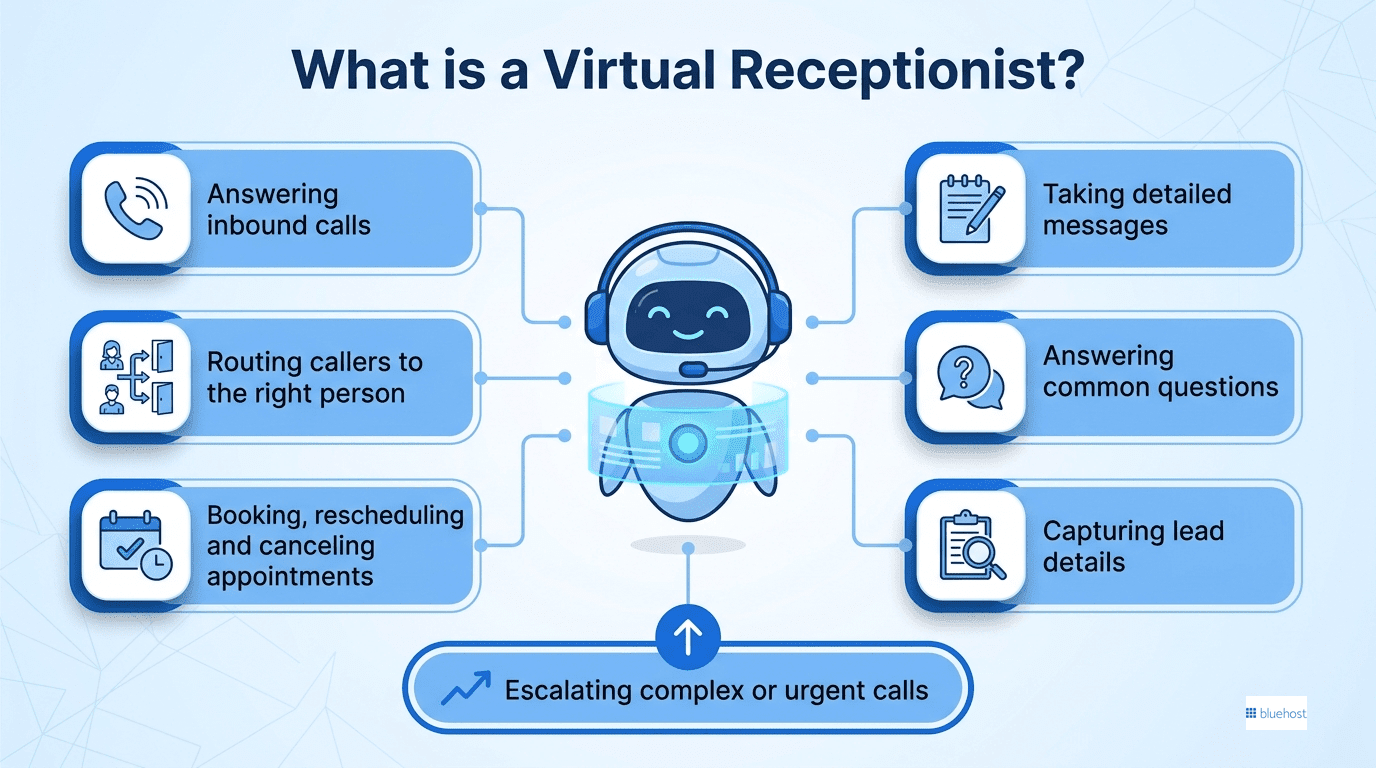
A virtual receptionist answers calls and handles customer communication on behalf of your business without sitting in your office. Depending on the provider, that work is done by a remote human agent, an AI voice or chat system, or some mix of the two.
The category has gotten broader over the past couple of years. “Virtual receptionist” used to mean a remote person answering your phone from a call center. Now it also covers AI agents that hold real conversations, chatbots that live on your website and hybrid setups where AI handles the easy stuff and a human steps in for anything complicated.
What does a virtual receptionist do
Most services cover some combination of the following:
- Answering inbound calls or messages with a custom greeting
- Routing callers to the right person or department
- Booking, rescheduling and canceling appointments
- Taking detailed messages and forwarding them by text or email
- Answering common questions about hours, pricing and services
- Capturing lead details so nothing falls through the cracks
- Escalating complex or urgent calls to a live team member
More advanced plans add CRM logging, bilingual support, outbound follow-up calls and multi-channel coverage across phone, SMS and web chat.
Also read: AI Receptionist for Small Business: Your 24/7 Answering Service in 2026
How much does a virtual receptionist cost?
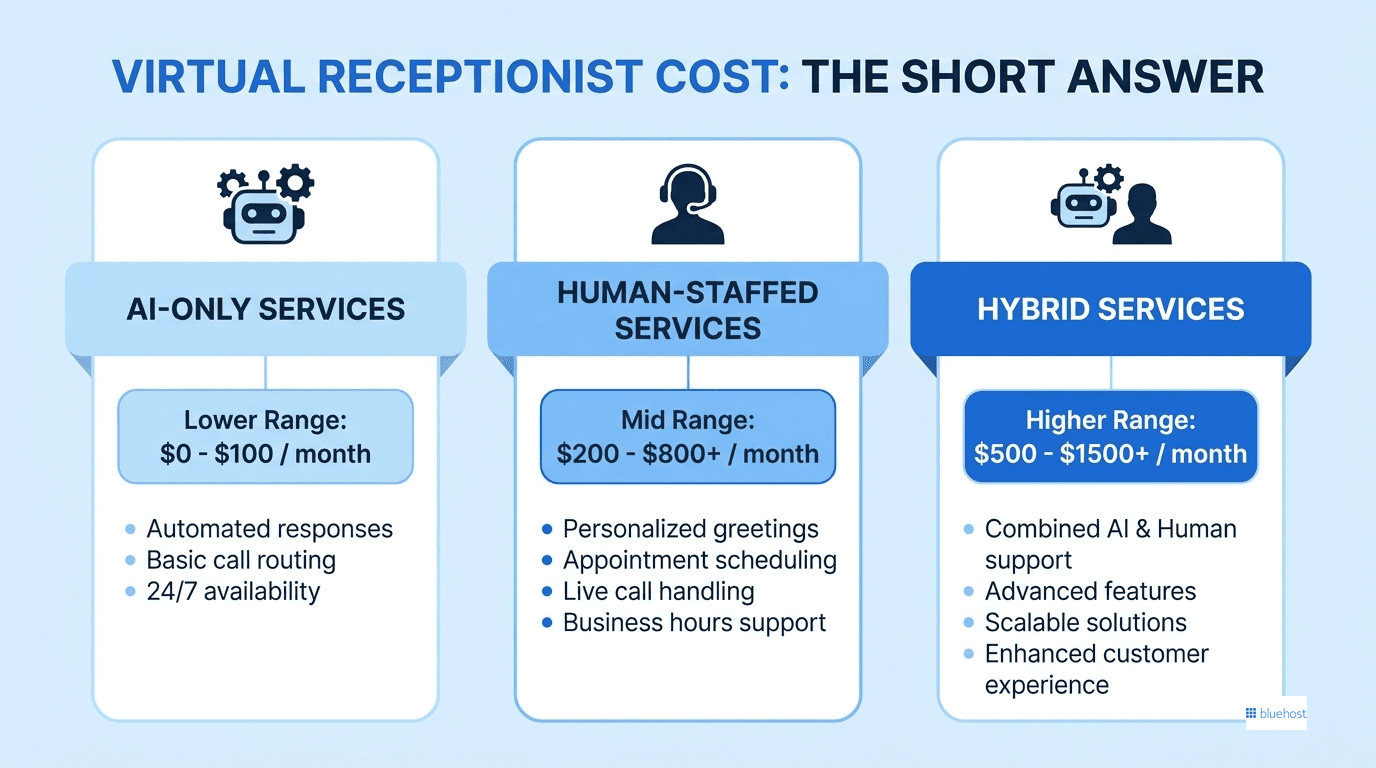
Pricing splits cleanly into three tiers once you strip away the marketing language.
- AI-only services run $25 to $300 a month. Entry plans cover a few hundred minutes or calls. Mid-tier plans add calendar and CRM integrations. These operate 24/7 without extra charges for nights or weekends.
- Human-staffed services run $200 to $2,400 a month depending on minutes included and whether you want a dedicated receptionist or a shared pool of agents. Premium plans with extended hours and dedicated staff can push past $3,000.
- Hybrid services that blend AI for routine calls with human escalation typically land between $150 and $800 a month, giving you most of the cost savings of AI with the judgment of a real person for the calls that need it.
A few providers also offer per-country pricing that shifts the math. Outsourced human receptionists based in the Philippines or India can run $400 to $850 a month for full-time dedicated coverage, well below US-based human services, though you take on more of the hiring and management yourself.
Virtual receptionist pricing models explained
How a provider bills you matters as much as the sticker price. Here is how the four common models break down.
| Pricing model | Typical rate | Best for | Watch out for |
|---|---|---|---|
| Per-minute | $0.25 to $2.50 per minute | Short, simple calls | Rounding up to the next 30 seconds or full minute inflates your real cost |
| Per-call | $2 to $11 per call | Long, detailed conversations | Spam and wrong numbers can still count against your plan |
| Flat monthly subscription | $25 to $500+ for a set bucket of minutes or calls | Predictable, steady call volume | Overage rates often run 50 to 100 percent higher than your included rate |
| Unlimited flat rate | $49 to $500+ | High, consistent volume | “Fair use” policies can cap call length or restrict hours more than the word “unlimited” suggests |
A quick way to think about it. If your calls are short and frequent, per-minute pricing usually wins. If your calls run long but happen less often, per-call pricing is friendlier. If your volume is steady month to month, a flat subscription keeps your budgeting simple.
What pushes the price up or down?
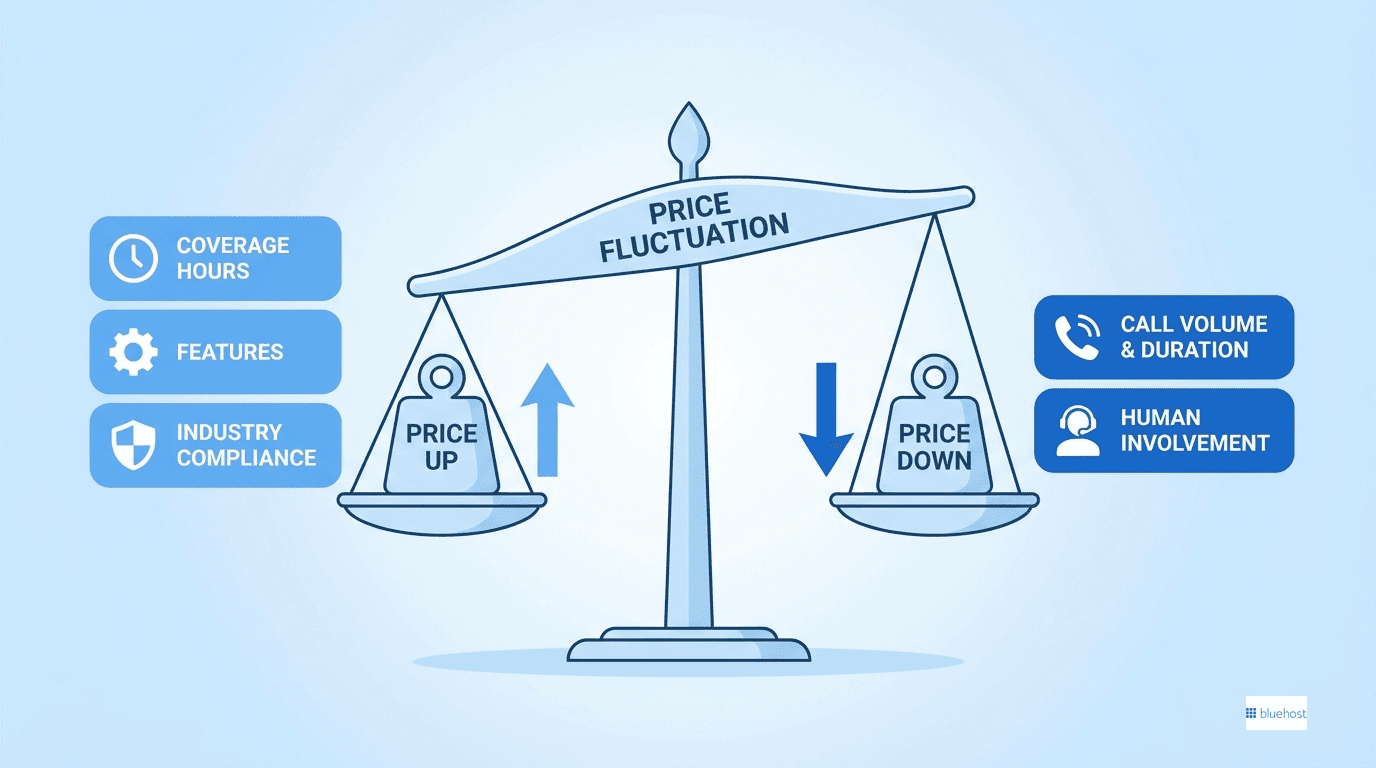
Several factors swing your final bill well beyond the advertised starting rate.
- Call volume and duration. More calls and longer calls mean more minutes, which means a bigger plan. Most providers recommend you review the last three to six months of call logs before picking a tier.
- Coverage hours. Business-hours-only coverage is the cheapest option. Extended hours typically add 20 to 30 percent. Full 24/7 coverage can add 40 to 50 percent to a human-staffed plan, though AI services usually include round-the-clock coverage at no extra charge since the system never clocks out.
- Features. Appointment scheduling integration, CRM logging, bilingual support and call recording each add their own line item, usually somewhere between $20 and $100 a month per feature on human-staffed plans.
- Industry compliance. HIPAA-compliant handling for medical and dental practices typically adds $50 to $200 a month. Legal intake with conflict checking and case management integration pushes costs toward the higher end of the range too.
- Human involvement. This is the single biggest cost multiplier. Adding a live agent to any part of the call flow increases the price far more than any other single feature.
AI virtual receptionist cost vs human virtual receptionist cost
This is the comparison most business owners actually want answered, so here it is side by side.
| Factor | AI receptionist | Human receptionist |
|---|---|---|
| Typical monthly cost | $25 to $300 | $200 to $2,400+ |
| Billing model | Flat rate, usually | Per-minute or per-call, usually |
| Hours covered | 24/7/365 with no extra charge | Business hours, with premiums for nights and weekends |
| Simultaneous calls | Unlimited | Limited by available staff |
| Consistency | Identical every time | Varies by agent and day |
| Best at | FAQs, scheduling, routine intake | Emotional nuance, complex consultations, VIP callers |
| Setup time | Often 10 to 20 minutes | Onboarding calls, scripts, training |
For most small businesses handling routine bookings and basic questions, AI delivers comparable results at roughly one fifth to one tenth the cost of a comparable human service. The trade-off shows up on the calls that genuinely need a person, like an upset customer or a complicated legal intake. That is exactly why hybrid models exist.
Also read: 12 Best AI Coding Assistant 2026: Top 12 Tools Ranked
Provider price comparison
Here is what specific, named providers actually charge, pulled from their published pricing.
| Provider | Type | Starting price | Notes |
|---|---|---|---|
| Ruby Receptionists | Human | $250/month for 50 minutes | Premium, US-based, popular with legal and healthcare |
| Smith.ai | Human | About $95/month for 50 calls | Call-based pricing rather than per-minute |
| PATLive | Human | $75/month for 10 users | Tiered by included minutes |
| AnswerConnect | Human | Around $325/month plus a setup fee | Built for higher volume and 24/7 coverage |
| Posh | Human | From $65/month | More budget-friendly human option |
| Dialzara | AI | From $29/month | Flat-rate AI answering with basic integrations |
| Bluehost AI Receptionist | Website-based AI | $25/month | 24/7 customer conversations, lead capture and appointment booking |
| Wishup | Human (managed VA) | From $1,999/month, unlimited calls | Dedicated, pre-trained virtual receptionist |
| OnCallClerk | AI | $29/month | Tiered by minutes and features |
| Zeeg | AI plus scheduling and CRM | From about €10/user/month plus minute bundles | Bundles booking and CRM into the same platform |
Prices shift often, so treat this as a starting point for your own research rather than a locked-in quote.
Where Bluehost’s AI Receptionist fits in
Most of the tools above are phone-first. Bluehost’s AI Receptionist takes a different approach worth knowing about, especially if you already run or are building a website.
It is not a phone-answering service. It is a website-based AI sales assistant that engages visitors, answers questions, captures leads and supports appointment booking. It gets trained on your own business documents and brand voice, so it answers the questions your customers actually ask rather than a generic script. It connects to Google Calendar through full OAuth integration, reading real-time availability and blackout dates so it can book, reschedule or cancel appointments without anyone on your team lifting a finger.
A few details worth knowing if you are comparing it against a traditional virtual receptionist:
- It captures leads and answers questions for visitors on your website, not inbound phone calls.
- Bluehost’s Professional Services team handles setup, including connecting your calendar and training the agent on your content
- It can work with a business website hosted anywhere, so you do not need to move your site to Bluehost to use the AI Receptionist.
- It is part of the broader Bluehost AI Suite, which also includes an AI website builder and access to multiple AI models, so pricing and bundling depend on which products you combine
Think of it less as a replacement for a phone answering service and more as the missing piece for the leads that never pick up the phone at all. A lot of inquiries today start as a website chat or an Instagram DM, and those channels rarely get the same attention as a ringing phone. If your business already loses leads to an unanswered contact form at 9pm, this is the gap it is built to close. If your biggest pain point is genuinely missed phone calls, a dedicated phone-based virtual receptionist is still the more direct fix.
Virtual receptionist cost by industry
Different industries have different call patterns and compliance needs, which shows up directly in pricing.
| Industry | Typical monthly cost | Key requirement |
|---|---|---|
| Legal | $250 to $2,000 | Intake forms, conflict checks, case management integration |
| Medical and dental | $300 to $3,000 | HIPAA-compliant call handling and patient data security |
| Real estate | $150 to $1,500 | Fast 24/7 lead capture, since showings happen evenings and weekends |
| Home services (HVAC, plumbing, electrical) | $100 to $600 | Emergency call routing and after-hours coverage |
| E-commerce and retail | $200 to $600 | Order support and basic troubleshooting |
| Startups and solo operators | $25 to $200 | Low volume coverage that scales as the business grows |
Home services businesses often see the fastest payback, since a single captured emergency call can be worth more than a full month of service.
Hidden fees to watch for
Advertised pricing rarely tells the whole story. Keep an eye on these before you sign anything.
- Setup and onboarding fees. Commonly $0 to $500, though complex configurations with custom CRM connections can run into the thousands.
- Overage charges. Going over your included minutes usually costs 50 to 100 percent more per minute than your base plan rate.
- After-hours and holiday premiums. Many human services add 20 to 50 percent for evenings, weekends and holidays unless you specifically pay for 24/7 coverage.
- Minute rounding. Some providers round every call up to the nearest 30 seconds or full minute, which can quietly add 30 to 40 percent to your effective rate on short calls.
- Add-on integrations. CRM logging, additional phone numbers and SMS capability are often billed separately from the base plan.
- Contract lock-in. Annual contracts often look cheaper per month but can carry early termination fees if you need to switch providers.
A good rule of thumb: ask for a sample bill at your expected call volume before committing, not just the advertised starting price.
Virtual receptionist vs in-house receptionist: the real cost comparison
This is where the math gets interesting. A full-time receptionist looks affordable on a job posting, but the real cost includes a lot more than salary.
| Cost category | Annual amount |
|---|---|
| Base salary | $34,000 to $42,000 |
| Payroll taxes (FICA, FUTA, state unemployment) | $2,800 to $3,400 |
| Health insurance | $6,500 to $9,000 |
| Paid time off (coverage gap) | $3,000 to $4,000 |
| Workers’ compensation | $300 to $600 |
| Equipment and overhead | $750 to $1,500 |
| Turnover costs (amortized) | $1,800 to $2,500 |
| Total fully loaded cost | $45,000 to $70,000 |
That figure covers roughly 40 hours a week with gaps for lunch, sick days and vacation. An AI virtual receptionist covering all 8,760 hours in a year typically costs $300 to $3,600 annually, which works out to a 90 percent or larger reduction with more total coverage, not less.
Even a premium human virtual receptionist service at $1,200 to $2,000 a month still costs 50 to 70 percent less than an in-house hire while offering more flexible hours.
Is a virtual receptionist worth the cost
Run the numbers on your own missed calls and the answer usually becomes obvious fast.
Say your business receives 200 calls a month and roughly 40 percent go unanswered, which is on the low end of what research shows across industries. That is 80 missed calls. If even 15 percent of those would have converted into a customer worth $300 on average, that is $3,600 in lost monthly revenue, or $43,200 a year, walking away because nobody picked up.
Compare that against a $150 to $300 monthly virtual receptionist plan and the return on investment becomes clear within the first month for most small businesses. Add in the hours you personally save not chasing voicemails between jobs, often valued at $50 to $100 an hour for a business owner’s time, and the math gets even more favorable.
Best virtual receptionist for small business: how to choose
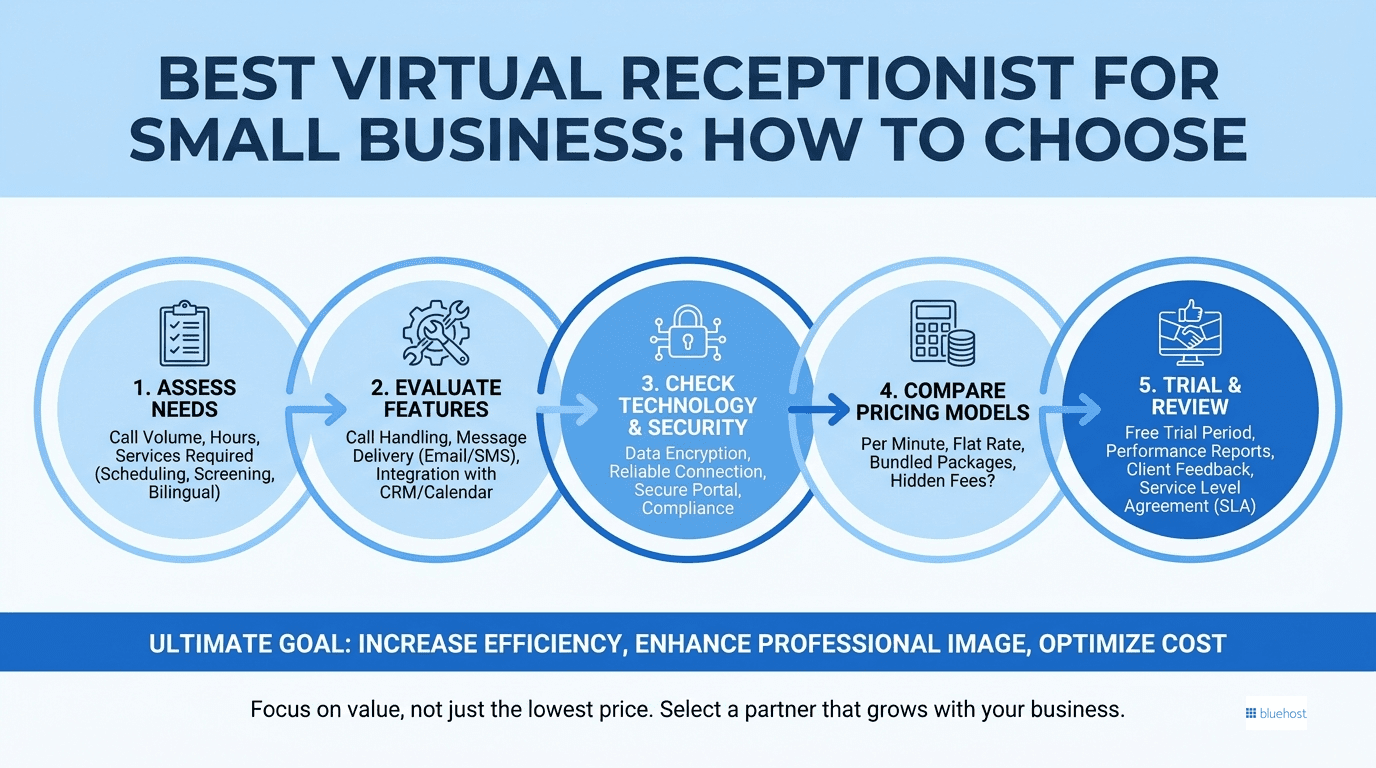
There is no single best option. The right choice depends on three things: your call volume, how complex your calls are and your budget.
Choose AI-only if:
- Most calls are routine, like booking appointments or answering FAQs
- Your call volume is predictable
- Budget matters more than a personal touch on every call
Choose human-staffed if:
- Calls regularly involve emotional situations, legal intake or high-stakes consultations
- One poor interaction could cost you a client
- Your customers expect a live voice every time they call
Choose hybrid if:
- You want 24/7 coverage without paying for live agents around the clock
- Most calls are simple but a meaningful share need human judgment
- You are scaling and want flexibility without overcommitting to one model
Choose a website-based AI agent like Bluehost AI Receptionist if:
- A large share of your leads come through your website, social DMs or text rather than phone calls
- You want appointment booking tied directly into your existing website and calendar
- You are already managing your site through Bluehost and want one less integration to maintain
How to calculate your own budget
Four quick steps to land on a realistic number before you start comparing quotes.
- Pull your call logs from the past three months. Calculate average calls per day and multiply by your business days in a month.
- Estimate average call duration. Simple inquiries run 1 to 3 minutes, scheduling runs 3 to 5 minutes and complex calls can run 5 to 10 minutes or longer.
- Add a 20 percent buffer. Growth, marketing campaigns and seasonal spikes will push your real volume above your historical average.
- Compare two or three pricing models against your numbers. Run the same call volume through a per-minute plan, a flat subscription and a hybrid plan to see which actually comes out cheapest for your specific pattern.
Final thoughts
The price tag on a virtual receptionist is never the full story. What matters is matching the pricing model and service type to how your business actually receives calls and messages. A solo service provider fielding five calls a day has nothing in common with a busy dental practice juggling 300 calls a month, and pricing should reflect that difference.
Start by counting your own missed calls for a week. Multiply that by what an average new customer is worth to your business. That single number will tell you more about whether a virtual receptionist is worth the cost than any pricing page ever will.
Explore Bluehost AI Receptionist and see how it can start capturing the leads your website is currently letting slip away.
FAQs
A virtual receptionist answers calls and customer messages on behalf of a business without working from that business’s physical office. The work can be done by a remote human agent, an AI system, or a hybrid of both.
Core tasks include answering calls or messages, routing them to the right person, scheduling appointments, taking detailed messages and answering common questions about a business’s hours, pricing and services.
Most small businesses pay $100 to $400 a month. AI-only services start around $25 a month, human-staffed services typically run $200 to $2,400 a month and hybrid plans land in between.
It depends on your call patterns. Low-volume, routine calls suit an AI-only plan. Complex or emotionally sensitive calls suit a human-staffed plan. A mix of both, or a website-based option like Bluehost AI Receptionist for businesses that get most of their leads online, covers the middle ground well.
Yes, by a wide margin in almost every case. A fully loaded in-house receptionist costs $45,000 to $70,000 a year. Even a premium human virtual receptionist service typically costs 50 to 70 percent less while covering more hours.
Setup fees, overage charges, after-hours premiums and minute rounding are the most common ways an advertised price ends up higher than what you actually pay. Always ask for a sample bill at your real call volume before signing.

Write A Comment