


Key highlights
- Understand that ccTLDs have widely varying renewal deadlines depending on the country registry, ranging from same-day to 57 days before expiration.
- Avoid paying $80–$180 in additional redemption fees by renewing ccTLDs on time, beyond standard renewal costs.
- Know that some ccTLDs such as .de, .cx and .am have zero grace periods and are deleted immediately after expiration.
- Use ccTLD-based domain hacks like .io, .ai and .me for creative branding while closely tracking renewal timelines.
- Protect your SEO value, customer trust and brand equity by preventing accidental domain expiration.
Owning a website with a country-code top-level domain (ccTLD) allows you to target a specific geographic audience. But just like any ccTLD domain renewal, ccTLDs must be renewed before expiring to maintain ownership and keep your website active. This can be incredibly confusing because the ccTLDs renewal timeline varies depending on the specific ccTLDs extension.
This comprehensive guide breaks down everything you need to know about ccTLD renewal timelines, from tracking your domain’s expiration date to understanding how domain removal affects your SEO performance. You’ll discover the essential steps for renewing your country code domains, learn about hosting provider grace periods and get actionable strategies for maintaining your website’s authority throughout the renewal process.
TL;DR: ccTLD vs gTLD renewals
| Feature | Generic TLD (.com, .org) | Country code TLD (ccTLD) |
|---|---|---|
| ccTLD | Country / Region | Typical Use Case & Notes |
| Grace period | Standard 30-40 days | 0-60 days (highly variable) |
| Renewal deadline | Typically at expiration | Can be 57+ days before |
| Redemption fee | ~$80-$100 | $80-$250+ |
| Deletion timeline | Predictable (75 days) | Highly variable |
| Recovery guarantee | Grace + Redemption periods | Some have NO recovery period |
| Auto-renewal support | Universal | Check with registrar |
| .ai | Anguilla | Standard for Artificial Intelligence and tech startups. |
| .ca | Canada | High trust; strict residency requirements for registration. |
| .co | Colombia | Popular global alternative to .com for startups and businesses. |
| .de | Germany | Europe’s most popular ccTLD; requires timely code renewal (no grace period). |
| .io | British Indian Ocean Territory | Preferred by tech, SaaS and gaming companies. |
| .tv | Tuvalu | The global standard for video, media and streaming brands. |
| .uk | United Kingdom | Essential for British businesses; typically .co.uk or .uk. |
| .ai | Anguilla (Global) | The gold standard for Artificial Intelligence and tech companies. |
| .au | Australia | Strict registration; requires local Business Number (ABN). |
| .br | Brazil | Restricted to local entities; dominant in South America. |
| .ca | Canada | High consumer trust; requires Canadian residency/presence. |
| .ch | Switzerland | Popular for finance and luxury brands; strict privacy. |
| .cn | China | World’s largest ccTLD; requires real-name verification. |
| .co | Colombia (Global) | Widely used as a global alternative to .com for startups. |
| .de | Germany | Europe’s top ccTLD; strict admin contacts and no grace period. |
| .es | Spain | Essential for Spanish markets; open to international registrants. |
| .eu | European Union | Unifies presence across Europe; open to EU residents. |
| .fr | France | Restricted to EU/EEA residents; high local authority. |
| .gg | Guernsey (Global) | Highly popular in the gaming and esports industry. |
| .in | India | Widely used in the tech sector and English-speaking markets. |
| .io | British Indian Ocean Territory | Preferred by SaaS, tech startups and coding projects. |
| .it | Italy | Requires EU residency; strictly regulated renewal process. |
| .jp | Japan | High trust factor; requires local address for registration. |
| .me | Montenegro (Global) | Ideal for personal brands, blogs and creative portfolios. |
| .mx | Mexico | Key for Latin American expansion; generally unrestricted. |
| .nl | Netherlands | Very high adoption rate; efficient, automated management. |
| .nz | New Zealand | Trusted locally; moderate restrictions apply. |
| .tv | Tuvalu (Global) | The global industry standard for media, video and streaming. |
| .uk | United Kingdom | Includes .co.uk; essential for British commerce. |
| .us | United States | For US citizens/entities only; no WHOIS privacy allowed. |
Selecting the appropriate extension is only half the battle; maintaining it requires vigilance. Because policies vary significantly by region, your cctld renewal timeline may differ from standard generic domains. Always verify the specific expiration rules for your chosen extension to ensure your business remains active and accessible.
Is a ccTLD right for your business?
Deciding whether to register a website country code depends largely on your target audience and long-term business goals. If your primary market is restricted to a single region—such as a local retail store or legal practice—using country web domains like .de or .ca is an excellent strategy. These extensions signal to search engines that your website is relevant to local users, which can significantly improve your local SEO rankings. However, if you plan to expand internationally, a generic top-level domain (gTLD) like .com offers broader flexibility and prevents you from being pigeonholed into one geographic location.
Beyond branding, you must consider the technical management involved. The cctld renewal timeline is often less predictable than standard domains, with strict rules that vary by country. Some extensions lack grace periods, meaning a missed code renewal deadline could result in immediate loss of your digital asset. While you might find offers for free cctlds, these often come with instability risks that aren’t suitable for a primary business site. Evaluate your team’s ability to track these unique deadlines; if you cannot manage the administrative complexity, a standard gTLD might be the safer choice.
How to register a ccTLD domain for your website?
Registering a website country code is a seamless process with Bluehost designed to get you online quickly. Start by entering your desired name into the domain search tool to check availability and verify eligibility, as some regions enforce strict residency rules. While some users search for unstable free cctlds, Bluehost provides a professional alternative by offering a free domain for the first year with qualifying hosting plans, making it cost-effective to establish a credible online presence.
During the checkout process, you will configure essential settings, such as choosing between www and non-www versions and adding domain privacy protection to shield your personal information. Crucially, you should enable auto-renewal during this initial setup. As highlighted in the cctld renewal timeline, missing a deadline can lead to immediate deletion for certain extensions. Automating your code renewal is the safest way to prevent accidental expiration and protect your SEO rankings.
Finally, select a short, memorable name that clearly signals your location to build trust with local customers. Don’t leave your brand’s security to chance.
What happens after domain expiration?
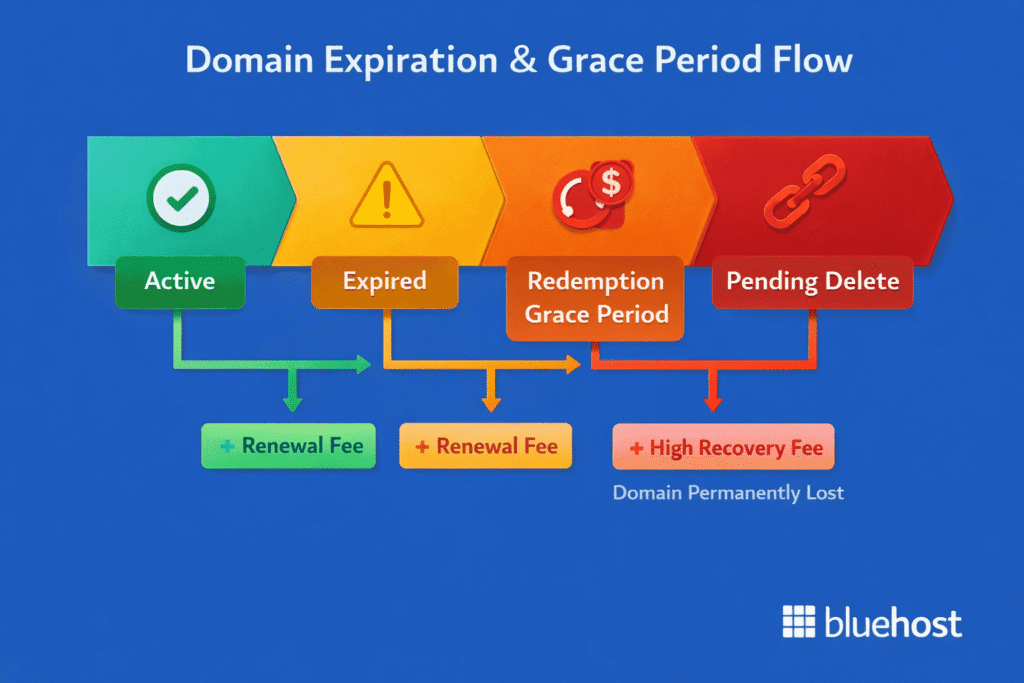
After a domain expires, it goes through three stages: expiration, redemption grace period and pending deletion. Each has different consequences:
- Active: Domain is under your control; renew on time to keep services running smoothly.
- Expired: Website and email stop functioning; renew immediately to keep the domain.
- Redemption grace period: A redemption fee is charged to recover the domain.
- Pending delete: Domain can no longer be retrieved and after 5 days, it’s deleted and made available for public registration.
Missing renewal can impact your website, brand and customers.
Grace periods by ccTLD extension
A grace period provides a final safety window to renew a domain after expiration, yet the cctld renewal timeline varies drastically by region. Unlike generic domains, many country web domains such as .de, .cx and .am enforce a zero grace period policy, resulting in immediate deletion or redemption fees exceeding $200 the moment they expire. Even for users managing free cctlds, missing a critical country code renewal deadline can mean permanent loss of the domain. Always verify the specific rules for your website country code to avoid costly service disruptions.
| Grace policy | Critical extensions | Consequence |
|---|---|---|
| Standard (30-40 Days) | .co, .me, .tv | Renewal allowed at standard rate |
| Zero grace (0 Days) | .de, .am, .cx | Immediate deletion or redemption fee |
What is ccTLDs renewal timeline & cost?
Each country-code top-level domain (ccTLD) has specific renewal deadlines. You must renew your domain before the expiration date to avoid losing it. Below are the renewal timelines based on the domain extension:
| # of days before expiration that the domain Must be Renewed | Top-level domain extensions |
| Up to the date of expiry | .ca .cn com.cn .net.cn .org.cn all regional .cn extensions .co .cx .gd .gs .im .in .co.in .firm.in .gen.in .ind.in net.in .org.in .me .ms .tc .tw .com.tw .org.tw .vg |
| 26 days | .ac .am .be .de .eu .fm .io .nl .sh .co.uk .me.uk .org.uk |
| 57 days | .at .ch .cz .es .com.es .nom.es .org.es .jp .li .mx .com.mx .nu .co.nz .net.nz .org.nz .pl .ru .sg .tk |
Note: Some ccTLDs like .de, .cx and .am have NO grace period and may delete or enter redemption within days of expiration!
Important: Renew your registered domain name before the expiration date to avoid the risk of losing it. We are here to support you with your domain name renewal process; however, we cannot be held responsible for any losses incurred due to missed renewal deadlines.
Cost breakdown example
| Stage | Standard .com | Typical ccTLD |
|---|---|---|
| On-time renewal | $15/year | $15-$50/year |
| Grace period renewal | $15/year | $15-$50/year |
| Redemption recovery | $95 ($80 fee + $15 renewal) | $130-$230 |
| After deletion | Lost forever (or premium auction) | Lost forever |
Money-saving tip: The math is simple – a $15 annual renewal beats a $180 redemption fee every time. Set up auto-renewal!
Creative ccTLD domain hacks: Building memorable brands and understanding your renewal timeline
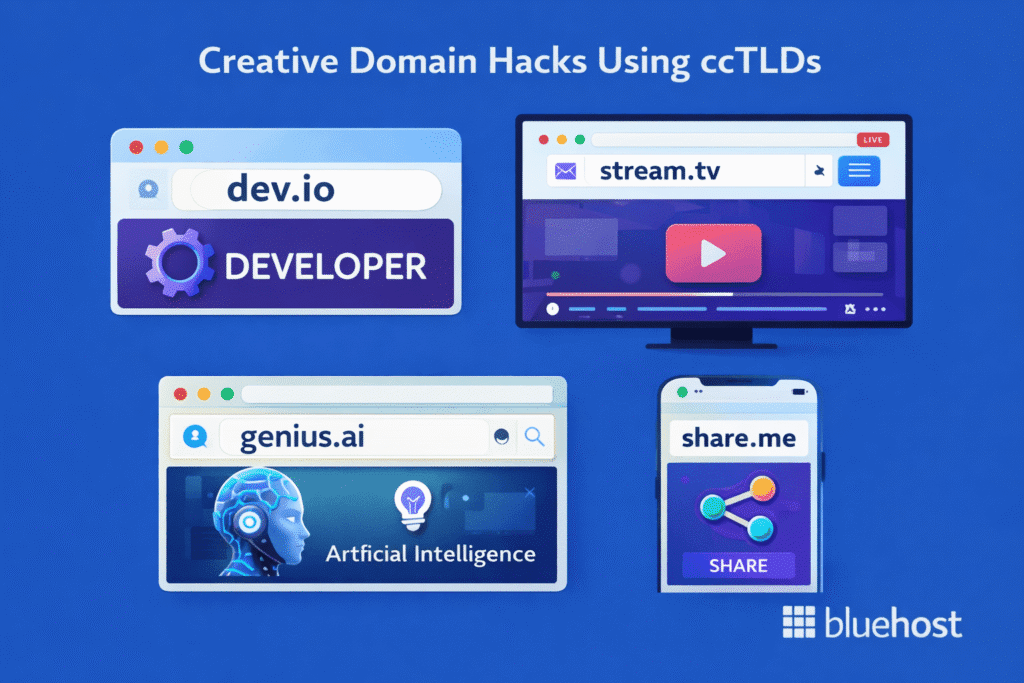
Many businesses and creatives are discovering innovative ways to utilize country web domains beyond their intended geographic borders. One popular strategy is the “domain hack,” where the website country code extension is used to complete a word or phrase. Famous examples include del.icio.us (using the United States’ .us extension) and bit.ly (using Libya’s .ly). These creative combinations allow brands to secure short, memorable URLs that stand out in a crowded digital landscape, effectively turning a standard web address into a domain name strategy when traditional .com options are unavailable.
Beyond wordplay, specific ccTLDs have been adopted by entire industries to signal relevance. The .tv extension (Tuvalu) is now the standard for video streaming, while .io (British Indian Ocean Territory) and .ai (Anguilla) are staples for technology startups and artificial intelligence companies. Similarly, .co (Colombia) acts as a global alternative to .com for commercial enterprises. Since many registries have relaxed restrictions, these domains are widely available for global registration, offering unique branding opportunities. While some users may initially search for free ccTLDs to reduce startup costs, investing in a recognized extension is often crucial for building authority.
While these creative uses offer distinct branding advantages, they still function technically as country codes with specific rules. It is essential to remain vigilant about the unique cctld renewal timeline associated with your chosen extension. Unlike generic domains, the timeline domain owners must follow can vary significantly by region. Tracking these dates ensures you don’t lose your creative brand identity due to an accidental expiration.
ccTLD retirement and discontinuation: What domain owners should know?
While rare, the discontinuation of a website country code is a reality that domain owners should understand. This scenario typically arises from significant geopolitical shifts or the dissolution of a territory, as seen historically with the .yu domain for Yugoslavia or recent discussions regarding the future of the .io extension. Unlike a standard code renewal where you simply extend your registration, a retiring ccTLD effectively ceases to exist, eventually requiring website owners to migrate their digital presence to a new extension.
Fortunately, registries do not shut down established country web domains overnight. The retirement process is highly structured, often spanning several years with ample notice to ensure a smooth transition. During this sunset period, the standard cctld renewal timeline is usually adjusted to prevent long-term registrations and registries provide specific migration paths to alternative domains. This ensures that active businesses have sufficient time to rebrand and redirect their traffic without losing their audience.
It is important to note that major, established extensions like .uk, .de and .ca are extremely stable and unlikely to face retirement. This situation differs significantly from individual domain expiration or the instability sometimes found with temporary free cctlds. Bluehost actively monitors global registry developments and keeps customers informed of any significant policy changes. If a shift affects your specific domain, we provide the necessary guidance to help you secure your website’s future.
Why buy a TLD from Bluehost?
Choosing a TLD from Bluehost simplifies your entire website setup by keeping your domain, hosting and performance tools in one trusted ecosystem. With seamless integration, fast DNS management and WordPress-ready compatibility, Bluehost helps your site go live quicker and perform better from day one.
Add in transparent pricing, free domain offers with eligible plans and 24/7 expert support and you get a reliable foundation that scales with your website as traffic, performance needs and business goals grow.
Final thoughts
Country-code top-level domains represent a powerful tool for businesses looking to build a strong regional presence and establish credibility. They offer clear advantages in local SEO performance and customer trust. However, ccTLDs come with complex and varied renewal timelines that require careful attention and proactive management to avoid costly domain loss.
Whether ccTLDs are used for geographic targeting or creative branding through domain hacks, understanding each extension’s renewal requirements is critical. Missing renewal deadlines can lead to permanent loss of SEO rankings, website & email downtime, erosion of customer trust and loss of brand recognition and digital assets.
Staying informed and renewing on time helps protect your online presence and the long-term value of your domain.
FAQs
A ccTLD (country-code top-level domain) extension is a two-letter domain suffix that represents a specific country or territory, such as .uk for United Kingdom, .ca for Canada or .de for Germany. These extensions are managed by individual countries and help identify the geographic location or target audience of a website.
Most ccTLD domains require annual renewal, though some countries offer multi-year registration options ranging from 1-10 years. The specific renewal timeline varies by country, with some ccTLDs requiring renewal every year while others allow longer registration periods to provide more flexibility for website owners.
Domain renewal is the process of extending your domain registration before it expires to maintain ownership and keep your website accessible. During renewal, you pay the registration fee for another term (typically one year) and update any necessary contact information to ensure continuous service.
Domain registration is the initial process of purchasing and claiming ownership of a new domain name, while domain renewal is the ongoing process of extending that registration to prevent expiration. Registration establishes your first-time ownership, whereas renewal maintains your existing ownership rights.
While most ccTLD extensions require registration fees, some countries offer promotional periods or specific programs that may provide free registration under certain conditions. However, these opportunities are rare and typically have restrictions or requirements that must be met to qualify for free registration.
If you don’t renew your ccTLD before expiration, your domain enters a grace period where you can still renew it, though often at a higher cost. After the grace period expires, the domain becomes available for public registration and you may permanently lose ownership of your website address.



Write A Comment