


Key highlights
- Understand the importance of domain name for website ownership and personal and business branding.
- Learn how a valid domain name improves your website’s search visibility, credibility and control over your own website.
- Discover what is a domain for a website, its components and how the Domain Name System (DNS) works to connect users to your site.
- Explore tips for choosing the right domain registrar and registering a desirable domain name.
- Recognize the benefits of custom domain name, including professional email addresses and full control over your online presence.
From third-party publishing platforms to Facebook pages and groups, internet users have many options for establishing an online presence without owning a domain of their own.
Whether you’re starting a personal blog or building a business, owning your own domain name is a smart move that puts you in control of your brand and the content you create on the web. If you have ever asked yourself, “Why do I need a domain name?”, the experts at Bluehost are here to help.
This guide will cover the importance of domain name for website success, what is a domain for a website and why you need one if you want to start a successful own website.
What is a domain name?
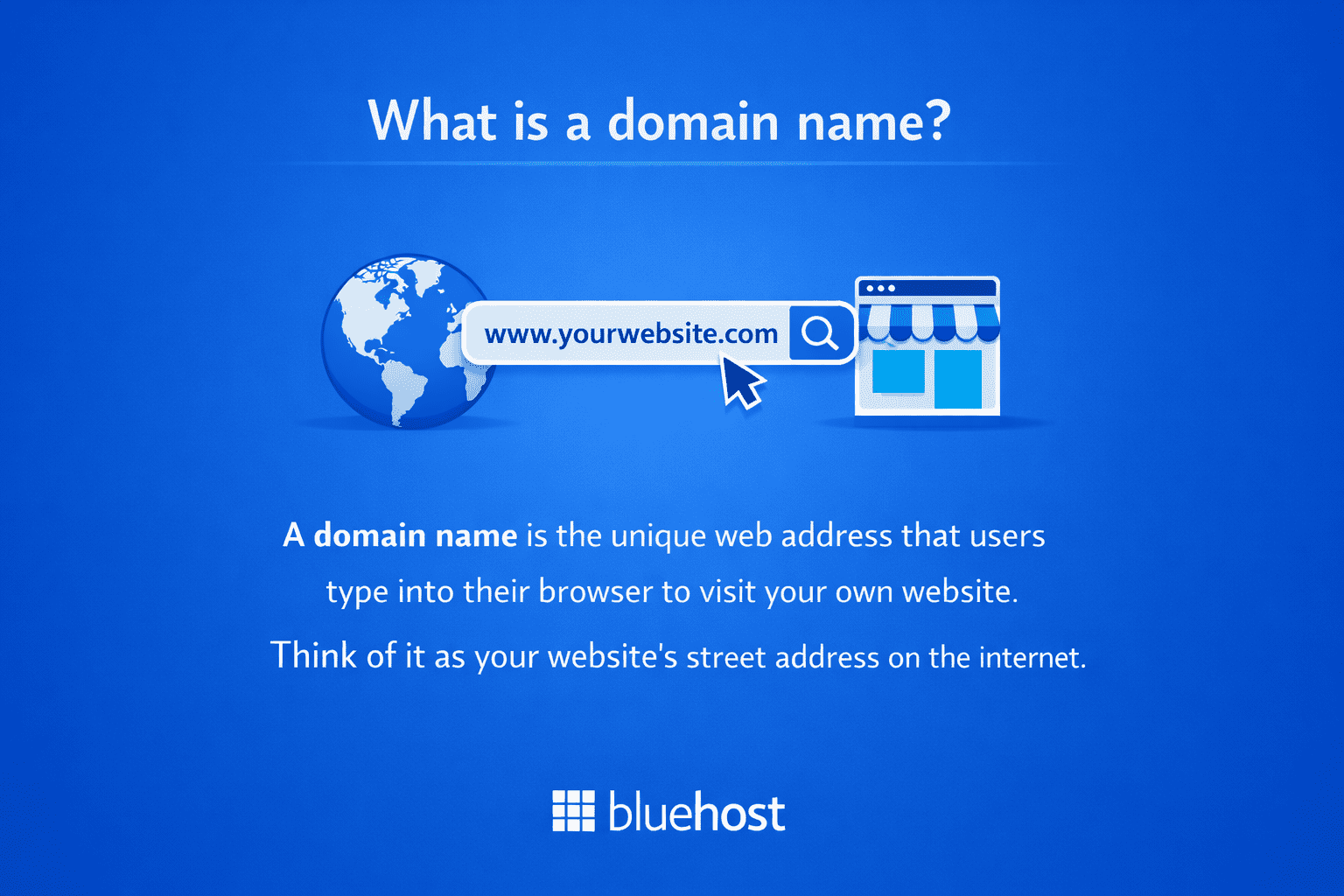
A domain name is the unique web address that users type into their browser to visit your own website. Think of it as your website’s street address on the internet. For example, when you type [yourbusiness].com into a browser, it directs visitors to your website. Without a domain name, people would need to use a complicated numerical string called an IP address to find your site, which isn’t easy to remember or practical.
The Domain Name System (DNS) helps by converting those hard-to-remember IP addresses into user-friendly domain names. DNS acts like a giant directory, ensuring that when someone types your domain name into a browser, they’re directed to the correct website. This system allows people to easily navigate the internet without needing to memorize long strings of numbers.
Key parts of a business domain name structure
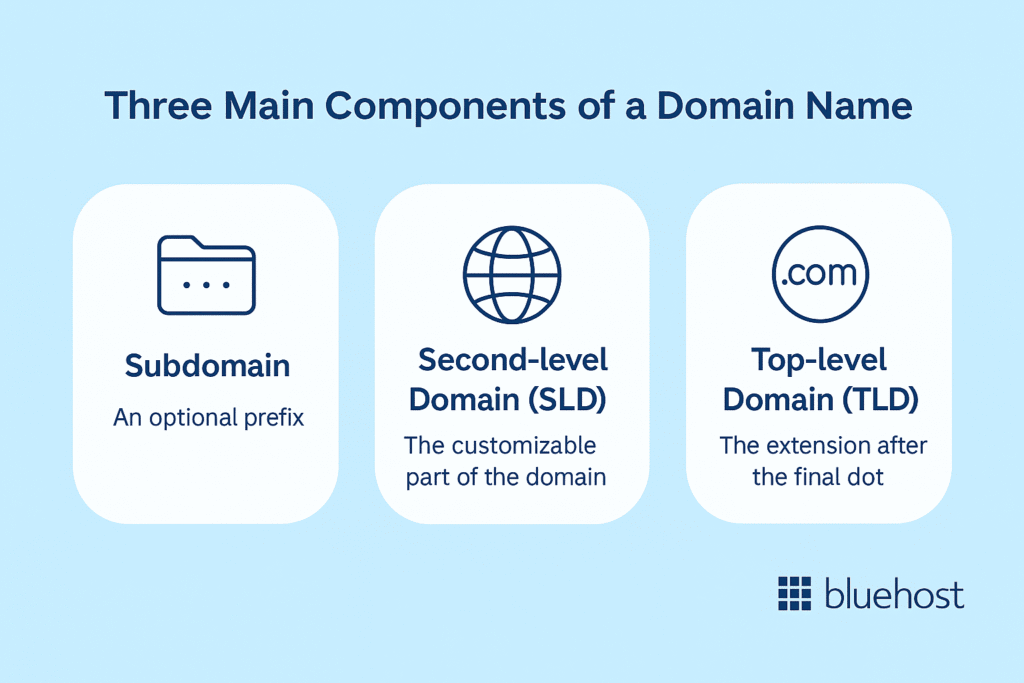
A domain name consists of several parts, each with its own function:
- Top-level domain (TLD): This is the extension that appears after the final dot, such as .com, .net or .org. The TLD helps classify domains based on their purpose or location. While .com is the most commonly used TLD, there are many others such as .edu for educational institutions and .gov for government entities.
- Second-level domain (SLD): This is the customizable part of the domain, often representing your business, brand or project (for example, [yourbusiness].com). It’s the part that makes your domain unique and memorable.
- Subdomain: A subdomain is an optional prefix that can be used to organize different sections of your website. For example, you might use store.[yourbusiness].com to direct users to your online shop, while blog.[yourbusiness].com takes them to your blog. Subdomains are useful for separating parts of your site without needing to register a whole new domain.
Also read: How Do Domains Work? The Ultimate Guide
How a domain name system works?
When you enter a domain name into your computer or browser, the DNS acts as an intermediary, converting the domain name into its associated IP address. This process ensures that users are directed to the correct website hosted on a server. The DNS system is crucial for maintaining the seamless flow of information on the web, enabling billions of websites to remain accessible without confusion.
The Domain Name System is overseen by various domain name registries and coordinated by the Internet Corporation for Assigned Names and Numbers (ICANN), which plays a key role in managing the global internet infrastructure.
Types of top-level domains (TLDs)
There are several types of TLDs to choose from, and each serves a different purpose:
- Generic TLDs (gTLDs): These include common extensions like .com, .net and .org. They’re not tied to any specific region, making them the most versatile option for websites of any type. These generic domains are widely used and recognized.
- Country-code TLDs (ccTLDs): These two-letter extensions, such as .co.uk (United Kingdom) or .de (Germany), are used to represent specific countries or regions. Businesses often use these if they operate in particular countries to appeal to a local audience.
- Specialized TLDs: There are newer, more specialized TLDs, such as .shop, .tech or .bio, which are industry-specific. These are great options for businesses looking to highlight their niche or focus area.
Many businesses still prefer .com because of its universal recognition, but depending on your industry, there are plenty of creative options to help your brand stand out.
Once you’ve decided on the right domain extension, registering and managing it should be just as easy. With Bluehost, you get a full suite of domain services designed to help you find, secure and control the perfect web address, all from one dashboard.
When you choose Bluehost for your domain needs, you get:
- Easy domain search and registration: Quickly find and register available domain names using Bluehost’s intuitive search tool.
- Wide selection of TLDs: Pick from hundreds of extensions including .com, .net, .org, .online, .store and many more to match your brand vision.
- Domain privacy & protection: Add Domain Privacy + Protection to keep your personal contact information out of public WHOIS records and reduce spam.
- Domain management tools: Use the control panel to manage DNS records, set auto-renewal, enable domain forwarding, lock domains against unauthorized transfers and more.
- Free domain with hosting plans: Many Bluehost hosting and WordPress plans include a free custom domain for the first year, helping you get started at no extra cost.
- Branded professional email (optional): After registration, you can set up email services with your domain so your address matches your brand (e.g., [name@yourbusiness].com).
- Domain transfers: Already own a domain? Bluehost makes it easy to transfer it into your Bluehost account and manage everything together.
- 24/7 expert support: Get help anytime via live chat or phone from Bluehost’s support team for any domain questions or technical setup needs.
Whether you’re launching your first site or building a brand, Bluehost gives you all the tools you need to secure and manage your domain effectively.
Domain name vs. URL
When exploring what is a domain name for a business, it is important to distinguish it from a URL. Your domain name is the human-friendly identity customers use to find your brand, such as [yourbusiness].com.
A URL (Uniform Resource Locator) is the complete web address that includes the protocol (https://), subdomains (www), the domain name and the specific file path (/services or /about), providing the exact digital coordinates for a single page on the internet.
| Feature | Domain name | URL |
|---|---|---|
| Definition | The unique, memorable name of your website. | The full address used to locate a specific resource. |
| Components | Name and extension (e.g., .com, .net). | Protocol, domain, subdomain and file path. |
| Example | [yourbrand].com | https://www.[yourbrand].com/contact-us |
Understanding this distinction is crucial for managing your online presence, troubleshooting technical issues and improving SEO. For example, while https://[yourbrand].com serves as your homepage URL, https://[yourbrand].com/blog points to a specific section. Similarly, https://store.[yourbrand].com utilizes a subdomain structure for eCommerce.
When configuring DNS records, knowing whether you are managing the root domain or a specific URL path is vital to prevent common setup errors and ensure your business site remains accessible and functional.
Why is a domain name important?
Owning a domain name is essential for establishing a unique online identity, whether you’re an individual or a business. It provides control over your web presence, builds credibility, enhances search visibility and helps you stand out from competitors. Both personal and professional domain name uses make securing a custom domain a smart investment for your digital future.
Why individuals need a domain name?
Owning a domain name isn’t just for businesses. Whether you’re a freelancer, creative professional or hobbyist, having a domain offers numerous benefits of custom domain name that free platforms can’t provide. Here are five key reasons why individuals should secure their own domain name:
1. Establish your personal brand identity
A domain name allows you to build a personal brand that reflects your unique identity. For example, a custom domain like [janesmithportfolio].com helps you create a professional, personal website that showcases your talents, skills or hobbies. This sets you apart from others who rely on third-party platforms.
2. Control your online presence
With your own domain, you’re in full control of how your website looks, what content is featured and how it’s presented. Free platforms often limit customization, but a custom domain lets you design your website to match your personal vision.
3. Make a memorable impression
A simple and personalized domain name, such as [johnsonwrites].com for a writer, is far easier to remember than something like [thirdpartyplatform].com/username. A memorable web address makes it more likely that visitors will return, especially if your site is part of your portfolio, blog, marketing or side business.
4. Secure your online identity for the future
Even if you’re not ready to launch a full website, reserving your name as a domain prevents others from taking it. As the internet grows, securing your domain name now ensures that it’s available when you’re ready to use it. Plus, if your personal brand grows, having your desired domain name will protect you from potential impersonation.
5. Enhance credibility and professionalism
Whether you’re applying for jobs, pitching clients or showcasing your work, a custom domain shows that you’re serious about what you do. A professional website with a personalized web address can give you a competitive edge and leave a lasting impression on potential employers or clients.
Why businesses need a domain name?
For businesses, a domain name is a cornerstone of building a strong online presence. It’s not just about having a web address, it’s about building trust, credibility and visibility. Here are five compelling reasons why every small business really should own a domain name:
1. Boost credibility and trust
A custom domain, like [yourcompany].com, signals professionalism and legitimacy to potential customers. A website hosted on a free platform with a subdomain (like [yourbusiness].[hostsite].com) can look untrustworthy. Owning your own domain reassures visitors that your business is established, legitimate and credible.
2. Enhance search engine visibility
Search engines favor websites with custom domain names when determining rankings. If you’re looking to improve your SEO efforts, a custom domain name is essential. It helps your business website appear higher in search results, driving more traffic to your site.
3. Professional email addresses
A custom domain allows you to create branded email addresses, such as info@[yourbusiness].com. Professional email addresses strengthen your brand and build trust with customers. They are also more memorable than generic email services like Gmail or Yahoo, giving your business a polished, professional look.
Also read: How to Create Email with Own Domain – Step by Step Guide
4. Full control of your website
With a custom domain, you’re not dependent on third-party platforms or their terms of service. You have complete ownership and control over your website’s content, design and functionality. If a social media platform changes its policies or closes down, your website remains unaffected, ensuring that your business always has a stable presence online.
5. Stand out from competitors
In competitive industries, having your own domain helps you stand out. A domain name that clearly reflects your business, like [bestbakeshop].com, is more memorable and distinctive than a generic subdomain. It also shows that you’re serious about your business, which can make a difference when customers are deciding where to take their business.
Who should get a domain name?
Anyone building a lasting online presence, whether for business, personal branding or creative work, benefits from owning a domain name. A custom domain signals commitment, builds trust and gives you full control over your digital identity, making it essential for anyone who wants to be taken seriously online.
- Small business owners: Establish credibility and improve local search visibility, helping customers find you more easily than competitors who rely only on social media.
- Local service professionals: Build a trusted hub for client referrals and lead generation with professional email addresses that reinforce your expertise.
- Bloggers and content creators: Protect your content and maintain full monetization control, independent of platform policy changes.
- Freelancers and consultants: Create a memorable digital portfolio that sets you apart from marketplace profiles.
- Job seekers: Demonstrate professional initiative by hosting your resume and work samples at a personal domain.
- Nonprofits: Build donor trust with a .org domain that provides a permanent campaign home beyond social media algorithms.
- Agencies: Manage multiple client projects with organized subdomains while maintaining brand separation.
- eCommerce sellers: Gain customer trust and control over data and marketing that third-party marketplaces cannot provide.
Even if you’re not ready to launch your site immediately, register your ideal domain name as soon as you’ve settled on a business name or brand identity. Domain names are claimed on a first-come, first-served basis and waiting could mean losing your preferred name to someone else, making early registration a small investment that protects your future online presence.
Tips for registering a domain name
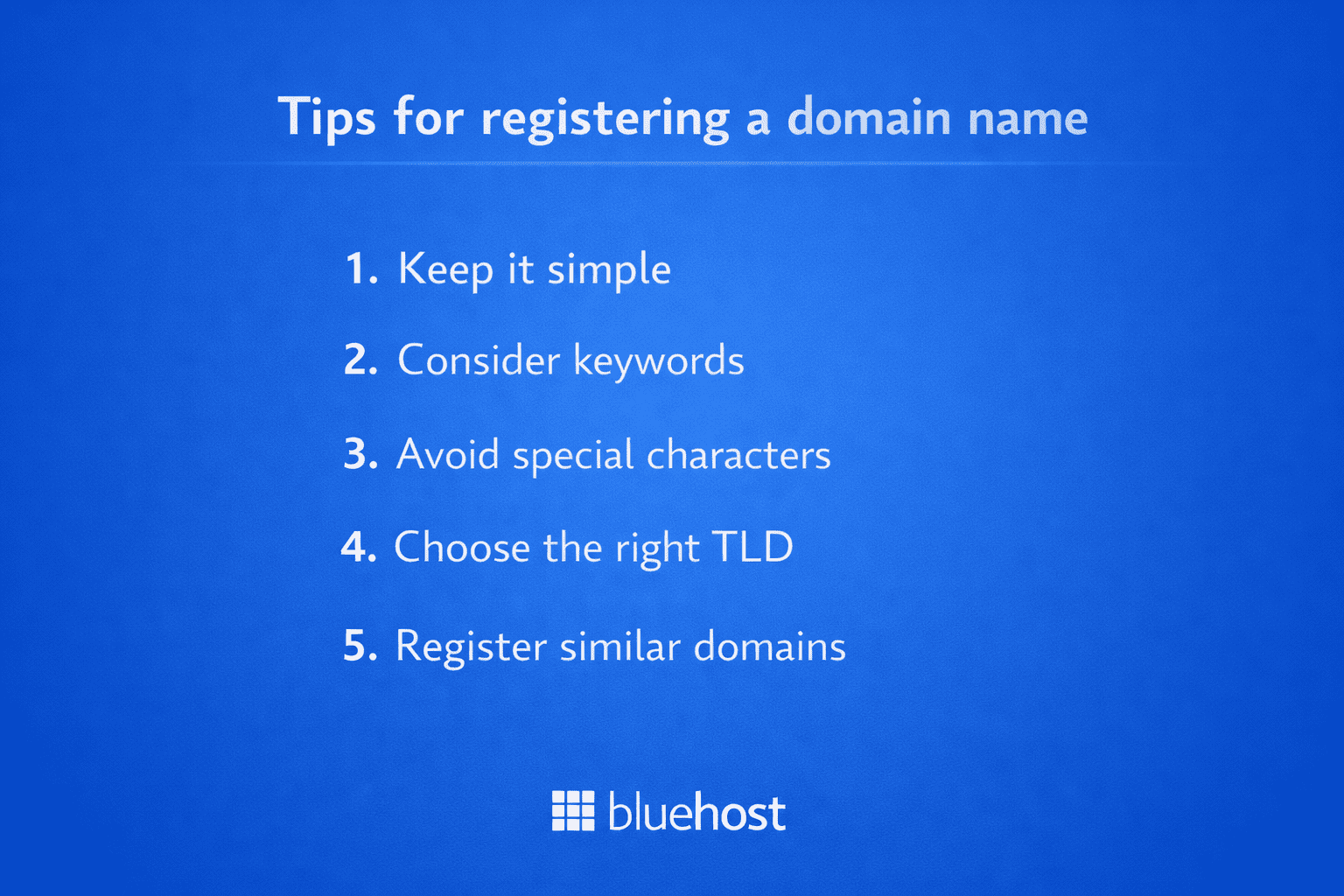
Choosing the right domain name is a crucial step in establishing your online presence. Here are some expanded tips to guide you through the process:
1. Keep it simple
Your domain name should be easy to remember and type. Simplicity is key—choose a name that is short, straightforward and free of any unnecessary complexity. Aim for one or two words if possible. Complicated domain names can lead to errors when people try to search for your website, which could result in lost visitors. For example, [bluehostdesign].com is far more memorable and user-friendly than [the-best-web-design-hosting].com.
Tip: If your ideal domain name is unavailable, consider slight variations, but avoid making it too complex.
2. Consider keywords
Incorporating relevant keywords into your domain name can boost your search engine optimization (SEO). Keywords should reflect what your website or business is about, helping potential visitors quickly understand your content.
For example, a hosting services provider might choose a domain like [besthostingsolutions].com. Including keywords can make your website easier to find when people search for related topics.
However, don’t overstuff the domain with too many keywords, keep it natural and brand-focused.
Tip: Use tools like Google Keyword Planner to find high-ranking keywords that could fit your desired domain name.
Also read: How to Register a Domain Name
3. Avoid special characters
Numbers, hyphens and other special characters can make a domain harder to remember and they’re often mistyped. People might not remember where the hyphen goes or they could forget the number altogether, leading them to the wrong site. For example, [webhosting4all].com or [web-hosting-services].com could confuse users compared to something simpler like [webhostcentral].com.
Stick with letters only to keep your domain user-friendly and free of potential mistakes.
Tip: If your brand or business name contains a hyphen or number, consider registering both versions of the domain to ensure all visitors find you.
4. Choose the right TLD
While .com is the most recognizable and trusted TLD, it’s not the only option available. Depending on your industry, other TLDs could make more sense and even help you stand out. For example, .shop is great for eCommerce businesses, .tech for tech companies and .design for creative professionals.
Using an industry-specific TLD can also convey what your business is about before visitors even reach your site. That said, .com remains the most common and familiar, so it’s worth prioritizing if it’s available.
Tip: Check for new and emerging TLDs that could align with your niche, there are constantly new ones being released, such as .co, .blog or .app.
Also read: How to Choose Your Domain Name | Everything You Need to Know
5. Register similar domains
To protect your brand, consider registering multiple variations of your domain name. For example, if you own [yourbusiness].com, you might also want to secure [yourbusiness].net or [yourbusiness].co to prevent others from using similar domains. This strategy is particularly helpful if your brand becomes well-known, as it safeguards against competitors or other parties potentially confusing your customers by using similar names.
Additionally, if your domain name contains common misspellings, you can register those variations as well and redirect them to your primary site. For example, if your brand name has an unusual spelling, securing the commonly misspelled version ensures that even if visitors make a mistake, they’ll still land on your website.
Tip: Securing your company or brand on multiple TLDs also helps protect against cyber-squatting, where someone buys up domain names similar to your brand and tries to sell them back at a premium.
Final thoughts
Owning a domain name gives you control, credibility and a professional edge. Whether you’re building a personal brand or growing a business, a custom domain makes you stand out and shows you’re serious about your online presence.
Ready to get started? Secure your ideal domain name with Bluehost and set the stage for your digital success..
FAQs
A domain name is essential because it serves as your website’s unique address on the internet. It helps visitors easily find and remember your site, establishes your brand identity and provides you with full control over your online presence.
The importance of a domain name for a website lies in its ability to build credibility, improve search engine rankings and create a professional image. It also enables you to have a memorable web address that differentiates your site from competitors.
Benefits of a custom domain name include enhanced brand recognition, improved trust and professionalism, the ability to create branded email addresses and greater control over your website’s design and content.
A domain name is important because it establishes your unique identity online, increases your website’s visibility in search results and helps protect your brand. It is a key part of your digital strategy, whether you are a business or an individual looking to build a strong online presence.
Yes, getting a custom domain name is highly recommended as it provides you with credibility, control and a professional appearance. It also helps you stand out in search engines and makes your website easier to find for potential customers or visitors.
Domain name uses include hosting a website, creating professional email addresses, setting up online stores, managing personal portfolios and forwarding to social media or other online platforms to consolidate your digital presence.
Without a domain name, your online presence is limited to third-party platforms, which can restrict customization and control. You’ll be assigned a subdomain (like [platformname].com/yourname) that may not look professional or memorable. If the platform you’re using changes its rules or goes offline, you could lose all your content and online visibility.
A domain name is your business’s unique digital address, acting as a virtual storefront that directs customers to your website. By translating your URL into an IP address via the DNS, it ensures your brand is accessible to visitors worldwide 24/7.
While not mandatory, a domain name is essential for building a professional and credible online presence. Overall, it provides businesses with trustworthiness and gives individuals control over their personal brand and digital identity.



Write A Comment