 ChatGPT,
 Claude,
 Gemini,
 Grok — all four for

Key highlights
- Understand the differences between AI Receptionists, IVR systems and auto-attendants to choose the right solution for your business.
- Compare how each system handles real customer interactions, from call routing to appointment booking and lead qualification.
- Discover which businesses benefit most from AI Receptionists and when traditional IVR still makes the most sense.
- Uncover the hidden operational costs of traditional call handling, including missed leads, manual scheduling and customer frustration.
- Learn how to transition from IVR to an AI Receptionist and explore how Bluehost AI Receptionist supports modern customer conversations.
Businesses have long relied on auto-attendants and interactive voice response (IVR) systems to manage incoming calls, route customers and reduce the workload on reception staff. While these tools are effective for directing callers, they typically follow predefined menus that can make even simple enquiries feel time-consuming.
AI Receptionists take a more conversational approach. Instead of asking callers to navigate menu options, they understand natural language, answer business-specific questions, book appointments and escalate complex requests when needed.
Each solution serves a different purpose, and the right choice depends on your business goals, customer expectations and call volume. In this guide, we’ll compare AI Receptionists, traditional IVR systems and auto-attendants, explain where each works best and help you decide which solution is the right fit for your business in 2026.
What is an AI Receptionist?

An AI Receptionist is an AI-powered virtual receptionist that interacts with customers using natural, conversational language instead of fixed menu options. Rather than asking callers or website visitors to “press 1 for sales” or “press 2 for support,” it understands customer intent, answers questions and helps complete routine tasks without requiring immediate human involvement.
A modern AI Receptionist can typically:
- Provide support 24/7 across customer interactions.
- Understand customer requests using conversational AI.
- Answer business-specific questions using your website or knowledge base.
- Book appointments and manage scheduling.
- Qualify leads by collecting relevant customer information.
- Escalate complex enquiries to a human team member.
Unlike traditional phone systems that primarily route calls, an AI Receptionist aims to resolve customer enquiries whenever possible, helping businesses automate routine interactions while keeping human support available for more complex requests.
What is an IVR system?
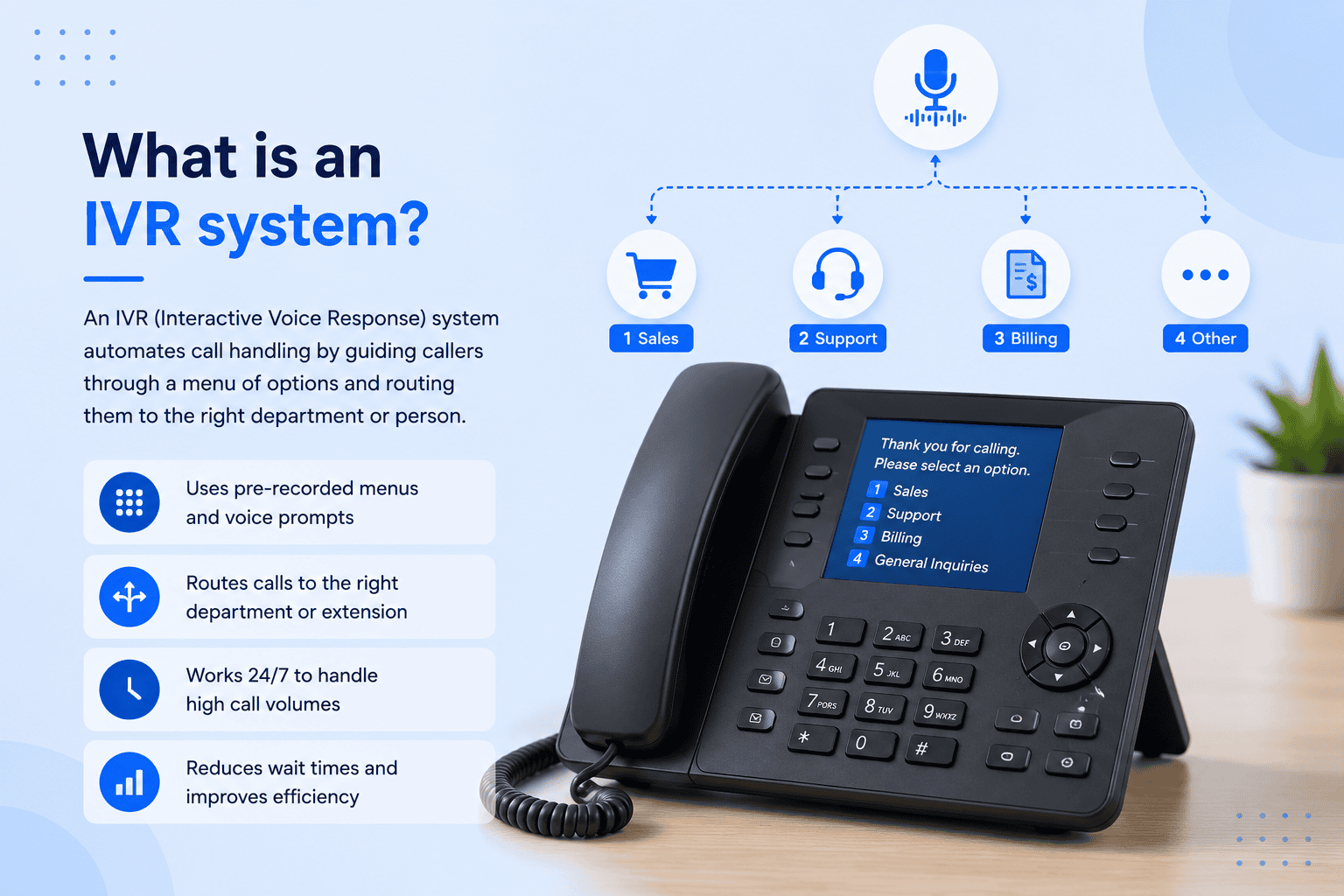
An IVR (Interactive Voice Response) system is an automated phone technology that answers incoming calls and guides customers through predefined menu options. It helps businesses manage high call volumes by routing callers to the appropriate department or providing basic self-service options before a live agent gets involved.
A traditional IVR system typically allows businesses to:
- Route calls using keypad inputs (DTMF or dual-tone multi-frequency signals).
- Recognize simple voice commands through speech recognition.
- Direct callers to departments such as sales, support or billing.
- Share pre-recorded information like business hours or account updates.
- Reduce receptionist workload by automating repetitive call routing.
IVR systems first gained popularity in large enterprises such as banks, airlines, healthcare organizations and government agencies, where handling thousands of calls efficiently was a priority. Today, they remain a reliable choice for businesses with predictable call flows and high-volume routing needs. However, because IVRs follow predefined menus and scripts, they generally cannot understand complex requests or engage in natural, back-and-forth conversations the way an AI Receptionist can.
AI Receptionist vs IVR system: Key differences at a glance
The main difference between an AI Receptionist, an IVR system and an auto-attendant is how much each system can understand and accomplish. An auto-attendant mainly routes calls, IVR supports structured menus and self-service workflows and an AI Receptionist can interpret conversational requests and help customers complete tasks.
| Feature | AI Receptionist | Traditional IVR system |
|---|---|---|
| Understands natural language | Yes, interprets conversational requests and customer intent | Limited; usually recognizes predefined words or phrases |
| Call routing | Routes based on the customer’s request or intent | Routes through keypad or voice-menu selections |
| Answers business questions | Yes, using connected business information or a knowledge base | Limited to prerecorded or predefined responses |
| Appointment booking | Can book appointments when connected to a scheduling system | Possible through a structured workflow, but often requires additional configuration |
| Lead qualification | Can ask follow-up questions and collect lead details | Limited to fixed questions and responses |
| CRM integration | Often available, depending on the platform | Available on many advanced enterprise systems |
| Calendar integration | Can connect with calendars for real-time scheduling | Possible, but usually requires custom integration |
| After-hours support | Can answer questions and complete routine tasks 24/7 | Can provide menus, prerecorded information and self-service options |
| Handles simultaneous enquiries | Yes, subject to the provider’s plan and capacity | Yes |
| Learns from business updates | Responses can be updated through websites, documents or knowledge bases | Call flows and scripts must usually be updated manually |
| Setup effort | Requires business information, rules, integrations and testing | Requires call-flow planning, menu design and technical configuration |
| Personalization | Can adapt responses using customer context and business information | Limited to predefined caller data and workflow branches |
| Analytics | May provide conversation, enquiry and performance insights | Commonly provides call-flow and routing analytics |
| Best for | Businesses that need conversational support, lead capture or appointment booking | Organizations with high call volumes and predictable self-service workflows |
| Typical limitations | Requires accurate business information, careful setup and human escalation rules | Menu-heavy experiences can frustrate callers with complex requests |
In simple terms, an auto-attendant directs the call, an IVR guides the caller through a structured process and an AI Receptionist understands the request and attempts to resolve it. However, available features vary by provider, plan and integration setup.
How each system handles the same customer call?
The clearest way to understand the difference between an AI Receptionist and IVR is to see how each responds to the same request.
Scenario 1: Dental clinic
Caller: “I chipped my tooth. Can I come today?”
- AI Receptionist: Understands that the request may be urgent, checks appointment availability, collects the caller’s details and confirms a suitable time.
- IVR system: Asks the caller to select an option such as “Press 2 for appointments,” then routes them to the scheduling team or a recorded queue.
Scenario 2: Law firm
Caller: “I need help with a contract.”
- AI Receptionist: Asks what type of contract is involved, collects basic case details and routes or escalates the enquiry to the appropriate legal team.
- IVR system: Directs the caller through options such as corporate law, family law or existing clients before transferring the call.
Scenario 3: Plumbing company
Caller: “My basement is flooding.”
- AI Receptionist: Identifies the request as urgent, gathers the address and contact details and helps connect the caller with emergency services.
- IVR system: Asks the caller to select emergency service from a menu, then places them in a queue or transfers the call.
Scenario 4: Restaurant
Caller: “I’d like to reserve a table for six.”
- AI Receptionist: Asks for the preferred date and time, checks availability and confirms the reservation.
- IVR system: Routes the caller to reservations or provides instructions for booking through another channel.
In each case, the auto-attendant focuses on routing, the IVR guides the caller through a predefined process and the AI Receptionist attempts to understand and complete the request.
Also read: What Is an AI Chatbot? A Beginner’s Guide
When does a traditional IVR still make sense?
Despite the rise of conversational AI, traditional IVR systems continue to play an important role in many industries. They are designed to efficiently route large volumes of calls through predefined workflows, making them a reliable choice when customer requests are predictable and processes must follow specific business or regulatory requirements.
A traditional IVR may still be the better choice if your business:
- Handles thousands of calls daily: Banks, airlines, utilities and government agencies often use IVRs to direct callers to the correct department before connecting them with an agent.
- Follows structured, repeatable workflows: Tasks such as checking account balances, paying bills, confirming flight details or reporting service outages can be completed using standardized menu options.
- Has strict compliance or security requirements: Many organizations require callers to verify their identity or navigate approved workflows before speaking with a representative.
- Needs dependable call routing: IVRs excel at directing customers to the appropriate team, reducing manual call transfers and helping distribute high call volumes more efficiently.
That said, IVR systems work best when customer journeys are predictable. When callers have unique questions, need personalized assistance or want to complete tasks through a natural conversation, menu-based workflows can become frustrating. In those situations, an AI Receptionist can complement or replace traditional IVR by understanding customer intent instead of relying solely on predefined menu selections.
Also read: AI Customer Service Automation Features for Faster Workflows
When is an AI Receptionist the better choice?
An AI Receptionist is often the better fit when customers need more than basic call routing. It works well for businesses that rely on appointments, lead capture, fast responses or frequent customer questions but do not always have staff available to handle every enquiry.
It can be especially useful for:
- Small businesses: Respond to enquiries without adding full-time reception coverage.
- Healthcare practices: Answer routine questions, collect basic information and support appointment scheduling.
- Law firms: Capture enquiry details and direct prospective clients to the right legal service.
- Home service providers: Identify urgent requests, collect job information and help schedule visits.
- Real estate businesses: Qualify property enquiries and arrange viewings or consultations.
- Agencies: Handle discovery requests, gather lead information and book introductory calls.
- Salons and wellness businesses: Manage service questions and appointment requests outside working hours.
- Coaches and consultants: Qualify prospects and schedule sessions without interrupting client work.
In general, an AI Receptionist is most valuable for appointment-driven businesses where missed calls can mean missed revenue. It can respond 24/7, handle routine requests consistently and escalate conversations when a customer needs human assistance.
Also read: Front Desk Automation: Benefits, Features & Examples
The hidden costs of traditional IVR auto attendant
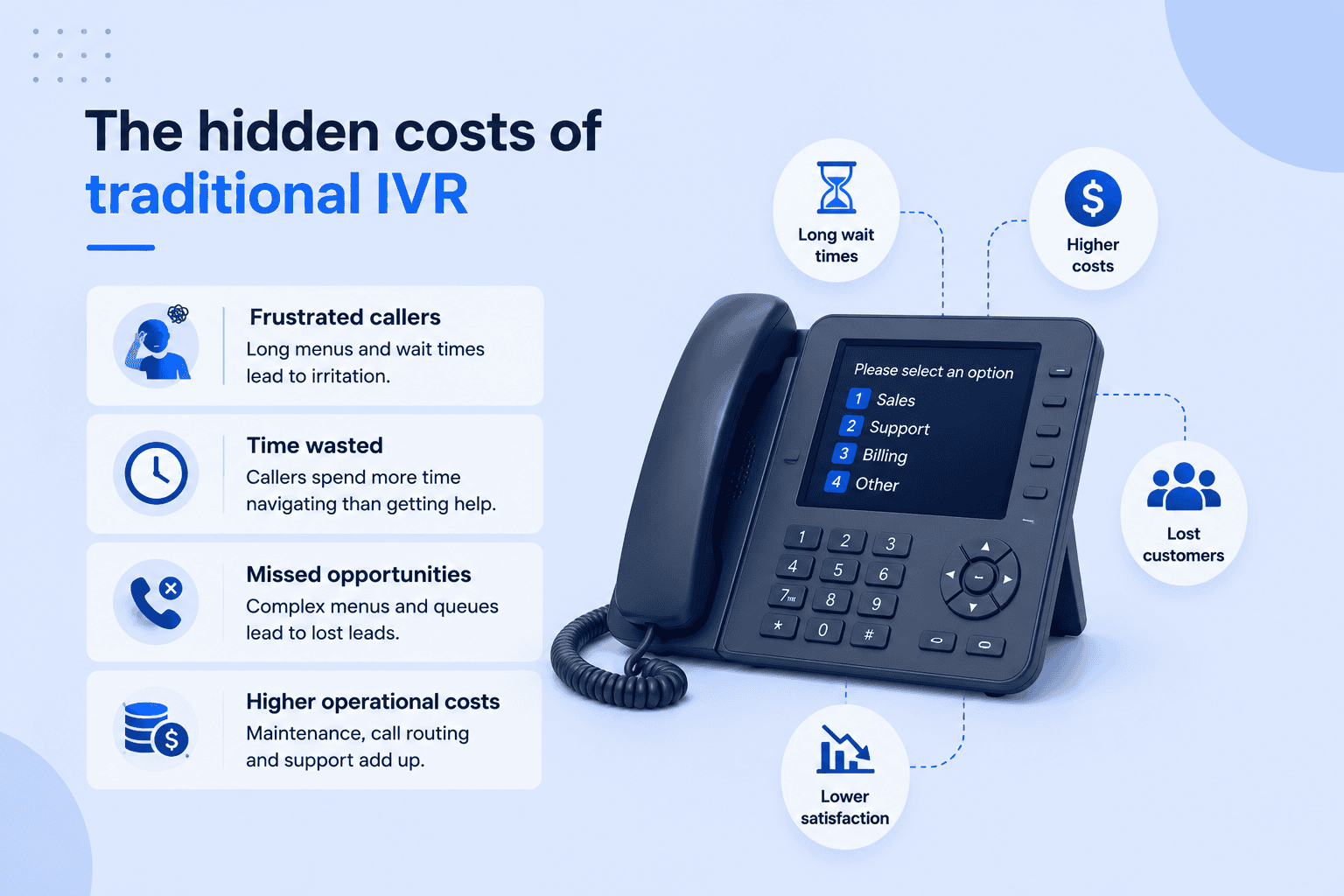
When comparing an AI Receptionist with an IVR or auto-attendant, it’s easy to focus on software pricing alone. However, the bigger costs often come from inefficient customer interactions, manual work and missed business opportunities.
Here are some hidden costs to consider:
- Abandoned calls: Long wait times or confusing menu options can cause potential customers to hang up before reaching the right person.
- Missed leads: Calls that go unanswered after business hours or are sent to voicemail may result in lost enquiries and revenue.
- Employee interruptions: Receptionists and office staff often spend significant time answering repetitive questions instead of higher-value work.
- Menu maintenance: IVR menus, extensions and recorded messages require regular updates as teams, services or business hours change.
- Customer frustration: Repeating information, navigating multiple menu options or being transferred between departments can negatively affect the customer experience.
- Manual scheduling: Without integrated appointment booking, staff must coordinate calendars, return calls and confirm bookings manually.
- Inconsistent information: Different employees may provide different answers, while outdated recordings can confuse customers if they are not updated promptly.
- Training and onboarding: New reception staff need time to learn common questions, routing procedures and booking processes, adding ongoing operational costs.
These costs may not appear on a monthly software invoice, but they directly impact customer satisfaction, team productivity and revenue. Looking beyond subscription pricing gives a more accurate picture of the long-term value of each solution.
Also read: 25 Best AI Productivity Tools to Boost Work Efficiency in 2026
How does Bluehost AI Receptionist fits modern businesses?
For many businesses, the goal isn’t simply to replace an IVR or auto-attendant—it’s to create a better customer experience while reducing repetitive work for employees.
Bluehost AI Receptionist is designed to help businesses engage customers through natural conversations rather than menu-driven interactions. Instead of asking visitors to navigate predefined options, it uses your business information to answer questions, qualify enquiries and support appointment booking through Google Calendar. The result is a more personalized experience that can continue even when your team is offline.
Key capabilities include:
- Business-specific responses: Trained on your website, documents and knowledge base to provide answers relevant to your business.
- Conversational customer interactions: Understands customer intent instead of relying on fixed menus or scripted responses.
- Google Calendar integration: Lets customers book, reschedule or cancel appointments based on real-time availability.
- Customizable brand experience: Configure your business hours, communication style and brand voice during setup.
- Human handoff: Supports escalation to your team when enquiries require personal attention.
- 24/7 customer support: Answers routine questions and captures leads even outside normal business hours.
For businesses that depend on appointments, consultations or customer enquiries, Bluehost AI Receptionist extends beyond traditional call routing by helping customers get answers, complete routine tasks and connect with your team more efficiently.
Final thoughts
The choice between an AI Receptionist, IVR and auto-attendant is not simply about choosing the newest technology. It comes down to what happens when a customer contacts your business and what you need the system to do next.
An auto-attendant may be enough when callers only need to reach the right department. IVR still works well for high-volume, predictable workflows. But when customers expect to ask questions in their own words, receive an immediate response or complete tasks such as booking an appointment, an AI Receptionist may offer a more practical experience.
Bluehost AI Receptionist is built for businesses that want to move beyond menu-driven interactions. It uses your website and business documents to answer routine questions, supports appointment booking through Google Calendar and keeps human handoff available when personal assistance is needed.
Ready to move beyond menu-driven customer support? Explore Bluehost AI Receptionist.
FAQs
AI is not replacing IVR in every situation. IVR remains useful for high-volume, structured workflows such as account verification, bill payments and basic call routing.AI Receptionists are becoming a stronger alternative when businesses need natural conversations, appointment booking, lead qualification and more flexible customer support.
An auto-attendant mainly greets callers and routes them using simple menu options. IVR is more advanced and can support structured self-service tasks through keypad inputs or basic voice recognition. Neither typically offers the same conversational understanding as an AI Receptionist.
Yes. An AI Receptionist can remain available outside normal business hours to answer routine questions, collect customer information and support appointment requests. Available channels and capabilities depend on the provider and setup.
Not necessarily. An AI Receptionist is best used to handle repetitive enquiries, scheduling and basic lead capture while human employees manage sensitive, urgent or complex conversations. A clear human escalation path should remain part of the customer experience.
Yes. IVR is still widely used by banks, airlines, healthcare organizations, utilities and government agencies. It remains effective when call volumes are high and customer journeys follow predictable, standardized workflows.
AI Receptionists are especially useful for appointment-driven and service-based businesses, including healthcare practices, law firms, home service providers, real estate agencies, salons, consultants and small businesses that receive frequent customer enquiries.
Traditional IVR relies on predefined menus and routing rules. Bluehost AI Receptionist uses your website, documents and business information to answer customer questions through conversational interactions. It also supports Google Calendar booking, customizable responses, 24/7 availability and human handoff when needed.

Write A Comment