 ChatGPT,
 Claude,
 Gemini,
 Grok — all four for
AI agents are becoming a practical way to automate workflows, handle repetitive tasks and power intelligent applications. As teams explore Hermes Agent, one key question comes up: should you choose self-hosting Hermes Agent or use a managed AI agent hosting solution?
The right choice depends on your technical expertise, budget, security needs and long-term goals. Self-hosting gives you more control over infrastructure, data, integrations and AI workflows, while managed AI hosting reduces setup and maintenance work.
In this guide, we compare both options across setup, performance, security, scalability and cost to help you choose the right path.
What is Hermes agent hosting?
Hermes Agent is an open-source AI agent from Nous Research designed to automate tasks, use tools and maintain context across interactions. It supports persistent memory, autonomous skill creation, web search, image generation and multi-platform messaging through channels like Telegram, Discord and Slack.
With a built-in learning loop, Hermes Agent can retain conversation history, create skills and support automation, research and AI-powered workflows.
One of the most common ways to deploy Hermes Agent is through self-hosting, which gives you greater control over the environment and infrastructure.
What is self-hosting Hermes agent?
Self-hosting Hermes Agent means running the agent on infrastructure you control, such as a VPS, cloud VM, dedicated server or on-premises environment. Unlike managed AI agent hosting, you own the environment, configuration and operational decisions.
Many users choose to host Hermes Agent on VPS infrastructure because it provides dedicated resources, scalability and full root SSH access without the higher cost of dedicated hardware.
With self-hosting, you are responsible for:
- Installing Hermes Agent
- Running the Hermes setup wizard
- Managing operating system updates
- Configuring Hermes settings and API keys
- Securing the server environment
- Monitoring performance and uptime
- Managing backups and recovery
- Scaling resources as workloads grow
A typical Hermes Agent deployment includes a VPS plan or cloud VM, a supported LLM provider and Hermes configuration settings. It also requires messaging gateway integrations and persistent storage for conversation history and knowledge retention.
Also read: Best VPS for Hermes Agent: Top Picks for Reliable Performance
Once deployed, the agent runs continuously on the server. This allows it to process requests, automate workflows and maintain persistent memory even when your local machine is offline.
Benefits of self-hosting Hermes Agent
Self-hosting Hermes Agent gives teams more control over how their AI agent is deployed, configured and scaled. It is useful for technical users who want ownership over infrastructure, data, model providers and integrations.
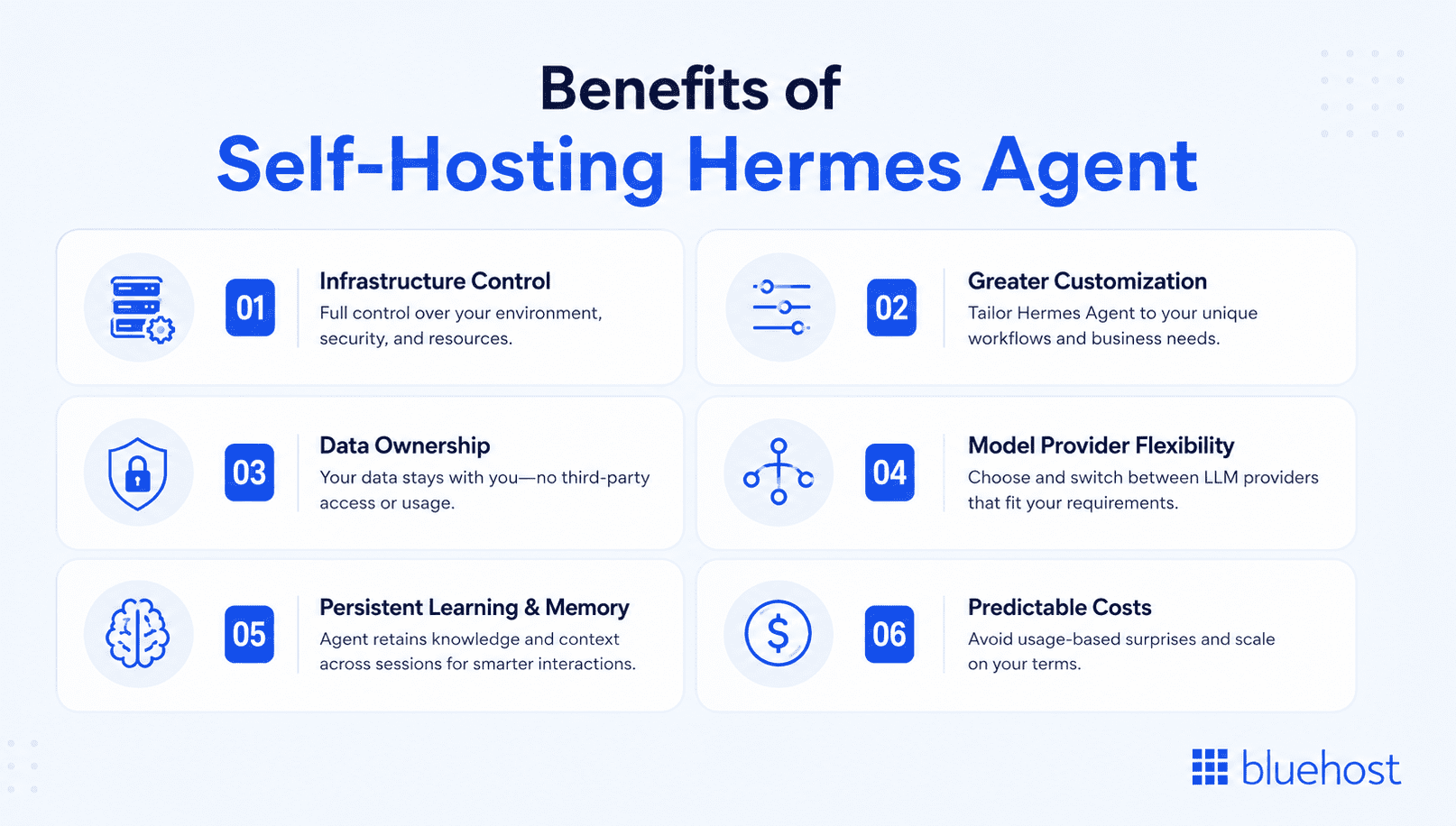
Key benefits include:
- Complete infrastructure control: Manage server settings, storage, networking and software versions directly.
- Greater customization: Configure Hermes Gateway, automation tools, MCP server connections and custom workflows.
- Enhanced data ownership: Keep conversation history, session history and persistent memory on owned infrastructure.
- Freedom to choose model providers: Switch providers using API keys and Hermes config settings.
- Persistent learning and memory: Let Hermes Agent persist knowledge and create reusable skills over time.
- Predictable infrastructure costs: Pay mainly for your VPS plan or server resources instead of full managed service fees.
Together, these advantages make self-hosting Hermes Agent a strong option for teams that prioritize control, flexibility and long-term ownership of their AI infrastructure.
Challenges of self-hosting Hermes Agent
Self-hosting Hermes Agent gives you more control, but it also adds operational responsibility. Teams need the right technical skills to manage setup, security, updates and scaling.
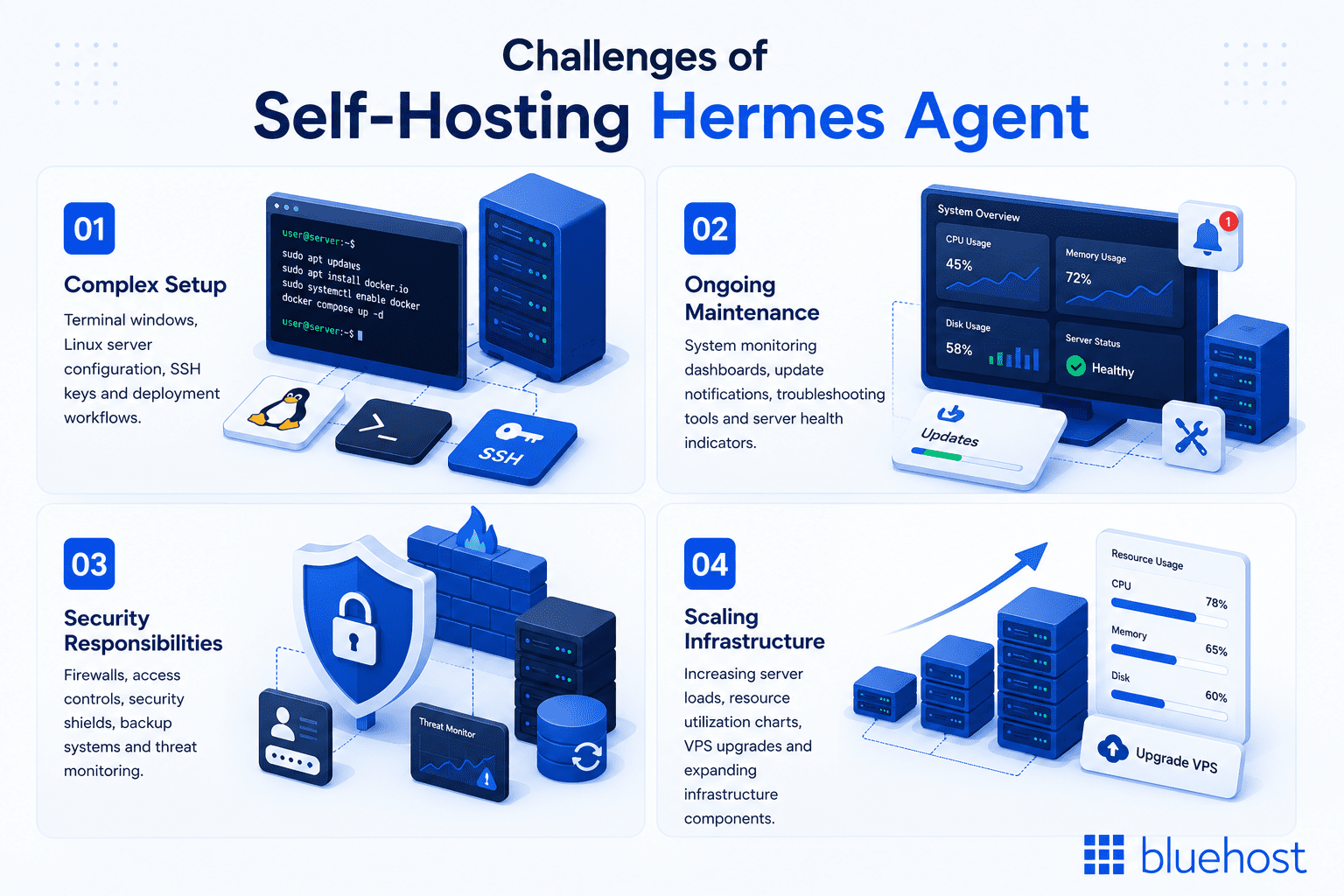
Key challenges include:
- More complex setup: Deploying Hermes Agent requires knowledge of Linux servers, networking, SSH keys and terminal commands.
- Ongoing maintenance: Your team manages updates, monitoring, troubleshooting and infrastructure health.
- Security responsibilities: You need to configure firewalls, access controls, backups and security monitoring.
- Scaling requires additional work: As usage grows, you may need to upgrade resources or adjust the server setup.
Also read: Hermes Agent VPS Security Guide for Self-Hosted AI Agents
Overall, self-hosting is best suited for teams that have the technical capacity to manage their own Hermes Agent infrastructure. Now, let’s look at how managed AI agent hosting simplifies deployment and ongoing operations.
What is managed AI agent hosting?
Managed AI agent hosting gives you an environment where the hosting provider handles the infrastructure and operational tasks. Instead of managing servers yourself, you can focus on building and using AI-powered applications.
A managed hosting provider typically handles:
- Server provisioning
- Environment configuration
- Security updates
- Monitoring
- Infrastructure maintenance
- Performance optimization
- Backup management
With managed AI hosting, teams can use AI agents without needing deep infrastructure or server management expertise.
Benefits of managed AI agent hosting
Managed AI agent hosting helps teams reduce setup work and operational complexity. It is useful for users who want to run AI agents without managing the full server environment themselves.
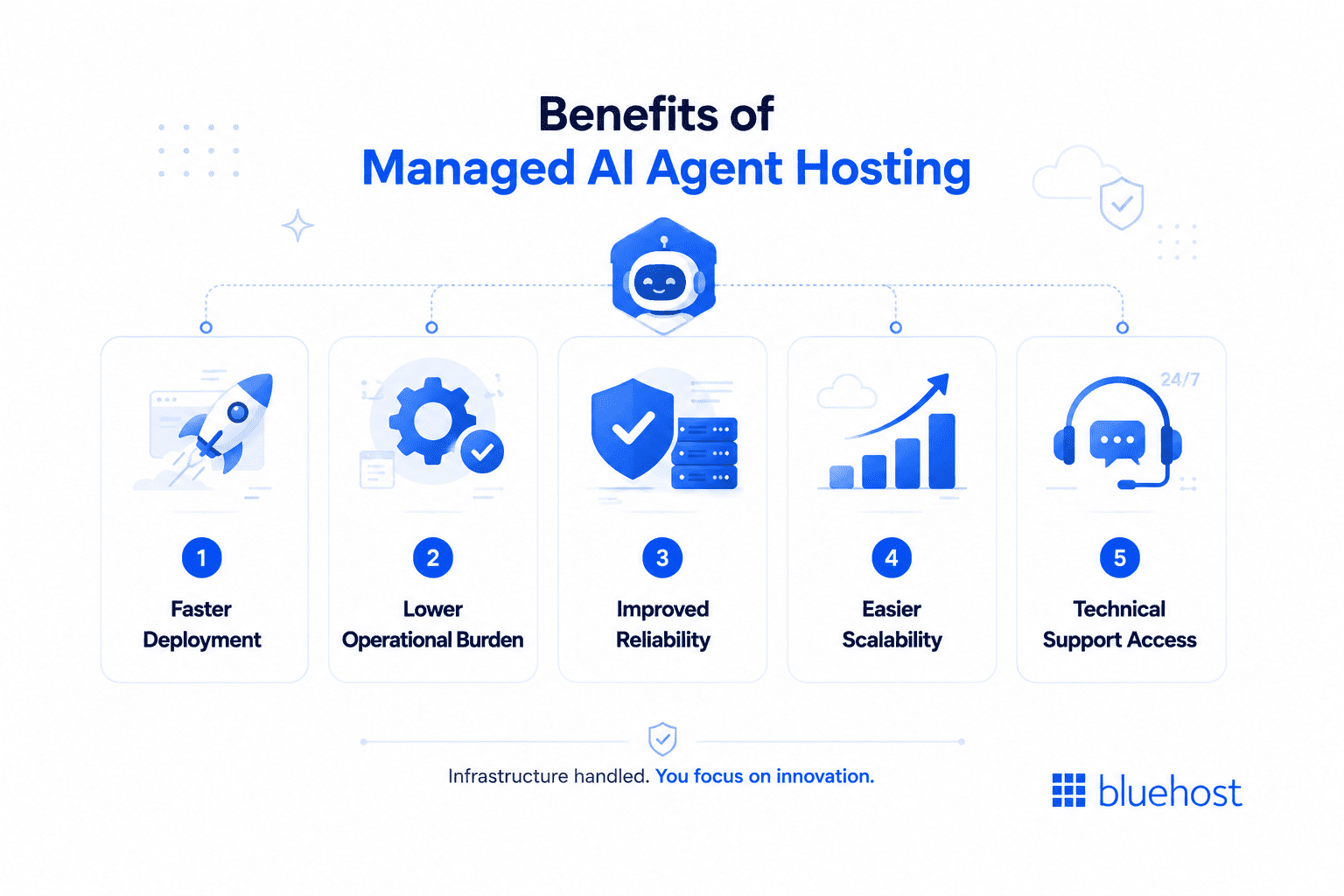
Key benefits include:
- Faster deployment: Start using your AI agent sooner with less manual setup.
- Lower operational burden: Spend less time managing infrastructure and more time on business goals.
- Improved reliability: Benefit from provider-managed monitoring, redundancy and infrastructure optimization.
- Easier scalability: Add resources more easily as workloads grow.
- Access to technical support: Get help with infrastructure-related issues when they arise.
Overall, managed AI agent hosting is a strong option for teams that want simplicity, speed and provider-backed support.
Potential limitations of managed hosting
Managed hosting reduces infrastructure work, but it may also limit flexibility. Teams should consider how much control, independence and long-term cost predictability they need before choosing this option.
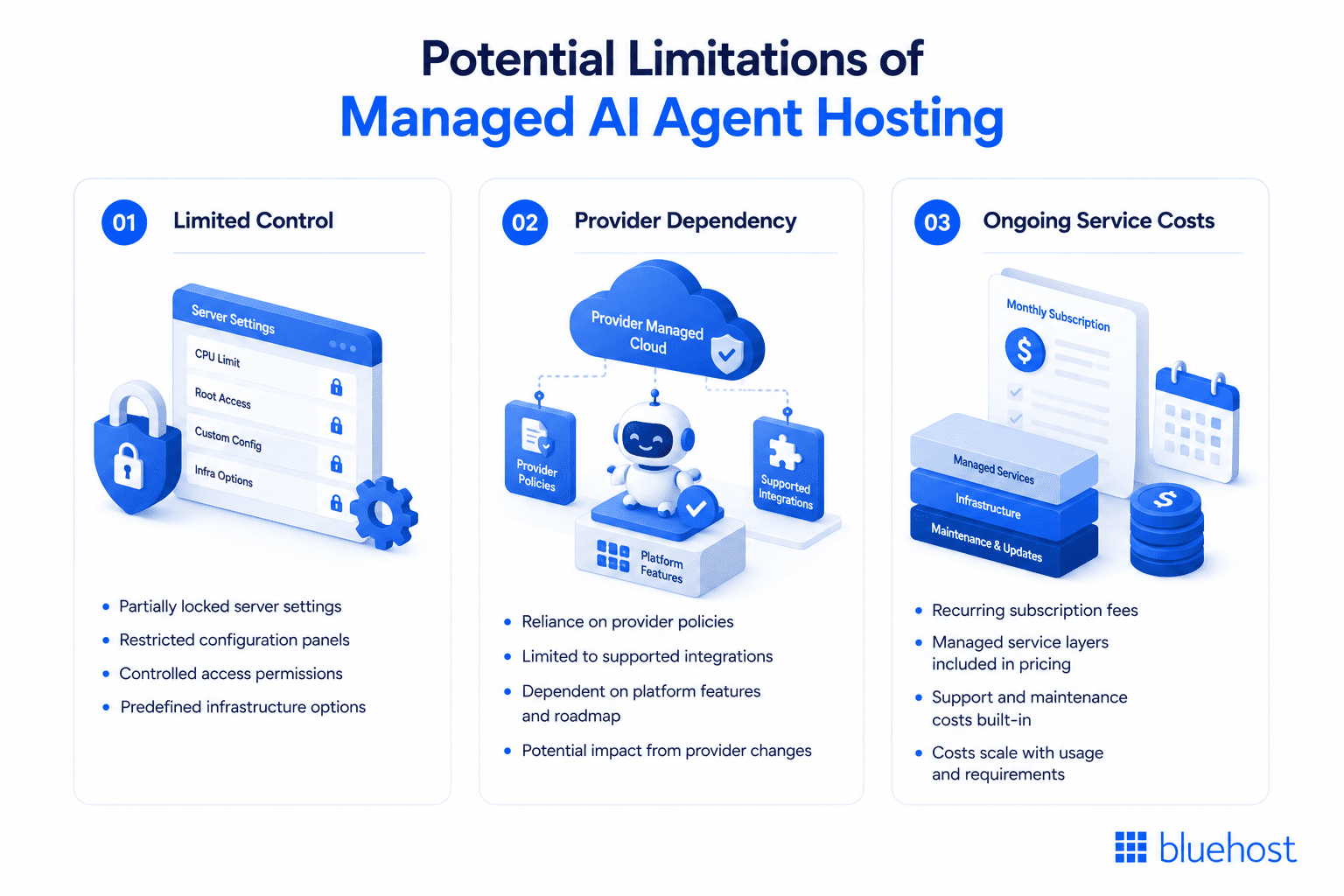
Key limitations include:
- Less control: You may not have full access to server settings, software versions or advanced configuration options.
- Provider dependency: Your deployment depends on the provider’s infrastructure, policies and supported features.
- Ongoing service costs: Managed services often cost more than infrastructure alone because support and maintenance are included.
Overall, managed hosting works well for convenience, but it may not be ideal for teams that need deep customization or full infrastructure ownership. Now, let’s take a closer look at how self-hosting Hermes and managed AI agent hosting compare across key areas.
Self-hosting Hermes Agent vs managed AI agent hosting
The right hosting choice depends on how much control, support and technical responsibility your team wants. Self-hosting Hermes Agent gives you deeper infrastructure ownership, while managed AI agent hosting reduces setup and maintenance work.
| Feature | Self-hosting Hermes Agent | Managed AI agent hosting |
| Setup complexity | High | Low |
| Infrastructure control | Full | Partial |
| Maintenance | User-managed | Provider-managed |
| Security management | User responsibility | Assisted by provider |
| Deployment speed | Slower | Faster |
| Scalability | Manual | Easier |
| Technical expertise required | High | Moderate to low |
| Monitoring | User-managed | Typically included |
| Support | Community or internal team | Provider support |
| Operational overhead | High | Lower |
For teams that value full control, customization and owned infrastructure, self-hosting is often the better fit. For teams that want speed, simplicity and support, managed AI agent hosting may be more practical.
Cost comparison: which option is more affordable?
Cost is a key factor when comparing self-hosting Hermes Agent with managed AI agent hosting. The difference comes down to what you pay for: infrastructure and control, or convenience and provider support.
With self-hosting Hermes Agent, costs may include:
- VPS or server infrastructure
- Storage and backups
- Monitoring and security tools
- AI model/API usage
- Internal setup and maintenance time
Self-hosting can reduce costs because you mainly pay for the VPS and related tools. One VPS can often run Hermes Agent, its gateway and automation workflows, but your team must handle setup, security, updates and troubleshooting.
With managed AI agent hosting, costs may include:
- Hosted infrastructure
- Platform access
- Maintenance and monitoring
- Security updates
- Technical support
- Managed deployment features
Managed AI agent hosting usually costs more because support, monitoring and maintenance are included. It can be a better fit for teams that want faster deployment, less hands-on work and provider-backed support.
Compare both options by total cost of ownership: self-hosting favors control and lower infrastructure costs, while managed hosting favors convenience and reduced operational responsibility.
When should you self-host Hermes Agent vs choose managed AI agent hosting?
The right choice depends on your technical expertise, operational requirements and long-term goals. The table below can help you determine which approach is a better fit for your needs.
| Choose self-hosting Hermes Agent if you: | Choose managed AI agent hosting if you: |
| Need complete infrastructure control | Want faster deployment |
| Have DevOps or system administration experience | Have limited technical resources |
| Need extensive customization | Want to minimize infrastructure management |
| Have strict compliance or data residency requirements | Need dependable uptime and monitoring |
| Want to connect custom tools and workflows | Prefer focusing on application development |
| Prefer managing your own technology stack | Want a simpler onboarding experience |
| Want ownership of your AI agent infrastructure | Prefer provider-managed support and maintenance |
Self-hosting is often the better fit for teams that prioritize control, customization and ownership. Managed AI agent hosting is ideal for organizations that value simplicity, faster deployment and reduced operational overhead.
Why VPS hosting is a strong option for Hermes Agent
For teams that want the benefits of self-hosting without investing in expensive dedicated infrastructure, VPS hosting provides a practical middle ground. It gives you more control than shared hosting while keeping costs manageable.
Key advantages include:
- Dedicated resources: VPS environments provide dedicated CPU, RAM and storage allocations, giving Hermes Agent consistent resources for requests and workflows.
- Greater control: Full root SSH access lets you configure Hermes Gateway, messaging channels, automation tools and model provider integrations.
- Scalability: You can upgrade resources as your agent handles more users, conversations and automations.
- Cost efficiency: A VPS delivers many benefits of dedicated infrastructure at a lower cost, making it a practical option for AI agent server hosting.
- Suitable for production workloads: Modern VPS environments can support Hermes Agent deployment, AI-powered assistants, multi-step pipelines, automation tools, APIs, integrations, messaging gateways and business-critical applications.
Overall, Hermes Agent VPS hosting offers a strong balance of control, scalability and affordability for teams that want to run AI agents on owned infrastructure. Now, let’s look at how to choose the right hosting option for your Hermes Agent deployment.
How to choose the right option?
Before choosing between self-hosting Hermes Agent and managed AI agent hosting, consider your control needs, technical skills, growth plans, budget and maintenance capacity.
Key questions to ask include:
- How much control do you need? If infrastructure customization is essential, self-hosting may be the better choice.
- How much technical expertise is available? Teams without dedicated infrastructure specialists may benefit from managed hosting.
- What are your growth plans? If you expect rapid growth, evaluate how easily each option can scale.
- What is your budget? Consider both infrastructure costs and the time spent managing systems.
- How important is operational simplicity? If reducing maintenance is a priority, managed hosting often provides the smoother experience.
Also read: Deploy Hermes Agent on Bluehost VPS for AI Workflows
Your final choice should balance control, cost, scalability and the amount of infrastructure responsibility your team is ready to manage.
Final verdict: Which hosting option is right for Hermes Agent?
The right choice depends on how much control, support and simplicity your team needs. Self-hosting Hermes Agent gives you full ownership of your infrastructure, data, integrations and configuration.
Managed AI agent hosting is better if you want faster deployment, lower maintenance and provider-backed support. It helps teams focus on building AI workflows instead of managing servers.
For many technical teams, Bluehost Hermes Agent VPS hosting offers a strong middle ground. With dedicated resources, full root access and scalable VPS infrastructure, you can run Hermes Agent on owned infrastructure while keeping costs predictable.
Ready to self-host Hermes Agent? With dedicated VPS resources and full control over your environment, Bluehost helps you build and scale AI-powered workflows reliably.

Write A Comment