 ChatGPT,
 Claude,
 Gemini,
 Grok — all four for
Key highlights
- Understand exactly what separates a true AI chatbot from a basic scripted bot and why that distinction matters for how it handles real customer questions.
- Learn how NLP, machine learning and generative AI work together behind the scenes to turn a typed message into an accurate, natural-sounding reply.
- Explore the different types of AI chatbots and real examples across industries like eCommerce, healthcare, hospitality and professional services to see where one fits your own business.
- Uncover a practical, no-fluff framework for choosing the right AI chatbot, including the questions to ask before you commit to a tool.
- Know the most common mistakes businesses make when adopting an AI chatbot, so you can avoid the pitfalls that quietly frustrate customers.
It’s 11 p.m. on a Tuesday and someone just landed on your website. They have one question, like do you ship to their area, are you open Saturdays or how much the service actually costs and they need the answer right now, not tomorrow morning when you check your inbox. If there’s no one there to answer, they close the tab and move on to the next search result.
That moment happens more often than most small business owners realize. Customers expect instant answers, but nobody can staff a live chat window 24 hours a day. That gap is exactly what an AI chatbot was built to close.
In this guide, we’ll break down what an AI chatbot actually is, how it works behind the scenes, the different types you’ll come across and real examples across industries. We’ll also cover a simple framework for choosing the right one for your own business. Just a clear, practical answer to the question: what is an AI chatbot, really?
What is an AI Chatbot?
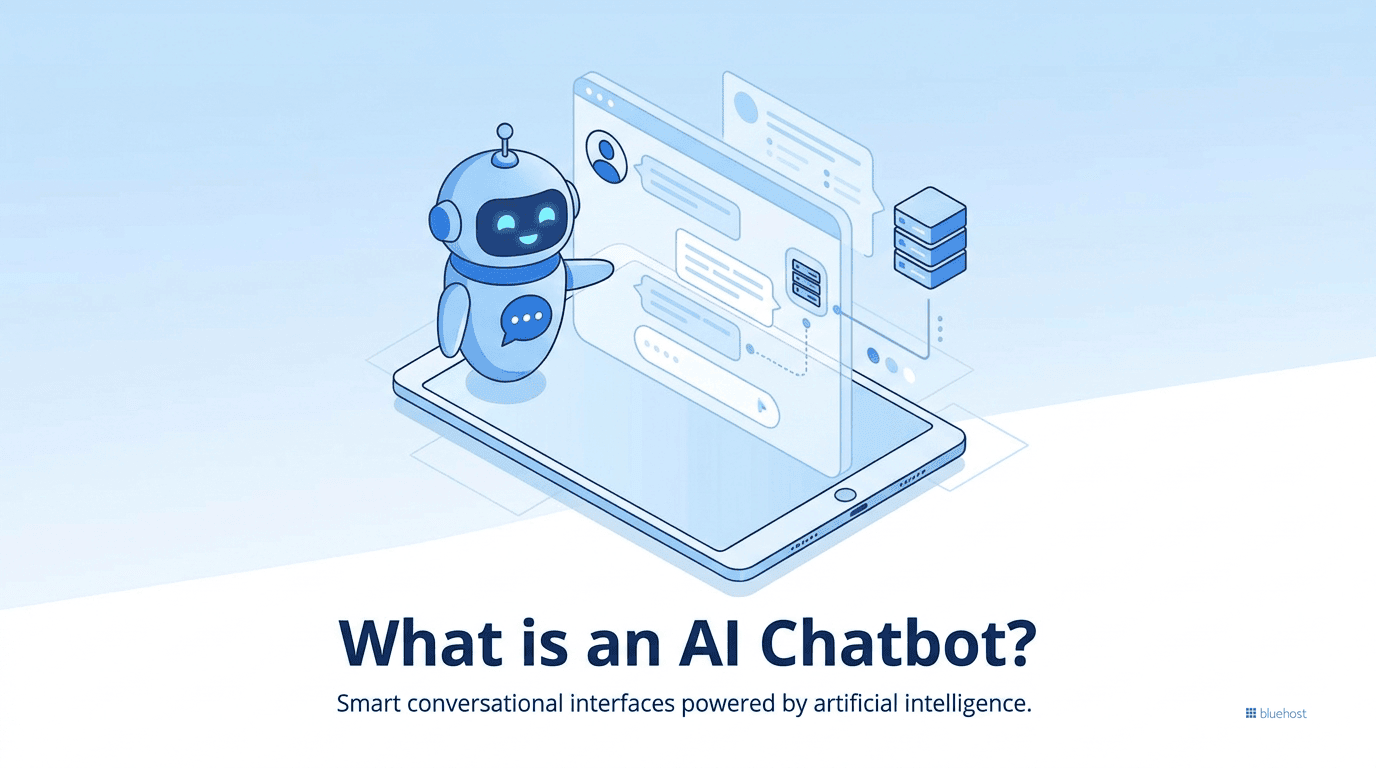
An AI chatbot is a software application that uses artificial intelligence, specifically natural language processing and machine learning, to understand what a person is actually asking, interpret the intent behind it and generate a relevant, conversational response in real time.
The key difference from a traditional chatbot comes down to one word: understanding. A traditional chatbot matches keywords. An AI chatbot understands meaning. That means you can ask it the same question three different ways, with typos, slang or an incomplete sentence and it will still figure out what you’re after, something a scripted bot simply can’t do.
A quick real-world example
Picture a small bakery’s website. A visitor types, “do you guys do gluten free cakes?” It’s casual, it’s got no capital letters and it’s phrased nothing like a formal customer service inquiry.
An AI chatbot doesn’t need an exact script match. It recognizes the intent (asking about a gluten-free product), pulls the relevant information and replies naturally. It might even follow up by offering to help the visitor place an order or book a pickup time. That’s the practical difference between a bot that merely responds and one that actually helps.
How AI chatbots work (explained simply)
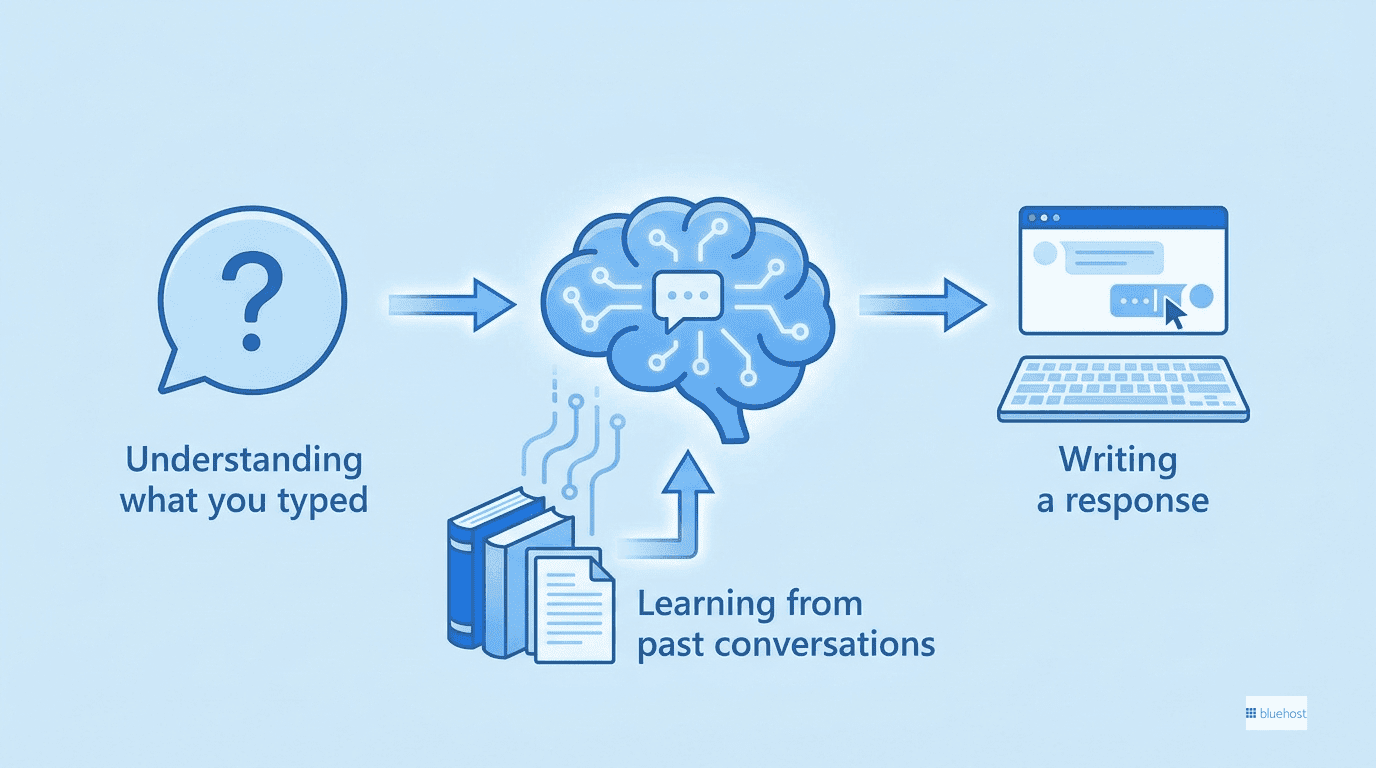
Under the hood, an AI chatbot relies on a few layers of technology working together in the span of a second or two:
Step 1: Understanding what you typed (NLP)
Natural language processing or NLP, is essentially the chatbot’s reading comprehension. It breaks your message down into the intent (what you actually want), the entities (specific details, like a date, a product name or a location) and the context (how your message relates to anything said earlier in the conversation).
Step 2: Learning from past conversations (machine learning)
Machine learning is what allows the chatbot to improve over time. Instead of a developer manually reprogramming it every time a new type of question comes in, the system learns patterns from prior conversations and feedback, gradually getting better at recognizing what people mean.
Step 3: Writing a response (generative AI and LLMs)
This is where the newest AI chatbots really separate themselves from older systems. Generative AI, powered by large language models (LLMs), lets the chatbot compose an original, natural-sounding reply on the spot rather than pulling a pre-written line from a database. This is the same underlying technology behind tools like ChatGPT and it’s increasingly built directly into everyday business chat tools too.
AI Chatbots vs. traditional chatbots: What’s the difference?
Traditional chatbots, often called rule-based or keyword-based chatbots, operate off a fixed decision tree. If a user says X, the bot replies with Y. The moment a question falls outside that script, the conversation breaks down.
AI chatbots don’t have that limitation. Because they understand meaning rather than matching exact keywords, they can handle typos, casual phrasing, follow-up questions and even multi-part requests in a single message. A rule-based bot might only recognize the exact phrase “what are your hours.” An AI chatbot understands “when are you guys open” and “still open rn?” just as easily.
That said, rule-based bots aren’t obsolete. Plenty of businesses still use them for simple, high-volume, highly predictable questions, because they’re cheap, fast to set up and perfectly reliable within their narrow scope. It’s not that rule-based chatbots are bad, they’re just limited to what they’ve been explicitly scripted to handle.
| Feature | Rule-based chatbot | AI chatbot |
|---|---|---|
| Understands natural language | No, matches exact keywords/scripts | Yes, understands meaning, typos and slang |
| Handles follow-up questions | No | Yes |
| Learns and improves over time | No | Yes, via machine learning |
| Setup complexity | Low | Low to moderate (varies by platform) |
| Best for | Simple, high-volume, predictable FAQs | Varied, conversational or open-ended questions |
| Cost | Generally lower | Varies; often comparable for small-business tools |
AI Chatbots vs. virtual agents vs. AI agents (Clearing up the confusion)
This is one of the most common points of confusion, so let’s clear it up plainly.
- Chatbot is the broadest term, any software that simulates conversation, whether it’s rule-based or AI-powered.
- AI chatbot is a chatbot that uses NLP and machine learning to understand and respond conversationally. It’s typically scoped to a specific channel or task set, think of a website widget that answers common questions.
- Virtual agent or AI agent describes a more advanced system that goes a step further. It can take autonomous action across multiple systems, not just answer a question. Instead of explaining how to book an appointment, it actually books it.
The simplest way to remember it: an AI chatbot handles the conversation, while a virtual agent or AI agent handles the conversation and the follow-through. If you’re weighing the two for your own business, this comparison of a virtual receptionist service versus a standard chatbot is a useful next read and this deeper look at what a virtual receptionist actually is explains where the two overlap and where they don’t.
What are the key technologies behind AI chatbots?
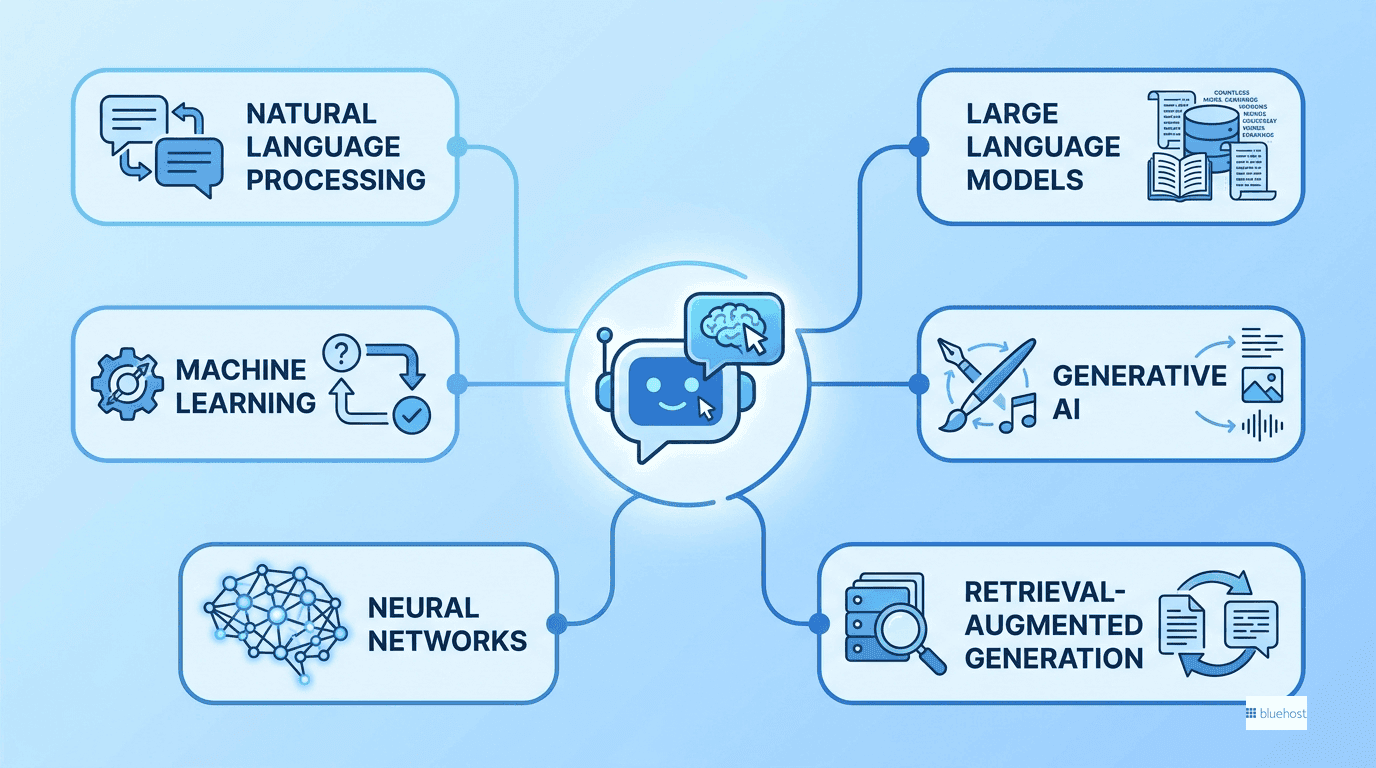
A handful of technologies work together to make AI chatbots possible:
- Natural Language Processing (NLP): how the chatbot parses and makes sense of what you’ve written.
- Machine Learning (ML): how the chatbot improves its responses based on data and experience over time.
- Large Language Models (LLMs): the “brains” behind today’s most capable chatbots, trained on enormous amounts of text so they can understand and generate human-like language.
- Generative AI: the capability that allows a chatbot to write an original response instead of retrieving a pre-scripted one.
- Neural networks: the underlying structure that lets a model figure out which words in your message matter most.
- Retrieval-augmented generation (RAG): lets a chatbot pull real, current information from a business’s own content instead of relying purely on what it was trained on.
What are the different types of AI chatbots?
Not all AI chatbots are built the same way or for the same purpose. Here are the types you’re most likely to come across.
1. Menu/button-based chatbots
The simplest form, where users click preset options rather than type freely. These work well for narrow, predictable journeys like choosing a department or picking a product category.
2. Rule-based (keyword) chatbots
Respond to specific keywords with scripted answers. Not technically AI, but often grouped in the same conversation since many businesses still use them for basic FAQs.
3. AI-powered/conversational chatbots
Understand natural language and can hold a real back-and-forth conversation, adjusting to follow-up questions and different phrasing.
4. Generative AI chatbots
The newest and most capable category, composing original, dynamic responses rather than pulling from a fixed script. This is the type most people picture when they hear “AI chatbot” today.
5. Transactional chatbots
Built to complete a specific task, like checking an order status or processing a simple request, rather than holding open-ended conversation.
6. Voicebots
The voice-based version of a chatbot, from smart-speaker assistants to phone-based automated systems.
7. Hybrid chatbots
Combine multiple approaches to handle a wider range of requests than any single type could manage alone.
For most small businesses, the type that matters most is the AI-powered or generative AI chatbot, the kind capable of handling real customer questions without needing every possible phrasing pre-programmed in advance.
What are the benefits of AI chatbots for businesses?
Why are so many businesses, large and small, adopting AI chatbots? A few reasons keep coming up.
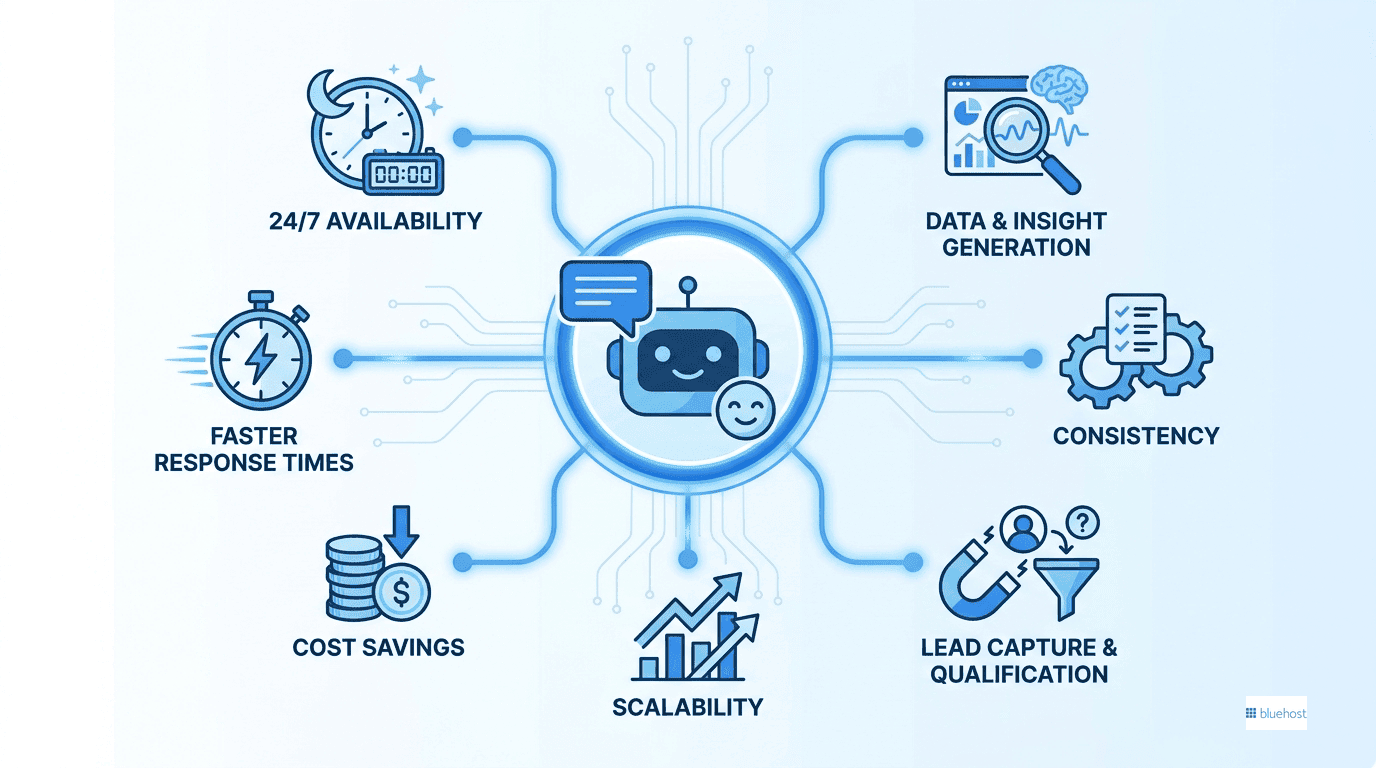
1. 24/7 availability
No missed questions overnight, on weekends or during a busy lunch rush. Your website can answer a customer at any hour, even when your team is fully offline.
2. Faster response times
Instant answers help reduce bounce rates and abandoned carts, since customers rarely wait around for a reply that doesn’t come quickly.
3. Cost savings
An AI chatbot reduces the need to staff live chat around the clock, which matters a lot for a small team without a dedicated support department.
4. Scalability
It can hold unlimited simultaneous conversations without adding headcount, whether five people visit your site at once or five hundred.
5. Lead capture and qualification
It collects visitor information and questions even when no one’s watching the inbox, turning after-hours traffic into usable leads. This is one of the more underrated benefits for growth-focused businesses and it’s worth reading more on how an AI chatbot for lead generation actually works in practice.
6. Consistency
Every visitor gets the same accurate, on-brand answer, regardless of who’s “working” that day.
7. Data and insight generation
Every conversation reveals what customers are actually asking, valuable information for improving your website, your FAQ page or even your product itself.
Customer expectations have shifted too. More consumers now expect an immediate response the moment they reach out to a business online and a slow or missing first reply is often the difference between capturing a lead and losing it to a competitor.
Understanding AI chatbot examples across industries
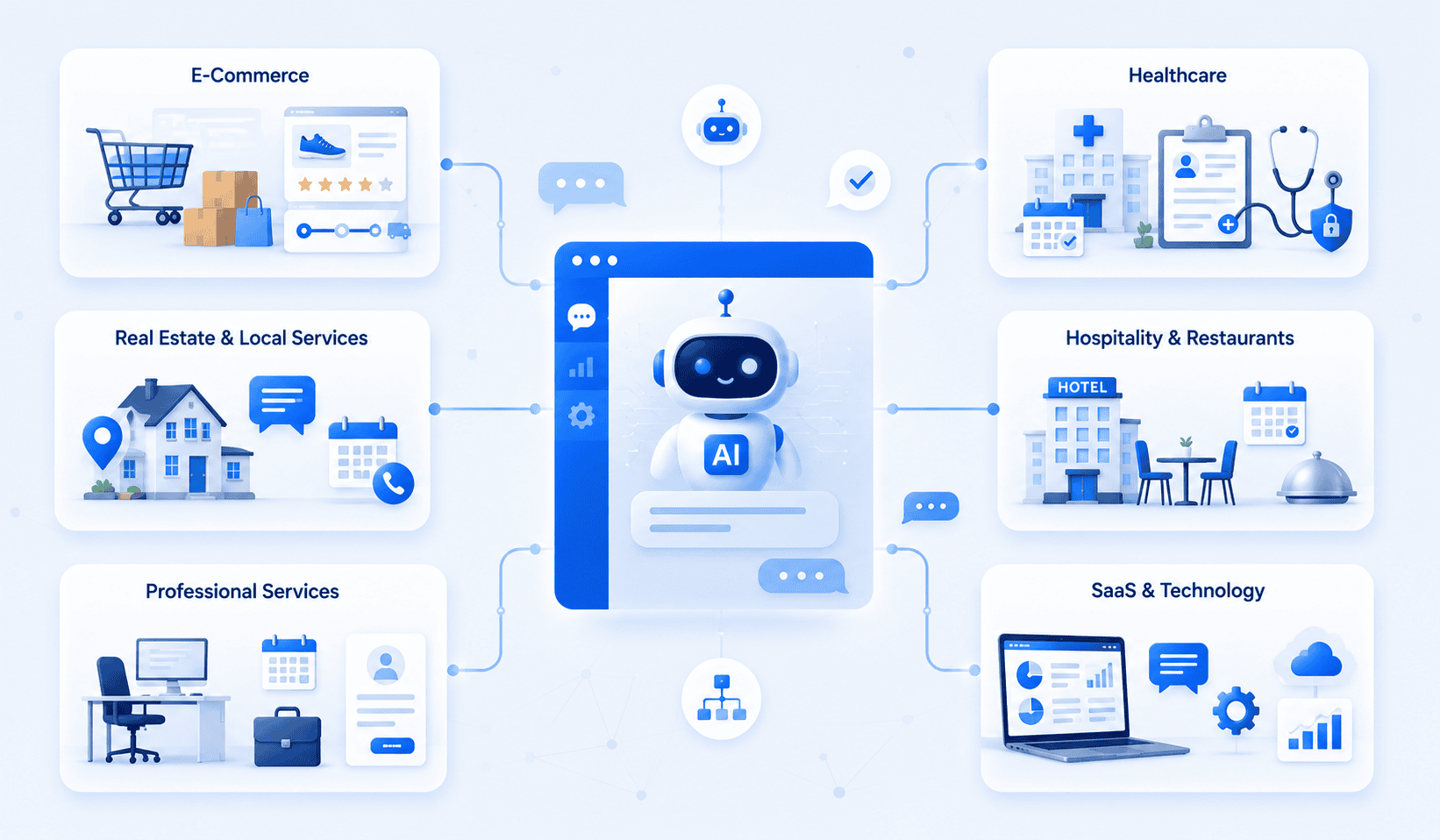
To make this more concrete, here’s what AI chatbots typically look like in a few common industries.
1. eCommerce
Product recommendations order tracking and abandoned-cart follow-up messages that nudge a visitor back to checkout.
2. Healthcare
Appointment scheduling and basic pre-visit intake questions, always paired with clear guidance to contact a provider directly for anything medical.
3. Real estate and local services
Answering “are you open,” “what do you charge” and helping visitors book a consultation without waiting for a callback.
4. Hospitality and restaurants
Handling reservation requests, hours and menu questions and special-event inquiries during peak call times.
5. Professional services
Salons, contractors and consultants use chatbots for appointment booking, service-area questions and after-hours lead capture.
6. SaaS and tech companies
Onboarding questions, basic troubleshooting and feature FAQs that would otherwise flood a small support inbox.
The common thread across every one of these examples: the chatbot isn’t replacing the business’s expertise, it’s making sure no question goes unanswered while the team is busy doing everything else running a business requires.
AI chatbot Tools, solutions and platforms: What’s out there
If you start researching AI chatbot tools, you’ll find they generally fall into a few categories:
- Standalone AI chatbot platforms are dedicated tools built specifically for conversational AI, usually requiring their own setup and integration into your website.
- Built-in website or hosting-provider chatbots are increasingly common. This is a chatbot that comes bundled directly into your website or hosting platform, so there’s no separate tool to buy, configure or connect.
- Enterprise conversational AI platforms are larger, highly customizable systems, typically built for bigger support or IT teams managing high volumes across multiple channels.
For a small business, the built-in category is worth paying attention to, since it removes most of the setup work. If you want a broader look at what’s available before narrowing things down, this roundup of the best AI assistants is a good starting point and this guide to AI marketing tools covers how chatbots fit alongside other AI tools a small business might use.
Bluehost AI Receptionist: A closer look
Most of the chatbot tools on the market are built to answer questions. Bluehost AI Receptionist is built to do more than that. It’s not a basic chatbot sitting on your website. It’s designed to act like an always-on front desk and sales partner that knows your business inside and out.
Here’s what it actually does:
- 24/7 context-aware conversations: It provides instant, accurate responses based on your business’s own knowledge base, so visitors get helpful information any hour of the day or night, not a generic canned reply.
- Automated appointment management: Through direct Google Calendar integration, customers can book, reschedule or cancel 30-minute appointment slots instantly, without waiting on a human coordinator or exchanging back-and-forth emails.
- Knowledge base training: The agent is custom-trained on your own documents and resources, so answers are specific to your actual business rather than generic, made-up information.
- Custom voice and tone branding: You can define a specific brand personality and response style, so the agent feels like a natural extension of your team instead of a robotic script.
- Advanced admin and analytics dashboard: Track chat history, bookings and topic trends in one place, giving you real insight into what customers are asking and where to improve.
Ready to give your website its own 24/7 front desk? Try Bluehost AI Receptionist and start capturing leads and bookings the moment they happen.
What are the AI Chatbot use cases?
AI chatbots are transforming how businesses interact with customers, automate repetitive tasks and improve operational efficiency. Let’s explore few areas where chatbot has made significant contributions:-
AI Chatbot for customer service
Customer service is, by a wide margin, the most common real-world use of AI chatbots, so it’s worth looking at more closely.
A well-built AI chatbot for customer service can typically handle:
- Order status questions
- Business hours and location details
- Pricing and general FAQs
- Basic troubleshooting
- Appointment or booking requests
For a small business, that matters because most small teams simply can’t staff live chat around the clock, yet customers increasingly expect an immediate response the moment they reach out. A slow or missing reply is often the exact moment a potential customer decides to look elsewhere.
Escalation is the piece that separates a good AI chatbot for customer service from a frustrating one. When a question is too complex or sensitive for the bot to handle, it needs to hand off smoothly to a human, whether by email, phone or live chat, rather than leaving the customer stuck in a loop. This is where a lot of chatbot deployments fall short in practice and it’s a big part of what tools built around AI customer service automation features are designed to solve.
AI chatbot solutions for small businesses
Small businesses have different needs than large enterprises. There’s typically a smaller budget, no dedicated IT or support team and a strong preference for something that works well straight out of the box.
When evaluating AI chatbot solutions as a small business, prioritize:
- Easy website integration that doesn’t require code
- Straightforward and predictable pricing
- Built-in lead capture
- Low ongoing maintenance, since you don’t want a tool that requires constant manual retraining just to stay useful
For many small businesses, the simplest and fastest path is a chatbot that’s already built into the website or hosting platform they’re using, rather than layering on a separate third-party tool that needs its own setup and integration work. This is exactly where an option like an AI receptionist for small businesses fits: it can be added to your website to provide 24/7 visitor engagement, common-question answering and lead capture without requiring technical setup.
What are common mistakes to avoid when adopting an AI chatbot?
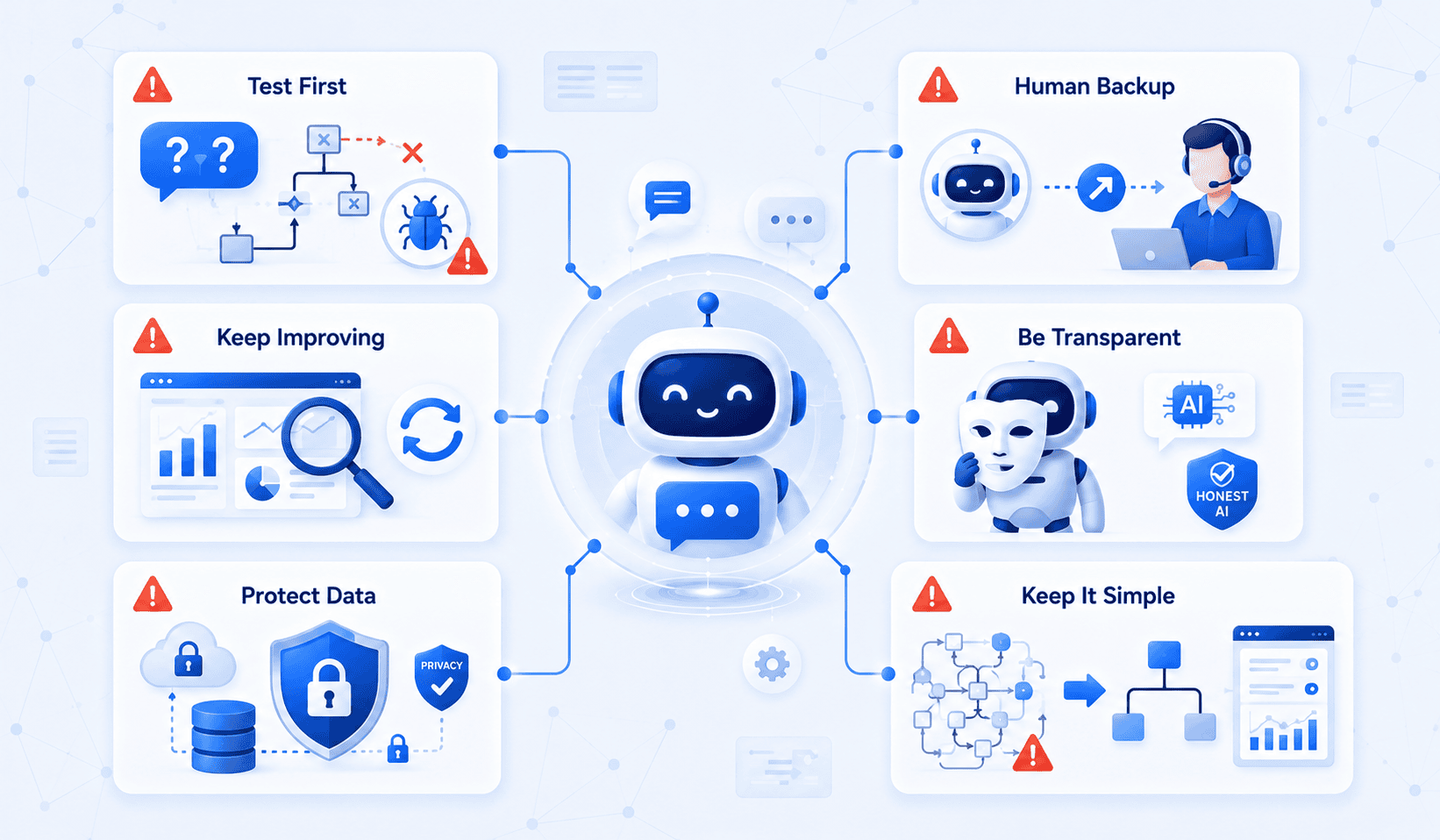
A few missteps show up again and again when businesses adopt an AI chatbot for the first time:
- Launching without testing real customer language, which leads to awkward “I don’t understand that” loops right out of the gate.
- Skipping a clear escalation path to a human, leaving customers with genuinely complex issues stuck with no way forward.
- Treating it as “set and forget.” Even a well-built AI chatbot benefits from an occasional review of what customers are actually asking.
- Overpromising what it can do, such as presenting it as a human when transparency about it being an AI chatbot actually builds more trust than it erodes.
- Ignoring data privacy. Be thoughtful about what customer information is being collected and stored, especially in regulated industries.
- Choosing based on features you’ll never use. Small businesses rarely need enterprise-grade complexity, so simpler is usually better.
Avoiding these pitfalls is often the real difference between an AI chatbot that quietly improves customer experience and one that quietly frustrates it.
What is future of AI chatbots?
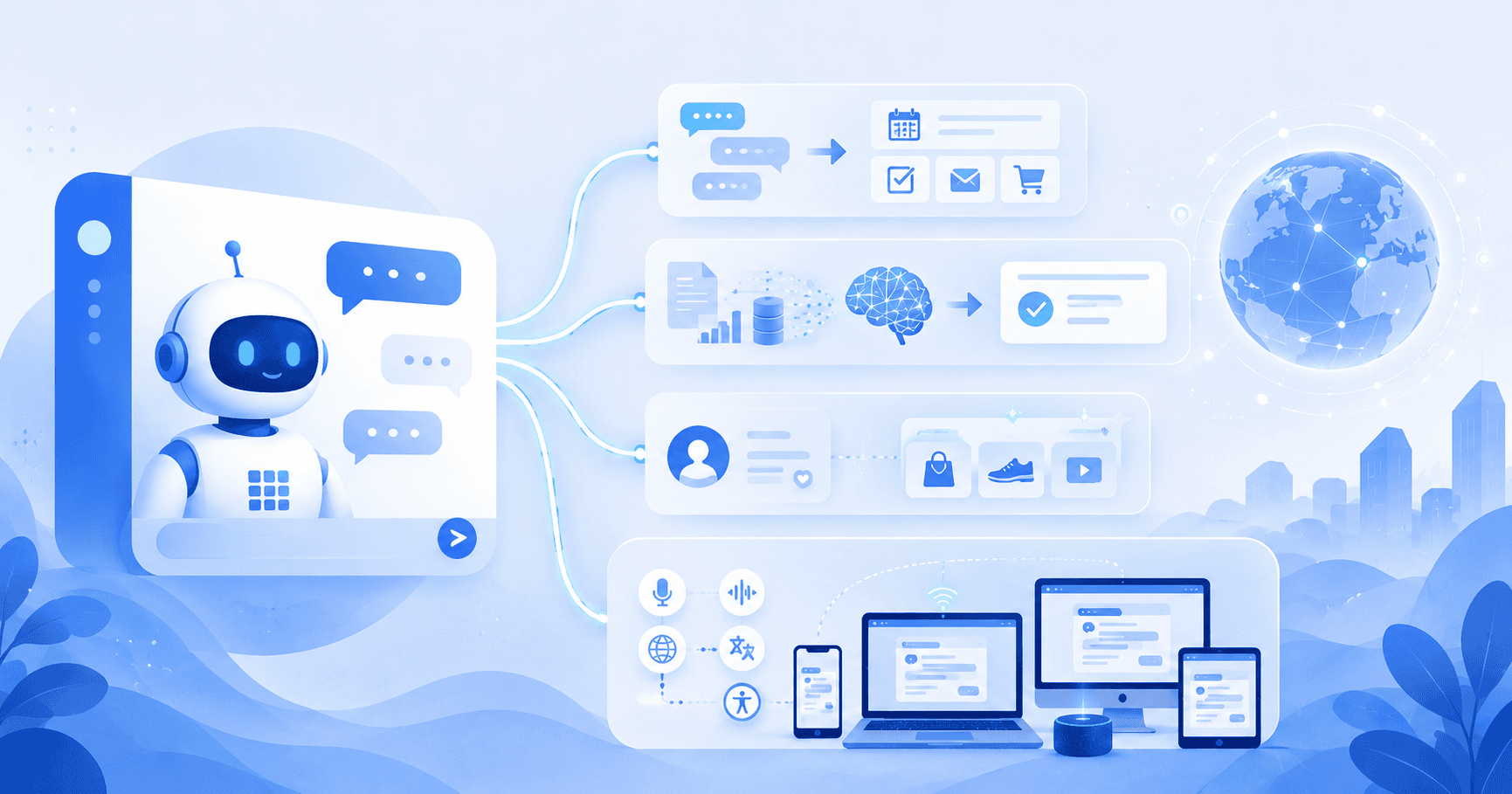
A few shifts are worth watching as this technology keeps moving:
- From conversation to action: AI chatbots are steadily evolving into systems that can take real action, a shift toward agentic AI and virtual agents that complete a task rather than simply explain how to do it.
- More accurate answers: Retrieval-augmented generation is making chatbots more accurate by letting them pull live, current information straight from a business’s own content instead of relying purely on what they were trained on.
- Voice and text blending together: Voice-based interactions are increasingly blending with text chat rather than staying as separate tools.
- Wider accessibility: AI chatbot capability that once required a developer and an enterprise-sized budget is increasingly built directly into everyday tools small businesses already use, including website hosting platforms, putting it within reach of businesses that never would have considered it a few years ago.
Final thoughts
An AI chatbot isn’t a flashy add-on anymore. It’s quickly becoming one of the simplest, most practical ways for a small business to stay responsive without stretching an already busy team even thinner.
The goal isn’t to replace the personal touch that makes a small business feel like a small business. It’s to make sure that touch is still there, in some form, at 11 p.m. on a Tuesday when a real question shows up and nobody’s at the desk to answer it.
For a lot of small business owners, that can mean adding a website-based AI receptionist that handles routine questions and captures leads without requiring technical setup.
Curious what AI-powered customer engagement could do for your website? See how Bluehost AI Receptionist adds 24/7 visitor support, lead capture and appointment booking to your site, no developer required.
FAQs
An AI chatbot is a software application that uses artificial intelligence, including natural language processing and machine learning, to understand what a user is asking and generate a relevant, human-like response in real time, rather than following a fixed script.
They use natural language processing to interpret your message, machine learning to draw on patterns from past conversations and, in modern chatbots, generative AI to compose an original response rather than pulling from a pre-written database.
“Chatbot” is the umbrella term for any program that simulates conversation, including simple rule-based bots. An AI chatbot specifically uses AI technologies to understand meaning and hold natural, flexible conversations rather than just matching keywords.
An AI chatbot focuses on holding a conversation and answering questions. A virtual agent or AI agent, goes a step further by taking autonomous action, like actually completing a booking or updating a record, rather than just describing how to do it.
Some basic AI chatbot tools offer free tiers or come bundled into existing platforms like website hosting, while more advanced or enterprise-grade solutions typically involve a paid plan based on usage or features.
No. AI chatbots handle high-volume, routine questions well, but they work best alongside human support for complex, sensitive or emotionally nuanced situations. The strongest deployments make the handoff between the two feel seamless.

Write A Comment